Welcome to this year’s Sports Illustrated Magic Eight!
The Magic Eight is an SI tradition, one that attempts to cut through the noise and find the eight teams capable of winning March Madness well before a bracket is ever revealed. Picking the eight comes with some stipulations to avoid leaning too heavily into chalk. At least two teams have to be from outside the most recent AP poll’s top eight teams, and one of those needs to come from outside the top 15.
Who should you be backing to cut down the nets? Here’s the case for eight to rule them all, plus what caused some controversial teams to miss the cut.
Duke
Why They’ll Win It
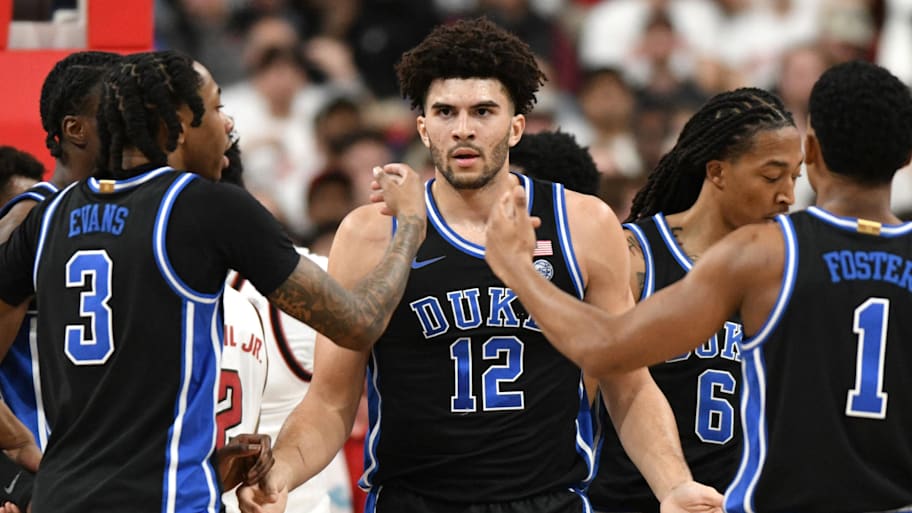
Cameron Boozer is the best player in college basketball, and winning has followed him everywhere. He won four state championships in high school and a national championship as a senior, won three Peach Jam titles in AAU and two gold medals with Team USA. Betting against Boozer to win something has long been a fool’s errand, and that’s why it’s hard not to back Duke to win it all.
Of late, what’s made Duke special is its defense. The Blue Devils have dominated on that end of late, holding 14 straight opponents under 70 points and climbing to the top spot nationally in defensive efficiency per KenPom. There are no mismatches to hunt against Duke. Every defender is tough and physical enough to guard multiple spots and not get hunted, and that keeps the Blue Devils out of rotations and opposing offenses out of the lane.
And while early in the season the narrative was that Duke needed a clear second option to emerge behind Boozer, the by-committee approach has worked well. Isaiah Evans is an electric scorer in spurts, Patrick Ngongba II provides another major presence around the rim, while Caleb Foster and Cayden Boozer can touch the paint in key moments. The Blue Devils’ role allocation is clear, and everyone seems bought in. There just aren’t many clear holes to exploit.
Cause for Pause
Duke’s point guard play is shaky compared to the other elite teams in title contention. And while the Blue Devils largely play through Cameron Boozer in key moments, having a true on-ball stabilizer when games start to turn on you is valuable. These same problems hurt Duke last year in its Final Four collapse vs. Houston, and you hope it won’t come back to bite them again this March.
Michigan
Why They’ll Win It
At their best, Michigan looks as overwhelming as any team in recent college basketball memory. Games snowball quickly against the Wolverines when they can get out in transition thanks to their incredible size, speed and athleticism across the board. Yaxel Lendeborg and Morez Johnson Jr. are absolute freight trains running the floor, and PG Elliot Cadeau is excellent in the open court. Pop on the film of the Wolverines’ 40-point win against Gonzaga if you’d like a reminder of what it looks like when Michigan can get out and run wild.
But equally important to Michigan’s title case is why the Wolverines are so hard to beat even when they aren’t at their best. The sheer size, physicality, and rim protection (largely from 7' 3" Aday Mara) simply wears down teams as games get late. To beat Michigan, you’ll likely have to do it without getting many great shots at the rim, instead surviving on tough twos or a spurt of threes. Mara could have a Donovan Clingan–like impact on March Madness assuming he can stay out of foul trouble.
At Michigan’s best, no one touches it. At its worst, it still might be able to grind out wins. That’s the type of combination you look for in a championship contender.
Cause for Pause
Michigan is beatable when you can force the Wolverines into a half-court game and make them execute. Losing backup PG L.J. Cason, a capable shot creator off the bench, hurts even more there. The Wolverines are statistically a very good shooting team, but you’ll live with getting into a half-court execution contest with them compared to the alternative.
Arizona
Why They’ll Win It
No team is more physically dominant than Arizona, using overwhelming size and physicality at every spot on the floor to suffocate opponents at times. The Wildcats are able to shut off the water at the rim almost entirely with Motiejus Krivas, perhaps the nation’s most effective rim protector who blocks plenty of shots and impacts even more of them. And that’s only if you can get there: Jaden Bradley is an elite point-of-attack defender, while Ivan Kharchenkov is phenomenal on the wing and Koa Peat and Tobe Awaka are built like tanks at the four. Arizona always brings the fight to its opponent, which is usually a pretty good March recipe.
Pair that elite physicality with top-tier guard play, and you really have something cooking. Bradley is among the nation’s best late-game closers, elite at getting to spots in the midrange and making tough shots when it matters most. And the emergence of freshman Brayden Burries into a legit star scoring guard has been a revelation. Arizona beat Florida and UConn in November while Burries was struggling … his star turn has taken them to a new level even from that high point.
Cause for Pause
Conventional thinking is that in March, you need to be able to make threes in case you end up playing from behind. Just two teams in college basketball shoot a lower percentage of their shots from three than Arizona. The Wildcats still have elite spurtability due to their pace and ability to dominate the glass, but in a one-game sample the lack of shooting leaves them vulnerable.
Florida
Why They’ll Win It
Florida has been dominant for most of SEC play, winning 15 of its last 16 games and 13 of those victories by double digits. How did the Gators turn the corner? The easiest area to circle is the play of their guards. Boogie Fland, much maligned early, has been excellent of late, emerging as a consistent downhill threat and a terrific on-ball defender. Xaivian Lee has also settled in and been more efficient offensively, while Urban Klavzar and Isaiah Brown have given quality minutes off the bench.
And at its core, simply stable guard play is more than enough for this Gators group to be elite given how outstanding they are up front. They dominate the backboards like few teams ever have, posting top-10 offensive and defensive rebounding rates. Their physicality wears teams down and in some cases can cause them to break, like Arkansas did in the Gators’ blowout win Saturday. Their bigs make life difficult for teams trying to score around the basket and steal easy buckets with how they run the floor and push in transition.
This is a team peaking at the right time that increasingly looks as good as the much-discussed top tier of the sport of late. Repeating is an incredibly difficult task, but it increasingly feels like the Gators have a real chance.
Cause for Pause
The Gators would be, by far, the worst three-point shooting team to ever win the title. Since the three-point line was instituted in 1987, the worst shooting team by percentage to win it all was 2011 UConn, which shot 32.9% on the season. Florida shoots just 30.8% from deep, though in SEC play it is at a more respectable 33.2% mark.
UConn
Why They’ll Win It
UConn has a two-time title-winning coach on its sideline in Dan Hurley and more than enough talent to go for a third. Stylistically, UConn is incredibly difficult to prepare for in a tournament setting because of the way its offense is structured, layering hard-to-guard actions on top of one another. And this season’s Huskies offense puts extra pressure on you because of the number of elite shooters on the floor: Alex Karaban, Braylon Mullins and Solo Ball can all take over a game if they heat up.
While Tarris Reed Jr. and Silas Demary Jr. aren’t quite Adama Sanogo and Tristen Newton, the similarities are there in terms of the way they can get UConn a bucket in key moments. Demary is the same type of bigger guard as Newton that can touch the paint at will, while Reed is a commanding presence around the rim on both ends and a beast on the offensive glass.
And another similarity between this season’s squad and Hurley’s prior championship-winning squads is its strong bench. UConn is a legit nine deep, and all four key bench pieces provide something different. Jayden Ross and Jaylin Stewart’s athleticism on the wing is huge, while Malachi Smith is a stabilizer at the point and Eric Reibe is highly skilled offensively playing behind Reed.
Cause for Pause
It hasn’t always felt like this season’s UConn team has the same killer instinct its two championship-winning squads had, playing with its food at times in Big East play before escaping late. Burying St. John’s last week was a sign that might be back, but the Huskies then turned around and played poorly most of the way against Seton Hall.
Iowa State
Why They’ll Win It
The sell for the Cyclones is the toughness, experience and poise of its three veteran stars: Tamin Lipsey, Joshua Jefferson and Milan Momcilovic. Lipsey is the ultimate gamer and leader at point guard, Jefferson is the do-it-all star and Momcilovic can shoot the cover off the ball. They’ve had big wins this season, and not just at home, winning at Purdue and going 3–0 at the Players Era in Las Vegas. Jefferson is the type of offensive engine that changes the ceiling of a program that under T.J. Otzelberger has always been known for its defense.
And it’s incredibly hard to score on Iowa State. Its aggressive defense forces tons of turnovers and takes teams completely out of their comfort zone. But unlike many physical, trapping defenses, Iowa State doesn’t foul much at all, which removes some of the risk of backing a team built like they are in the tournament.
Cause for Pause
Iowa State hasn’t been great lately, getting beat by a slumping BYU on Feb. 21 and handled at home by Texas Tech on Saturday. Among its problems: Iowa State’s backcourt has cooled of late from distance. Teams aren’t guarding freshman Killyan Toure on the perimeter, and Lipsey shot under 25% from deep in February. That can clog up the floor, making Jefferson’s life a lot more difficult around the rim.
Illinois
Why They’ll Win It
Statistically, Illinois has the best offense in the near 30-year history of the KenPom database. It’s a perfectly optimized group with shooting all over the floor that uses plenty of popular NBA principles to hunt mismatches, and star guard Keaton Wagler has been the biggest beneficiary of that. Wagler is capable of taking over a game with his off-the-bounce shooting and ability to get to spots and draw fouls. But when Illinois has been at its best, it has often been Illinois’s other top freshman, David Mirković, who has played well. He gives them another guy who can create advantages as a jumbo ballhandler, floor spacer and post scorer. He’s a bit mercurial, but when both Wagler and Mirković are hot, good luck slowing down the Illini.
The other huge edge for Illinois is how it rebounds offensively. Stealing so many extra possessions (many turning into quality looks around the rim and from three) is a huge value add in March. Between the elite shotmaking, the constant offensive rebounding pressure and the strain that having floor-spacing bigs puts on the defense, it’s an immense challenge to prepare for the Illini offensively.
Cause for Pause
Illinois has hit a wall of late, dropping four of six after surging earlier in Big Ten play. The root cause of that seems to be its defense. While analytically, Illinois is solid on that end, the way they’ve gotten there (ultra-conservative scheme that doesn’t foul or force turnovers) has gotten exposed by individually gifted shotmakers of late. We’ve seen the Illini’s limitations when forced into must-stop situations in February, and the lack of plus defenders on the floor other than versatile Kylan Boswell is a concern.
St. John’s
Why They’ll Win It
The Red Storm is our long shot entrant into the Magic Eight, ranking No. 18 in the latest AP poll and similarly outside the top 20 on KenPom. Why can they make a run? It’s still easy to believe in their talent, especially up front, where Zuby Ejiofor, Bryce Hopkins and Dillon Mitchell can mash with the best of them. The backcourt has been maddeningly inconsistent, but the likes of Ian Jackson, Joson Sanon and Oziyah Sellers are the type of streaky scorers who could get hot in March. And St. John’s still has a coaching edge in almost every game with Rick Pitino patrolling the sideline.
Plus, there’s plenty of data over the years on highly rated teams in the preseason performing well in March even after underachieving in the regular season. The theory: St. John’s is still among the sport’s most talented teams, and the “new season” effect of March basketball may help that pop. And unlike some of the season’s other preseason flops like Kentucky, at least the Red Storm enter March healthy.
Cause for Pause
As mentioned above, it’s hard to trust the Red Storm’s guards. They’re the main reason St. John’s is ranked outside the top 50 in KenPom’s offensive efficiency metric. And it will be hard to get St. John’s 32-point loss to UConn out of your head when filling out a bracket, no matter how hard you try to not judge a team based on its worst day.
Notable Exclusions
Houston
Houston’s five losses this season have come in the five toughest games on its schedule. One piece it misses from the last few seasons is a real post presence to throw the ball to when offense breaks down, a role J’Wan Roberts filled admirably on last season’s team. It’s just harder to imagine a team that’s this jump shot reliant winning six straight.
Michigan State
Jeremy Fears Jr. is an amazing player and one of the sport’s best closers, so adept at getting into the paint and either drawing fouls or creating for others in key moments. But do the Spartans have enough other options to manufacture offense in key moments? Freshmen Jordan Scott and Cam Ward have emerged nicely of late, but many of these lineups are light on shooting and weapons overall.
Nebraska
The Huskers are one of the nation’s best stories, reeling off a 20–0 record and building what is likely the program’s best team ever. They’re capable of beating anyone thanks to their elite three-point shooting, though stacking wins in March especially against some of the bigger and more physical teams they’d face later in the tournament could be difficult. The Huskers should, at the very least, secure the program’s first-ever NCAA tournament win this year … and maybe a few victories at that.
Texas Tech
It was easy to write off Texas Tech when star big man JT Toppin went down with a season-ending ACL injury, but the Red Raiders rallied with three straight wins including a highly impressive road win at Iowa State. Point guard Christian Anderson is a total stud, and highly touted portal pickup Luke Bamgboye has made an impact at center in Toppin’s absence. It’s still hard to imagine the Red Raiders going all the way, but we have to take them a whole lot more seriously than expected after the injury.
Purdue
We’ve seen enough of what Purdue looks like against elite teams that it’s hard to believe in it winning two or three of those extremely high-level games in a row to cut down the nets in April. The lack of positional size or athleticism on the wings has been a problem. That said, Braden Smith has everything it takes to be the star guard that carries a team to a March run.
Gonzaga
Gonzaga’s scorching start to the season looks less impressive in hindsight, as many of its key early wins haven’t aged well. Plus, not having ultra-efficient scoring big Braden Huff has capped its offensive ceiling of late. The Bulldogs still have big-time athleticism and defensive versatility on the wings to be dangerous, but perhaps not enough overall shotmaking in the backcourt to win six straight in the Dance.
Kansas
Kansas has long been uplifted as a team with a high March ceiling if it could add a fully healthy Darryn Peterson to its highly competitive veteran group. But Peterson appears as healthy as he’s going to get (and has played three straight full games) and the Jayhawks still seem good but not great. There’s just a lack of overall offensive talent beyond Peterson in this group, and so while you could see the Jayhawks make a run, I’m not sure I see a title in their future.
Miami (Ohio)
I feel obligated to at least mention the undefeated RedHawks here. We don’t have any data points for what Miami looks like against true high-level competition, but the size and physicality of a top-15-to-20 team nationally seems likely to give the RedHawks problems. A run to the second weekend isn’t totally inconceivable, but a national title is.
More College Basketball from Sports Illustrated
Listen to SI’s college sports podcast, Others Receiving Votes, below or on Apple and Spotify. Watch the show on SI’s YouTube channel.
- Dick Vitale Highlights Announcing Teams for First Four in Men's NCAA Tournament
- Travis Steele Dismisses Bruce Pearl’s Comments About Miami of Ohio’s Tournament Résumé
- Bobby Hurley, Moe Odum React to Arizona State's Upset Win vs. No. 14 Kansas on Senior Night
- Ranking Men’s College Basketball Power Conferences: Is It Big Ten’s Title to Lose?
This article was originally published on www.si.com as The Magic Eight: Teams That Can Win the 2026 Men’s NCAA Tournament.