Get all your news in one place.
100's of premium titles.
One app.
Start reading
Texas Observer
Texas Observer
National
Justin Miller

The Last Safe Haven for DEI in Texas Higher Ed?

Editor’s Note: The author is a social work student at Texas A&M University–Central Texas.


On May 20, a black hearse drawn by dark horses led the march of University of Texas at Austin students, clad all in black clothes, past the Governor’s Mansion and the Texas Capitol. The mourners carried signs with the words “Academic Freedom,” “Censored University,” “Alumni Mourn Our Degrees,” and—most damningly—“UT Is Dead.” Through the glass window of the hearse, a blood-red urn and several copies of George Orwell’s 1984 were visible.

The mock funeral, staged as the UT System Board of Regents convened, protested the university’s February decision to dissolve four of its standalone humanities departments—African and African Diaspora Studies; Mexican American and Latina/o Studies; Women’s, Gender and Sexuality Studies; and American Studies—and consolidate them into a single entity: the Department of Social and Cultural Analysis.

“This is yet another demonstration of the death by a thousand cuts of the University of Texas and its spirit of academic freedom,” Cameron J. Samuels, an organizer of Students Engaged in Advancing Texas (SEAT), testified at the UT Regent’s Meeting. “The University of Texas is dead. Serving at the pleasure of our Governor, you have failed to fulfill your mission, and students mourn what once was.”

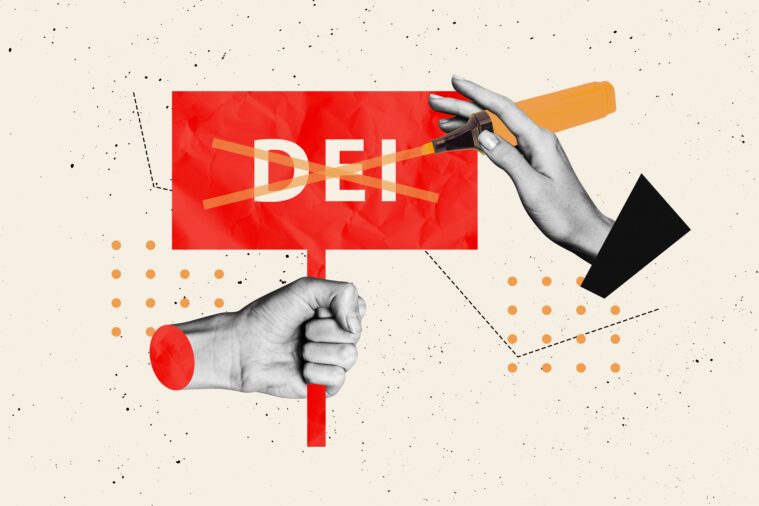
When Senate Bill 17 took effect on January 1, 2024, it shuttered every Diversity, Equity, and Inclusion (DEI) office at every public university in Texas. Resource centers that had operated for decades went dark, and staff were reassigned or let go. SB 17 banned the offices, but it left the classroom alone. Teaching, coursework, and scholarly research were explicitly protected.

But that was only the first step in Texas Republicans’ brazen crusade against anything and everything “DEI.” The next legislative session, Republicans targeted academics with the passage of Senate Bill 37.

When Governor Greg Abbott signed SB 37 in May 2025, it granted the board of regents—all of whom are the governor’s political appointees—sweeping authority to review and reject academic curriculum. Previously, the faculty that studied and taught the material had some control over what went into their syllabi. Now regents can reject a course, veto the hiring of a provost, or move to dissolve an entire degree program it deems insufficiently aligned with “workforce needs.” The faculty senates that once served as a check were reclassified as “advisory only.” The people who spent their careers building a discipline can only advise as their fields of study are dissolved.

But as programs focused on cultural diversity and inclusion are eliminated throughout Texas, there is a corner of higher education that remains a safe haven for DEI: accredited social work programs. The Council on Social Work Education (CSWE), the accrediting council for all such programs, requires students to be culturally competent, meaning that future social workers should be taught best practices for working with people of all races, classes, and creeds. There are 26 Texas public universities with accreditation, offering more than 45 degree programs at both the bachelor’s and master’s levels. The Texas Higher Education Coordinating Board reports that, in 2024, more than 4,000 students were enrolled in these programs at four-year universities.

The “Anti-Racism, Diversity, Equity, and Inclusion” competency standard suggests that students should be equipped with empirical, research-based expertise in the environmental and social factors that affect LGBTQ+ clients and people of color, among other populations. The reason is simple and universal: Everyone deserves competent care. If social workers are tasked with working with foster youth, they should be familiar with research and empirical information on foster youth; if social workers are tasked with working with a trans person, they should be familiar with the related body of research. Competence is not a recommendation; it is required. Accreditation is contingent on adherence to these standards—and without accreditation, students in the program cannot sit for licensure. Without licensure, the degrees that students so often go into debt for are hardly worth the paper they’re printed on.

Will Francis, executive director for the National Association of Social Workers (NASW) Texas and Louisiana chapters, has watched the battle for DEI in social work unravel over the last two years. “We allow for the introduction of DEI concepts to meet accreditation standards, and we allow for students to essentially engage in free speech around classroom discussion,” Francis told the Texas Observer in an interview. “However, Texas does require—from a rule standpoint—that all syllabi be posted online. That creates an interesting conundrum, because even though we’ve essentially said that accreditation allows you to explore these concepts, the posting of the syllabus means that anyone could pull that information and then attack professors by saying they’ve introduced DEI from an administrative standpoint.”

These attacks are not hypothetical. In April, Attorney General Ken Paxton opened an investigation into the University of North Texas (UNT) after the conservative group Accuracy in Media released a hidden-camera video of Paige Falco, the field coordinator for UNT’s social work department.

In the video, Falco acknowledged that DEI is “definitely still a focus” in coursework—just without the explicit keywords. In response, Paxton’s office began to investigate “radical UNT officials” and called for Falco’s firing. When the student newspaper reached out to Falco for an interview, the paper received an automated reply stating that Falco was no longer employed by the university. Days later, Accuracy in Media released a second video, this one from the University of Texas at Arlington, in which academic recruiter Melissa Cruz acknowledged that “we still have to cover the content” to an undercover investigator posing as a potential student.

In a September 2025 statement, CSWE acknowledged that it is “aware that several states have enacted or proposed legislation that limits or prohibits content related to diversity, equity, and inclusion in both implicit and explicit curricula. CSWE and its Board of Accreditation do not request and will not require any program to violate any enacted laws in order to maintain or achieve accreditation.”

The statement is less a defense of DEI than a handoff. CSWE won’t require a program to break the law, but it also doesn’t explicitly define where the line is. Instead, it advises university officials to consult “appropriate institutional counsel”—meaning each university’s own lawyers are left to navigate treacherous legal waters to protect the quality of their students’ education.

That uncertainty is already shaping conversations inside social work programs. Claudia Rappaport, a social work professor at Texas A&M University–Central Texas with 25 years of experience, said faculty in her department recently met with administrators to review state restrictions and assess whether any course content could be interpreted as running afoul of them. As part of the process, social work faculty received guidance on institutional compliance, including language stating that “advocating race or gender ideology, sexual orientation, or gender identity is prohibited in all courses.”

Rappaport explained: “The magic word is ‘advocate.’ That’s the word that they used over and over again, that you’re not allowed to advocate for a certain belief. You can state: This is what the research shows us. … I cannot say that my beliefs are the right beliefs. And what I was saying to them was—we don’t do that anyway.”

However, diversity is still taught as a subject. One of Rappaport’s classes is entitled “Diverse Populations,” in which students study how to provide competent care to clients whose lives look nothing like their own. The coursework is clinical, not ideological.

On one exam, students are asked to outline how they would counsel a 26-year-old Lakota man struggling with alcoholism—a question that requires knowing the history of how alcohol was introduced to Native communities, understanding that there are hundreds of distinct tribal nations rather than one monolithic “Native culture,” and learning how to adapt a standard 12-Step recovery framework around traditional practices. Other coursework covers working with Latino clients and the distinct differences among various Hispanic cultures, as well as the roles of familismo and machismo in a family system. A quiz on a documentary about transgender Americans asks students to identify the barriers to healthcare that trans clients face. All of these are critical for social workers to understand, as they are tasked with designing interventions to help individual people; no individual can be competently cared for if their culture is not accounted for.

This is the body of research under attack: Anything labeled with a political buzzword is now subject to removal from our books and universities. Yet this is the knowledge base social workers need to draw on when sitting across from a real person in crisis. Social work offers a glimpse of the contradiction at the heart of Texas’ higher education reforms: The same information that politicians increasingly dismiss as DEI is, in many cases, vital information that future professionals must understand to provide competent care. If academic subjects can be judged by their political acceptability rather than their empirical value, then the question is no longer what gets taught, but who gets to decide what counts as knowledge—and the students behind the hearse already know the answer.

Sign up to read this article
Read news from 100's of titles, curated specifically for you.
Already a member? Sign in here
Related Stories
Top stories on inkl right now
One subscription that gives you access to news from hundreds of sites
Already a member? Sign in here
Our Picks
Fourteen days free
Download the app
One app. One membership.
100+ trusted global sources.