Get all your news in one place.
100's of premium titles.
One app.
Start reading
Fortune
Fortune
Jessica Mathews

The Kitchen 66 food entrepreneurship incubator has helped 118 businesses get a start

(Credit: Jessica Mathews—Fortune)

The macaroni and cheese comes in a little brown box, topped with finely chopped chives. A creamy, rich sauce. Shrimp and bacon. Now that is decadent.

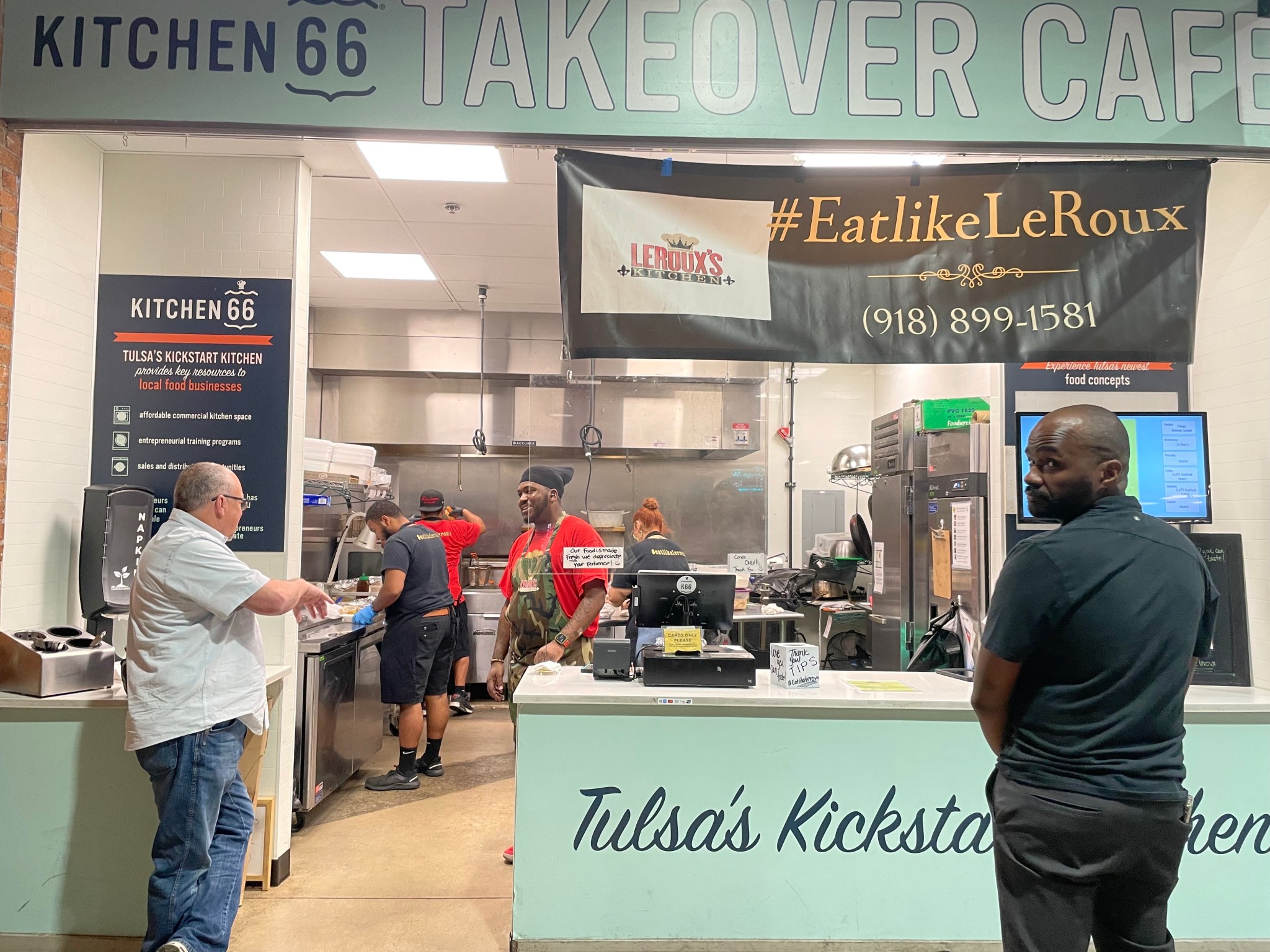
“People talk about knowing love when you see it. I want to make people know love when they taste it,” Renauld Porter tells me, grinning, as we stand in front of his Creole-style temporary kitchen in the corner of Tulsa’s Mother Road Market food hall. 
Porter, who moved to Tulsa from New Orleans 21 years ago, and his three-person team were in coveted real estate yesterday within the Food Hall—the Kitchen 66 Takeover Cafe. Every day, this food stall is handed off to a different food entrepreneur, so they can test new concepts with customers. On average, the vendor in this stall will make around $3,000 in sales from open to close. 

Renauld Porter, a graduate of the Kitchen 66 incubator, chats with a customer outside his Creole-style food popup in Mother Road Market.

The Takeover Cafe is part of a larger food entrepreneurship initiative within the city of Tulsa. Kitchen 66, a program backed by the Lobeck Taylor Family Foundation, offers an education incubator to 20 entrepreneurs each year and rents out affordable kitchen space, food stalls, and store shelf space for individuals looking to try out new concepts.

Porter himself is a graduate of Kitchen 66’s spring incubator program—and his LeRoux’s Kitchen, which features macaroni and cheese, honey jalapeño chicken and fish, gumbo, and cobbler, is one of the top selling vendors in the Takeover Cafe, according to KateLynn Dunning, program director of Kitchen 66. 

The incubator program dates back to 2016, shortly after various city players, including the George Kaiser Family Foundation, the Lobeck Taylor Family Foundation, and the Tulsa Regional Chamber got together and mapped out where the local Tulsa business ecosystem needed support, Lobeck Taylor Foundation executive director Shagah Zakerion tells me. 

“One of our main economic drivers in Tulsa from a grassroots and ground floor development standpoint were food entrepreneurs,” Zakerion says. At the same time, there wasn’t much opportunity available for them to hone in and develop their businesses.

Each year, Kitchen 66 has two cohorts of 10 food entrepreneurs—including aspiring restaurateurs, food truck chefs, catering businesses, or someone wanting to put their family’s salsa or spice blend on retail shelves. Entrepreneurs learn the ins and outs of launching their own business. A few years into the program, the Kitchen 66 staff realized that—while there was no lack of food ideas—people had no place to pilot their ideas. The Lobeck Taylor Foundation invested $5.5 million into building Mother Road Market, which includes a food hall, the pop-up cafe and food truck, shelf space for consumer packaged goods, a space for classes complete with food blogging technology, and a 2,800 square foot commercial kitchen where individuals can rent out kitchen prep stations, cooking stations, or storage space starting at $10 a day. There is also Route 66-themed mini golf in the outdoor area.

Approximately 250 food businesses have operated in Tulsa’s Mother Road Market food hall.

The foot traffic is heavy—with about 5,000 people coming through the food hall a week, with $128,761 in weekly food and bar sales. The idea behind Kitchen 66 is that the businesses will grow beyond Mother Road Market and be able to open their own restaurants or start selling their product elsewhere. (In the case of the Kitchen 66 food truck, Dunning says success may also look like a person realizing they despise working in a food truck prior to them putting down the money to purchase one.) 

Since 2016, more than two dozen Kitchen 66 businesses have opened up brick and mortar stores, food truck operations or supply consumer packaged goods to local businesses, according to Kitchen 66—including Big Dipper, Pamela’s Tamales, and Que Gust, which have all gone on to open stores.

Much of the food coming out of the Kitchen 66 incubator program is ethnically diverse—and so are many of the food entrepreneurs that are making it. In total, about 150 food businesses run by individuals representing 20 different countries have participated in the program (118 of which have graduated from it). About half of those are women. Kitchen 66 is currently piloting Cocina 66, a Spanish-speaking version of the incubator program. 

By the time I left Mother Road Market yesterday, there was a long line for LeRoux’s Kitchen. “It’s well worth the wait,” one customer told me.

And I’m back… The last two years have delivered record venture funding to startups being founded outside the Coasts—which is one of the reasons I decided to drive over to Tulsa, a city nearby where I’ve noticed escalating early-stage activity, and try out something new for Term Sheet. Thanks for following along, and you can expect the normal programming of this newsletter again starting tomorrow. 

See you then,

Jessica Mathews
Twitter: @jessicakmathews
Email: jessica.mathews@fortune.com
Submit a deal for the Term Sheet newsletter here.

Jackson Fordyce curated the deals section of today’s newsletter.

Sign up to read this article
Read news from 100's of titles, curated specifically for you.
Already a member? Sign in here
Related Stories
Top stories on inkl right now
One subscription that gives you access to news from hundreds of sites
Already a member? Sign in here
Our Picks
Fourteen days free
Download the app
One app. One membership.
100+ trusted global sources.