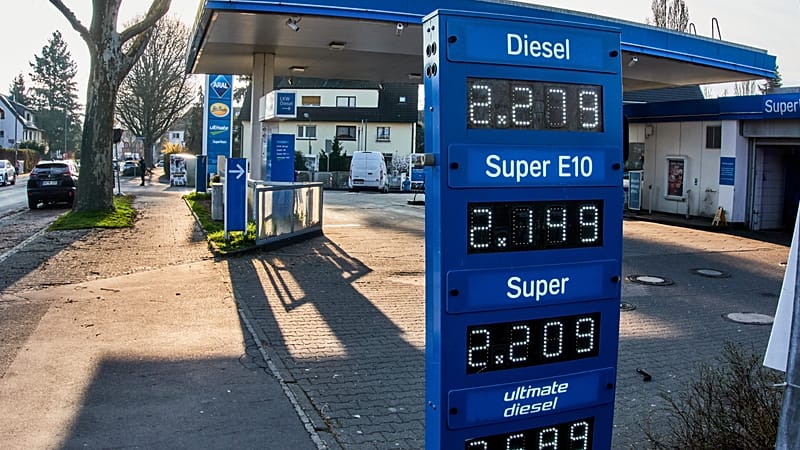
Petrol and diesel prices across Europe have been rising hand in hand with global oil costs due to the Iran war, and the disruption impacting the supply coming from the Gulf countries.
Brent crude briefly hit $119 a barrel twice since the first joint US–Israeli strikes on Iran in late February. The effects of fluctuating oil prices are now being felt by households across the continent, where taxes are making up a significant share of the cost at the pump.
How much of the price of oil is tax?
So, where do consumers pay the most tax on fuel in Europe? How much of the price of petrol and diesel goes to taxes? And which countries are the most expensive and the cheapest for fuel across Europe?
The first and most relevant indicator is the share of total taxes, including excise duty and VAT, in fuel prices.
Taxes, including excise duty and VAT, account for more than half of petrol (Euro-super 95) prices across the EU, according to Euronews Business' calculations, based on data provided by the European Commission, as of 16 March 2026.
Within the EU, the share ranges from 43.9% in Bulgaria to 57.8% in Slovenia, with 20 member states whose total taxes account for more than 50% of the petrol price.
The EU average stands at 52.1%.
Among the EU’s “Big Four” economies, Italy has the highest tax share at 55%, followed by Germany (54.5%), France (53%), and Spain (45%).
For diesel, the overall tax burden is lower, averaging 44.6% in the EU. Only four countries have taxes exceeding 50%: Malta (54.3%), Italy (51.1%), Ireland (50.6%), and Slovenia (50.1%).
The tax share is below 40% in Estonia (37.6%), Spain (38%), Sweden (38.5%), and Bulgaria (39.7%).
Among the EU's biggest economies, Italy still has the highest tax share on diesel at 51.1%. France (46.8%), and Germany (45.4%) are close to the EU average, while Spain (38%) has one of the lowest shares in Europe.
Tax rankings vary between petrol and diesel. Greece ranks fourth for petrol taxes but 20th for diesel. Finland and the Netherlands are around ten places higher for petrol than diesel, while Lithuania ranks 18th for petrol but eighth for diesel.
Tax rates compared with taxes paid
The total tax paid in euros can differ from the percentage share because pre-tax fuel prices vary widely. For instance, Slovenia has the highest petrol tax rate (57.8%), but consumers pay €0.83 per litre, ranking it only 17th in the EU in absolute terms.
Taxes per litre range from €0.58 in Bulgaria to €1.24 in the Netherlands. According to Eurostat data on 16 March, the EU average was €0.96, and amounts exceeded €1 in Denmark, Germany, Finland, Greece, Ireland, and France.
Using the same Eurostat figures for calculation, taxes paid per litre ranged from €0.58 in Bulgaria to €1.24 in the Netherlands. The EU average was €0.96. This figure was above €1 in Denmark, Germany, Finland, Greece, Ireland, and France.
Looking at petrol prices with taxes, Euro-super 95 price including taxes in the EU stood at €1.84 per litre. The most expensive countries for petrol were the Netherlands (€2.26), Denmark (€2.18), Germany (€2.09), Finland (€1.96) and Greece (€1.92).
In contrast, the lowest prices for Euro-super 95 were in Bulgaria (€1.33), Malta (€1.34), Cyprus (€1.42), Slovenia (€1.44) and Slovakia (€1.52). In Turkey, it was around €1.22 according to Petrol Ofisi.
For diesel, taxes averaged €0.87 per litre in the EU and only exceeded €1 in Italy (€1.04) and Denmark (€1.01).
People in Bulgaria (€0.57), Malta (€0.66) and Cyprus (€0.66) pay the least tax in nominal terms.
The most expensive diesel prices are in the Netherlands (€2.26), Denmark (€2.21), Germany (€2.15), Finland (€2.11) and Italy (€2.03).
Meanwhile, the lowest diesel price levels were seen in Malta (€1.21), Bulgaria (€1.44), Slovenia (€1.48), Slovakia (€1.53) and Cyprus (€1.59).
Fiscal and environmental policies
According to the Tax Foundation, fuel taxes include environmental levies in many EU countries, applied per litre. For example, at least eight EU member states include a carbon, energy or other environmental tax in their total excise duty.
The EU sets a minimum excise duty. However, member states can set higher national tax rates to meet their own fiscal, environmental and economic goals. Costs and margins in refining and distribution also influence consumer prices, according to the European Central Bank.