A modern fighter jet, an electric vehicle, and an industrial robot may have very different purposes. But they share a dependence on a group of minerals that has become increasingly important to global economic and national security.
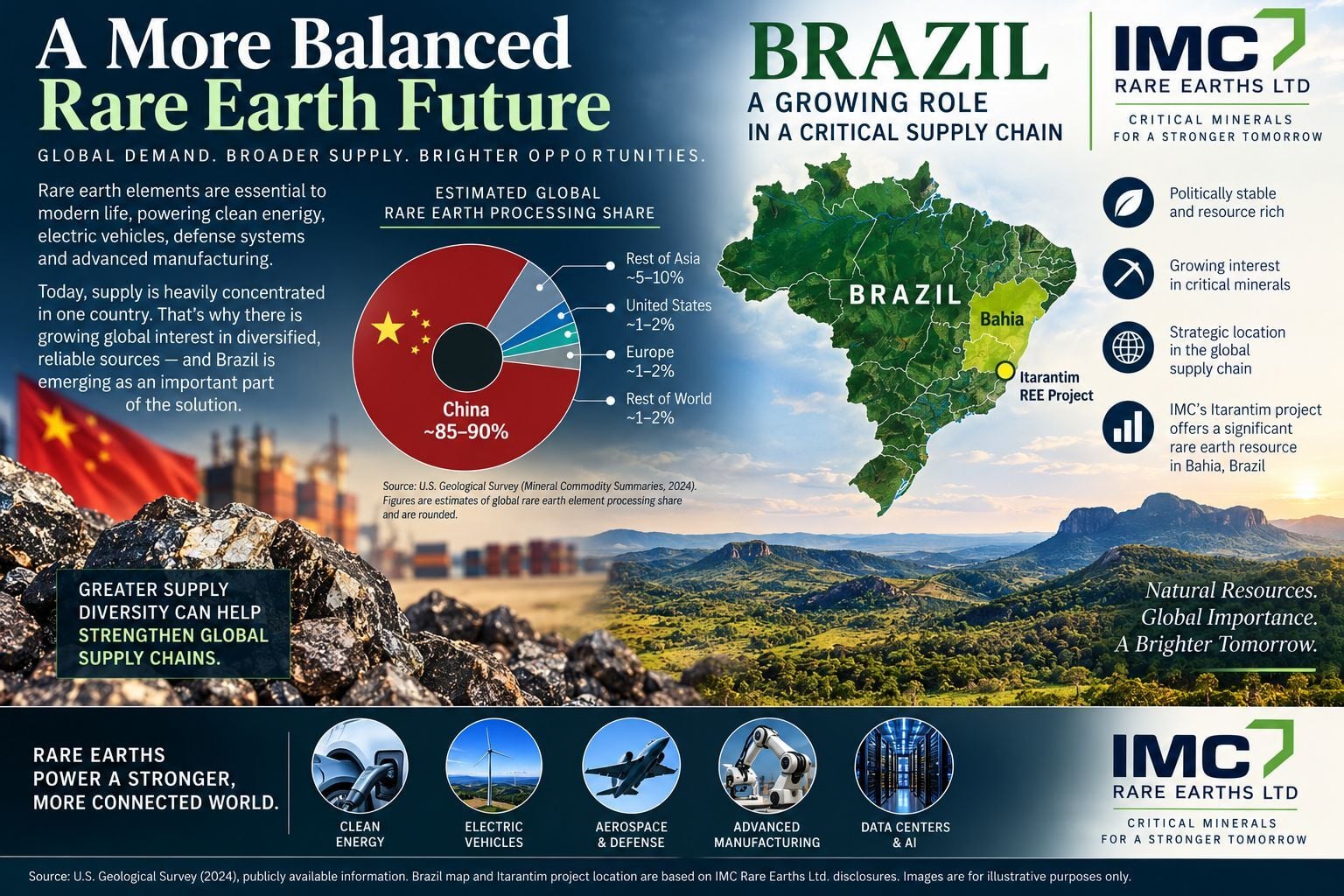
Rare earth elements help power some of the world's most sophisticated technologies, from high-performance magnets and aerospace equipment to robotics and advanced manufacturing. Yet one country, China, still controls much of the ability to process these materials into usable industrial products.
That concentration has created a strategic dilemma for governments and manufacturers. Developing tomorrow's technologies is one challenge. Securing dependable access to the materials needed to produce them is another.
And the search for alternatives is drawing attention to the mineral-rich regions of Brazil.
When Critical Minerals Become a Geopolitical Concern
China's dominance of rare earth processing and magnet manufacturing has become an increasingly important issue in international trade. Export restrictions on certain rare earth elements show how quickly supply-chain vulnerabilities can affect manufacturers thousands of miles away.
The implications reach well beyond electric vehicles. Aerospace systems, defense equipment, industrial robotics, wind turbines, and sophisticated electronics all depend on specialized materials whose availability can influence manufacturing schedules and technological development.
Terbium and dysprosium matter because they help certain permanent magnets maintain performance at high temperatures. Without dependable supplies of these elements, manufacturers may struggle to produce equipment designed to operate under demanding conditions.
For governments seeking greater economic resilience, the challenge is no longer simply identifying countries with mineral deposits. It is developing alternative sources that can eventually support reliable extraction, processing, and industrial supply.
Brazil's substantial rare earth resources make it an increasingly relevant part of that effort.
A Significant Resource Beneath Brazil's Surface
Major mining corporations aren't the only ones driving the search for alternative rare earth supplies. Smaller exploration companies are also playing an increasingly important role, investigating promising deposits and advancing the scientific work needed to understand their potential.
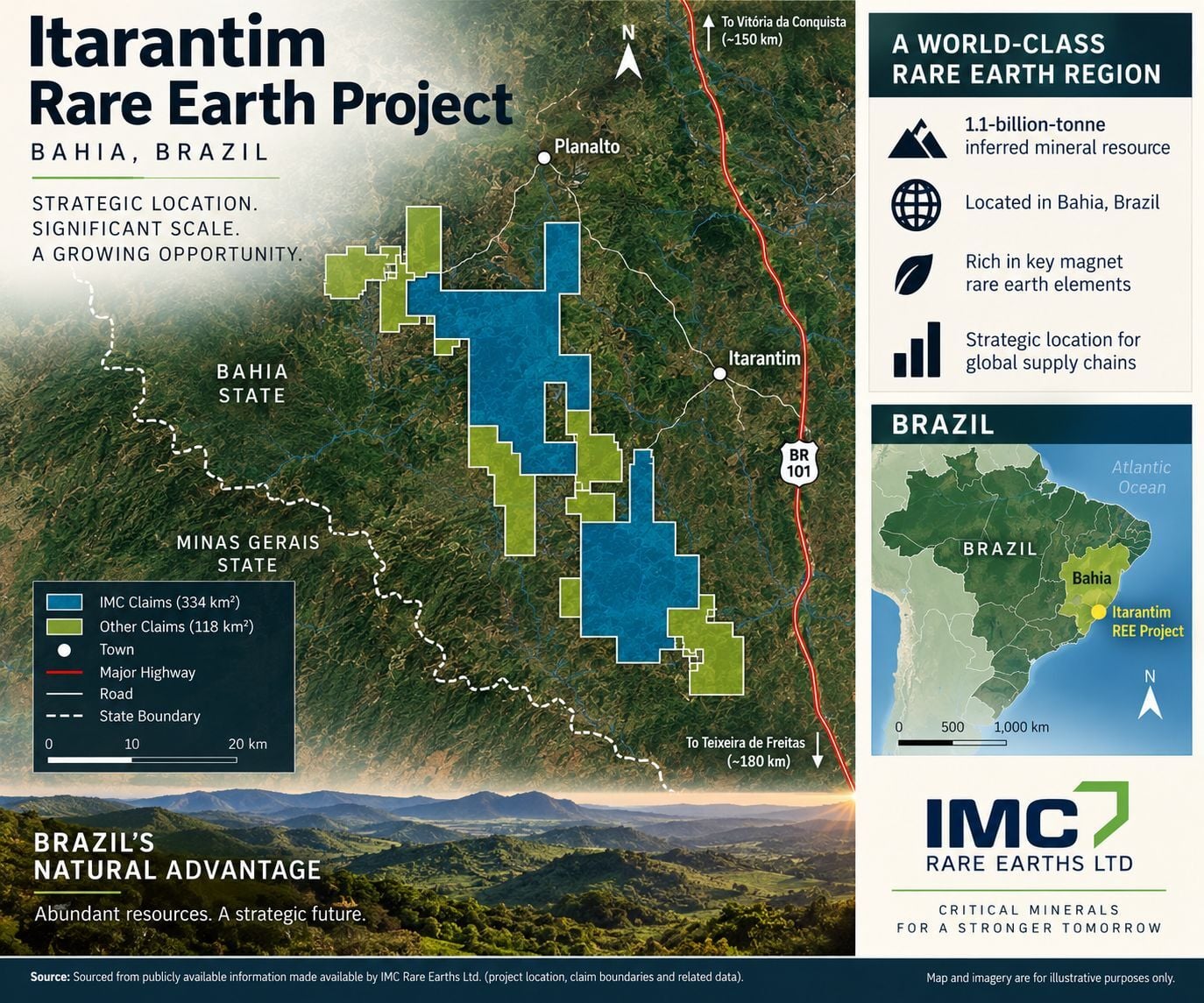
Among them is IMC Rare Earths Ltd., a smaller publicly traded exploration company advancing its Itarantim rare earth project across portions of Bahia and Minas Gerais in Brazil.
The project hosts a reported 1.1-billion-tonne inferred mineral resource containing four important magnet rare earth elements: neodymium, praseodymium, dysprosium, and terbium. While that resource provides a substantial geological foundation, recent exploration suggests there may be considerably more to discover beyond its established boundaries.
On October 8, IMC announced a new terbium-rich mineralized zone at Block H, outside its existing resource boundaries. Drilling identified a seven-meter interval beginning just two meters below the surface, including a higher-grade three-meter section.
The discovery is notable not only for its mineral concentrations but also for its location. Because Block H lies beyond the currently defined resource, additional exploration could reveal mineralization not previously incorporated into the project's geological estimates.
A separate area, Block D, has also produced encouraging results, including 20 meters of continuous mineralization. IMC plans additional drilling to investigate whether that zone extends beyond the depths reached by earlier equipment.
Together, the findings illustrate one of the most intriguing aspects of mineral exploration: even after a substantial resource has been identified, the full extent of a geological system may remain undiscovered. And at Itarantim, the latest results are giving researchers new areas to investigate as they work to understand just how far that potential may extend.
The Science of Getting Rare Earths Out of the Ground
Finding rare earth elements is only the beginning. Recovering them efficiently is another challenge, especially when the minerals occur in clay deposits.
At Itarantim, researchers have been investigating how rare earth elements respond to different extraction methods. Laboratory testing announced in September reported terbium recoveries reaching 95.2% under specific conditions, while additional work successfully produced a mixed rare earth carbonate that can undergo further processing.
Separate testing undertaken at the University of Brighton in the United Kingdom recovered 73% of total rare earth elements tested, excluding cerium. The results included approximately 71% recovery of both terbium and dysprosium.
These findings have encouraged further investigation of a technique known as in-situ recovery.
Rather than excavating large quantities of mineral-bearing clay, the proposed method involves introducing a solution through wells, allowing it to collect rare earth elements, and recovering the mineral-bearing liquid for processing.
If successfully demonstrated at commercial scale, this approach could reduce excavation, surface disturbance, and the need for extensive tailings storage.
Another encouraging observation emerged from the laboratory work: uranium and thorium remained below detection limits in the tested leachate solutions. IMC has also reported negligible deleterious elements in certain recovered solutions.
These findings do not establish that the entire deposit is free of radioactivity. However, they are relevant to researchers, regulators, and potential development partners evaluating how future rare earth extraction might be managed, particularly where environmental protection and waste handling are important considerations.
Brazil's Opportunity Extends Beyond Mineral Discovery
Brazil's potential contribution to diversified rare earth supplies will depend on more than the quantity of minerals beneath its surface.
Developing new supply chains requires geological expertise, processing technology, engineering infrastructure, regulatory approvals, and cooperation among companies, researchers, and governments.
At Itarantim, IMC continues to evaluate these requirements through additional drilling, metallurgical studies, and investigations into potential processing methods. The company has engaged ANSTO Minerals in Australia for further technical work and is assessing approaches that could help guide future development.
Its geological expertise also reflects Brazil's growing experience with rare earth exploration. Alexandre Rocha da Rocha, an IMC director and geologist involved in the project, has been credited with contributing to discoveries at other important Brazilian ionic adsorption clay deposits, including Serra Verde's Pela Ema project.
Such experience matters because transforming geological potential into a dependable source of critical minerals requires a detailed understanding of how deposits form, how their valuable elements can be recovered, and which technologies are best suited to their characteristics.
It also requires partnerships that connect exploration projects with the industrial capabilities needed farther down the supply chain.
For Brazil, those connections could become increasingly important as international manufacturers seek additional sources of materials essential to advanced technologies.
A New Geography for Critical Minerals
The world's dependence on rare earth elements is unlikely to diminish as robotics, electrification, aerospace technology, and advanced manufacturing continue to develop.
But where those materials originate—and how they reach manufacturers—is becoming just as important.
Projects such as Itarantim illustrate the scientific work taking place as countries seek alternatives to concentrated supply chains. Geological discoveries, recovery experiments, and international technical partnerships are all part of a much larger effort to establish dependable new sources of critical minerals.
Brazil's role in that effort is still developing, and the path from exploration to commercial supply requires substantial work.
Yet the strategic importance of investigating new resources is already apparent.
Because the future of advanced technology may depend as much on where the world finds its essential materials as on what it ultimately learns to build with them.