Get all your news in one place.
100's of premium titles.
One app.
Start reading
The Economic Times
The Economic Times

The hidden economics of international spending

A ₹10,000 purchase in India is relatively easy to understand. The price on the screen is usually close to the amount that eventually leaves your account.

Take the same purchase abroad, and the calculation becomes less straightforward.

The transaction may be priced in dollars, euros, pounds or another currency. The amount is converted into rupees. A foreign exchange mark-up may be added. Taxes may apply to the applicable charges. And the exchange rate used for the transaction may differ from the rate a traveller sees when casually checking the day's currency value.

None of these costs necessarily feels significant on its own. But across flights, hotels, shopping, dining and everyday expenses, small differences can accumulate into a meaningful part of the cost of travelling abroad.

This matters as international travel becomes an increasingly significant part of Indian consumer’s spending. The Ministry of Tourism's latest dashboard records 32.83 million Indian national departures in 2025, up 6.3% from 2024 1 . Meanwhile, RBI (Reserve Bank of India) data shows that resident Indians remitted US$17.01 billion for travel in 2023–24 under the Liberalised Remittance Scheme, making travel the largest category of outward remittances that year 2 .

The more people spend across borders, the more relevant the economics behind every transaction become.

What is forex markup on a credit card?

Foreign exchange mark-up is one of the less visible costs of using a credit card internationally.

When a transaction is made in a foreign currency, the card network converts the amount into the cardholder's billing currency. The issuer may then charge a forex mark-up on the transaction.

That means two cards offering the same credit limit and similar rewards can produce very different costs for someone who spends frequently overseas.

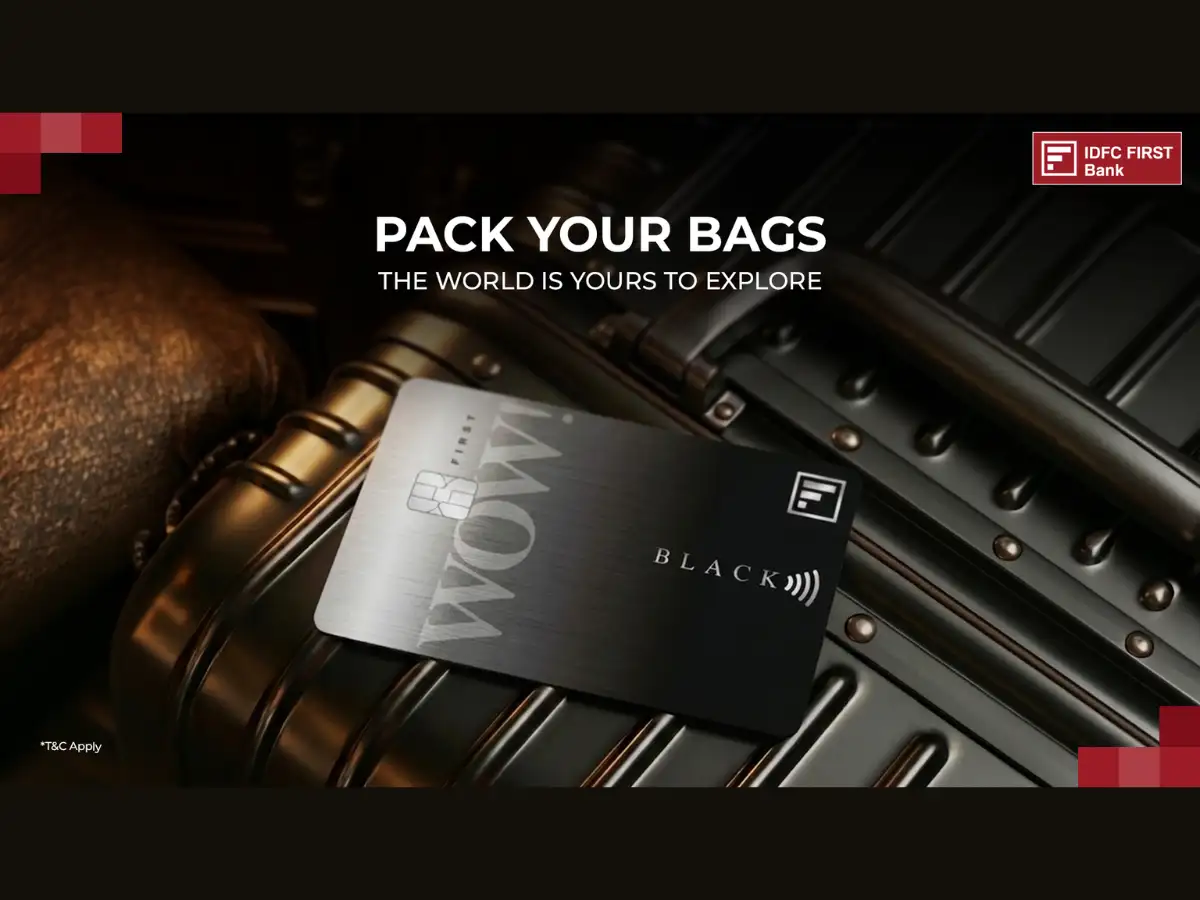
The FD-backed FIRST WOW! Black Credit Card by IDFC FIRST Bank addresses several of these considerations through a combination of international and travel-focused benefits. It offers zero forex mark-up on international transactions, airport lounge access, rewards on everyday spends and bonus reward points on travel bookings through the IDFC FIRST Bank app, along with the convenience of UPI payments.

By combining lower transaction costs with benefits that enhance the travel experience, the card reflects a broader shift in how consumers are evaluating premium credit cards: not simply by the rewards they accumulate, but by the costs they avoid and the experiences they can unlock.

The significance of zero forex mark-up becomes clearer when viewed through the larger economics of international spending. It removes one layer of cost from the transaction rather than simply adding another reward to it.

How much does international spending really cost?

The headline price of an overseas purchase is only the starting point.

Suppose a traveller buys a product priced at the equivalent of ₹1 lakh while abroad. Even a relatively small percentage-based mark-up can add a noticeable amount to the final rupee cost. The impact becomes more pronounced as spending increases across accommodation, shopping, dining and transportation.

This is why travellers comparing the credit cards for international travel increasingly need to look beyond rewards.

The relevant questions include:

  • What is the forex mark-up?
  • Is the card lifetime free, or does it have an annual fee?
  • What exchange rate will be applied?
  • Are there additional transaction-related charges?
  • Does the card provide useful travel benefits?
  • How easily can international transactions be monitored and managed?

The lowest apparent price is not always the lowest actual cost.

Why is the exchange rate not the whole story?

Currency conversion is often treated as the main variable when people think about international spending.

But the exchange rate is only one part of the calculation.

Currency markets move continuously, and the rate consumers see on a search engine or currency converter is not necessarily the exact rate applied to a card transaction. On top of the conversion itself, the issuer's forex mark-up can affect the final amount billed.

This makes credit card forex charges particularly relevant for frequent international travellers.

It also explains why a low or zero forex mark-up can be more valuable than a seemingly attractive reward proposition. A reward earned after spending may not fully compensate for a recurring cost attached to every foreign-currency transaction.

Why are Indians spending more across borders?

The growth in international travel is changing the scale and frequency of cross-border spending.

RBI's LRS (Liberalised Remittance Scheme) data provides one useful indication. Outward remittances for travel increased from US$13.66 billion in 2022–23 to US$17.01 billion in 2023–24 2 an increase of roughly 25%.

Travel is also becoming more diverse in purpose. The Mastercard Economics Institute's 2025 Travel Trends research 3 , based on aggregated and anonymised transaction data, found that purpose-driven travel, including sports, wellness, food and cultural experiences, continues to influence where and how consumers spend.

For Indian consumers, this means international spending is no longer confined to a large annual holiday. It can include business travel, international shopping, education, experiences and frequent short trips.

The economics of the card used for those transactions therefore becomes more important.

What should you look for in a credit card for international travel?

A good credit card for international travel is not necessarily the one with the longest list of benefits.A more useful evaluation starts with the costs.

Forex mark-up should be one of the first things to check. A card with a lower mark-up can potentially save money every time it is used abroad.

Annual fees also matter. A card may offer attractive travel benefits, but those benefits need to be considered against what the card costs to hold.

Acceptance is another practical consideration. International travel can involve hotels, restaurants, transport providers, online bookings and smaller merchants, so broad acceptance matters.

Then comes the benefits that improve the travel experience,including airport access, insurance, rewards and other privileges.

Why zero forex mark-up can matter more than rewards

Rewards are easy to notice. Costs are often easier to overlook.

A card may offer points on every transaction, but if international spending attracts a percentage-based forex mark-up, the customer is paying an additional cost each time the card is used abroad.

Zero forex mark-up addresses the cost at the transaction level.

That does not make rewards irrelevant. It changes the order in which the value proposition can be evaluated.

For someone who travels internationally or regularly shops on foreign websites, reducing the cost of each transaction can be more meaningful than earning a marginally higher number of points.

The best financial product, after all, is not necessarily the one that gives the most back. Sometimes it is the one that quietly takes less away.

International spending is becoming a financial decision

As more Indians travel internationally, the credit card in their wallet is becoming part of the economics of the trip itself.

The decision is no longer simply about whether a card is accepted abroad.

It is about how much the card adds to, or takes away from, the cost of every international transaction.

Exchange rates will continue to move. Travel prices will fluctuate. Spending patterns will change. Those variables are outside a traveller's control.

The choice of payment instrument is not.

That is why understanding the hidden economics of international spending matters. The difference between two cards may appear small when viewed transaction by transaction, but across an entire trip, and across several trips, it can become substantial.

A smarter international spending strategy, therefore, may begin not with asking how many rewards a card offers , but with a simpler question:

How much does it cost me to use it when I'm away from home?

Reference/s:

Reference1

Reference2

Reference3

Sign up to read this article
Read news from 100's of titles, curated specifically for you.
Already a member? Sign in here
Related Stories
Top stories on inkl right now
One subscription that gives you access to news from hundreds of sites
Already a member? Sign in here
Our Picks
Fourteen days free
Download the app
One app. One membership.
100+ trusted global sources.