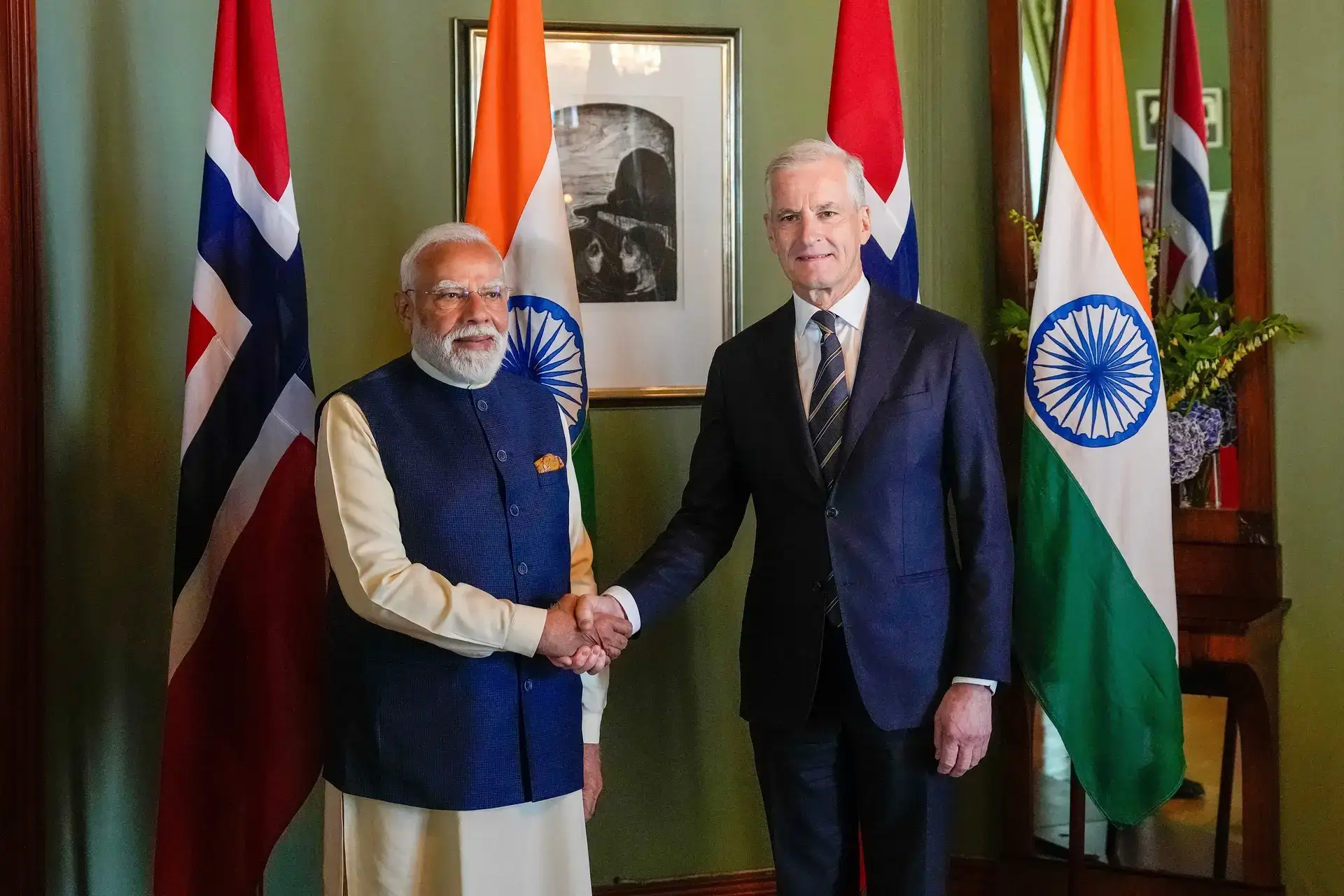
Prime Minister Narendra Modi’s visit to Norway on May 18–19, 2026 — the first by an Indian Prime Minister in over four decades — marks a significant turning point in bilateral ties. The visit elevated relations into a Green Strategic Partnership, signalling a convergence between India’s scale, talent, and expanding market and Norway’s world-class capabilities in high-tech areas.
Norway’s transformation has been driven by the prudent use of oil and gas revenues through its Government Pension Fund Global, the world’s largest sovereign wealth fund, valued at over $2 trillion. Oil wealth enabled Norway to build advanced capabilities in offshore drilling, tunnelling, shipping, fisheries, offshore wind, hydrogen, carbon capture, energy efficiency, and Arctic research. Of late, Norway has also emerged as a notable player in advanced missile and drone technologies, led by companies such as Kongsberg.

In recent years, India-Europe relations have witnessed a significant transformation. Despite a steep divide over the Russia-Ukraine conflict initially, the partnership evolved into a more pragmatic, multifaceted one focused on trade, investment, technology, and strategic cooperation. A defining milestone in this trajectory is the India-EFTA Trade and Economic Partnership Agreement (TEPA), which entered into force on 1 October 2025 after years of negotiations. Under this pact, the EFTA countries — Switzerland, Norway, Iceland, and Liechtenstein — have committed to investing $100 billion in India over 15 years, with Norway emerging as a vital partner.
Though more than 100 Norwegian companies operate in India, they could not scale up their operations due to “regulatory and operational hurdles”, as highlighted by Svein Holsetter, Yara's CEO, at the CEO forum attended by both Prime Ministers. We need to form a dedicated cell to help Norwegian companies scale up their operations by addressing their challenges. Amid global supply disruptions, India should deepen partnerships with firms like Yara International, one of the world’s leading fertiliser companies and the global leader in nitrogen fertilisers and nitrates. They also have advanced capabilities in sustainable crop nutrition and green ammonia and are at the forefront of sustainable agricultural models.
The 3rd India-Nordic Summit in Oslo elevated ties into a Green Technology and Innovation Strategic Partnership, combining Nordic strengths — from Norway’s expertise in multiple sectors, Iceland’s geothermal energy, Sweden’s manufacturing, Finland’s digital innovation, and Denmark’s green shipping — with India’s scale, innovation ecosystem, and skilled workforce.
Collaboration in the Arctic, energy, defence, and Space
The Arctic is becoming central to India’s climate and food security, with scientific evidence showing strong atmospheric linkages between the Arctic and the Himalayas, making both regions climate neighbours. Rapid Arctic warming is already affecting India’s monsoons and glacier systems, leading to cloudbursts and flash floods. Recognising this, India upgraded its Himadri station at Svalbard, Norway, into a year-round research facility. Svalbard’s strategic high-latitude location makes it one of the world’s most valuable satellite ground stations, with up to 12–14 passes daily, compared to just 2–3 at lower latitudes. Deeper Arctic cooperation with Norway can strengthen India’s climate modelling, monsoon prediction, agriculture planning, water management, and disaster preparedness.
Energy security remains a critical concern for India amid continuing instability in West Asia and volatile global energy markets. India should leverage Norwegian expertise in offshore oil exploration and advanced drilling technologies to strengthen its upstream energy sector and enhance long-term energy security, particularly given Indian companies' limited progress in this domain. Norway’s leadership in renewable energy technologies also offers significant opportunities for collaboration to accelerate India’s clean energy transition and sustainable growth.
Defence and space cooperation are also emerging as important pillars of the partnership. Kongsberg Defence & Aerospace is a global leader in naval strike missiles, air-defence systems such as NASAMS, and advanced maritime technologies. Building on existing collaboration, including waterjet systems for the Indian Navy’s Next Generation Missile Vessels, both countries can deepen cooperation in high-technology defence manufacturing.
Norway has emerged as an important facilitator for rocket launches through its strategically located high-latitude ground stations, particularly SvalSat in Svalbard. These facilities provide essential tracking, telemetry, and command support during and after rocket launches, especially for satellites placed in polar and sun-synchronous orbits. With India’s extensive satellite network and strong launch capabilities, this partnership offers excellent potential for the commercial space business. The new space cooperation agreement signed during PM Modi’s visit in May 2026 will facilitate this collaboration.
Besides, Norway’s welfare architecture — particularly in healthcare, pensions, and inclusive social protection — offers valuable lessons for India as it expands its social security systems. Conversely, India’s success in digital public infrastructure, including Aadhaar-enabled direct benefit transfers, provides useful models for efficient and transparent welfare delivery.
Sections of Pakistan Diaspora Fuel Anti-India Narratives in Norway
The partnership also carries an important diaspora dimension. Though the Indian diaspora of around 25,000 is increasingly successful in technology, finance, research, and entrepreneurship, it has historically remained less politically organised and less active in public advocacy. In contrast, Norway’s Pakistani diaspora — more than double the Indian community — has built a strong presence in politics, academia, civil society, advocacy networks, and sections of the media, often shaping anti-India narratives on South Asian issues. Although such narratives have been substantially neutralised since 2020, some elements persist, as reflected in the recent press conference fiasco. Importantly, the Norwegian public and political establishment, including His Majesty the King, continue to hold India’s diversity and pluralism in high regard. They see PM Modi’s rise from a humble background as a testament to the vibrancy of Indian democracy.
India: the land of spirituality
Apart from being a mature and ethical democracy, Norwegians are among the least religious populations in Europe in terms of formal church attendance and traditional religiosity. However, they often exhibit a strong spiritual orientation, rooted in a deep connection with nature, to experience awe, peace, and connectedness. This is best reflected in the distinctly Norwegian concept of friluftsliv — “open-air living” — which emphasises spending time in the hills, forests, and mountains for mental, emotional, and spiritual rejuvenation.
In this context, most Norwegians view India as the land of spirituality — a source of ancient wisdom, yoga, meditation, and holistic philosophies that complement their own nature-based spiritual inclinations. Yet people-to-people linkages are still weak. We need to develop strategies to deepen such linkages to make this evolving partnership more viable and dynamic.