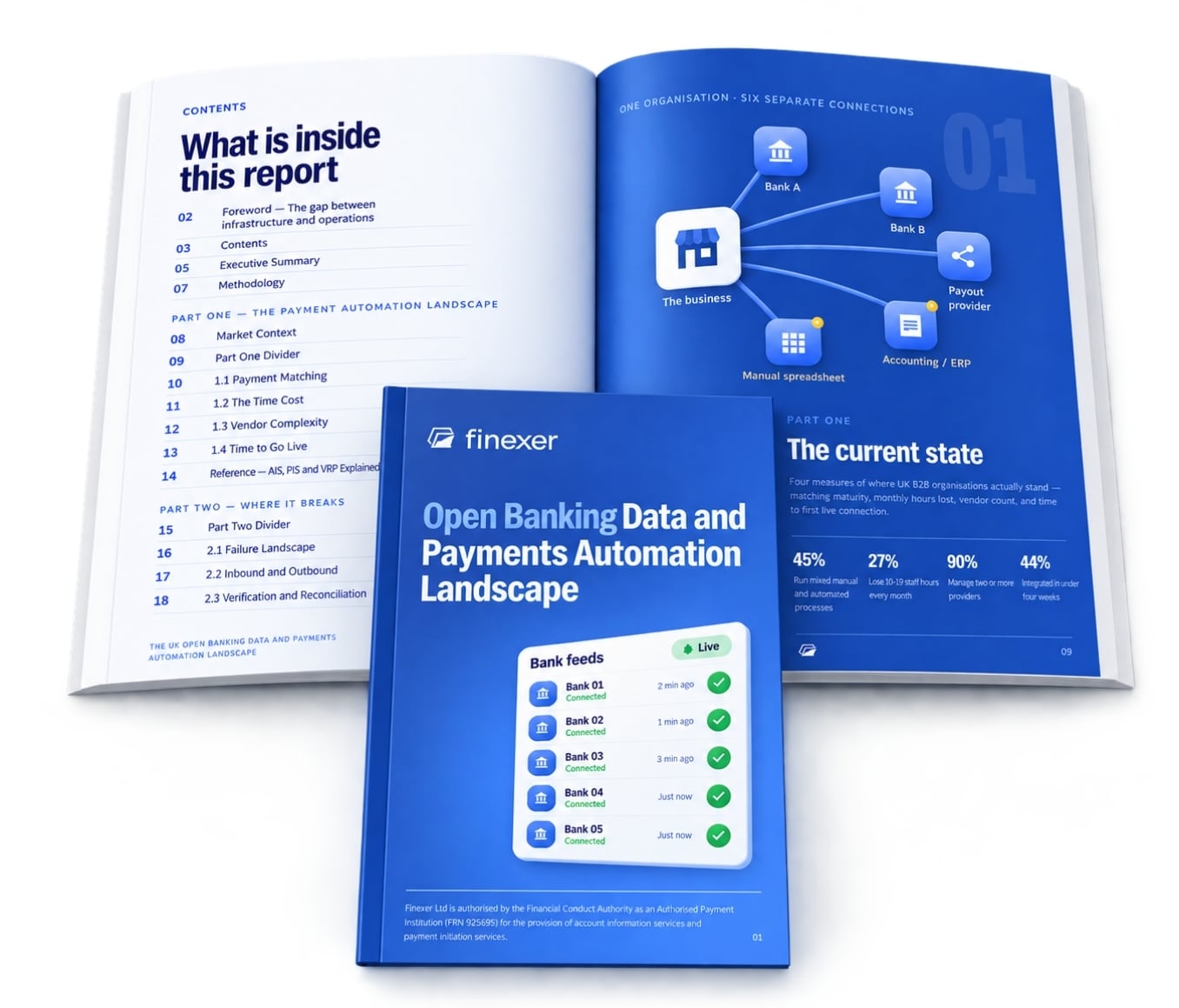
Just 10% of UK organisations report highly automated banking and payment workflows, according to new research of 418 senior leaders .
UK businesses have spent years automating sales, marketing and customer service. Finance is still catching up. New research from Finexer, based on a Pollfish survey of 418 senior leaders at UK organisations employing 10 to 500 people, found that just 10% report highly automated processes across most of their banking and payment workflows.
The survey covered accounting, ERP and financial management, FinTech and B2B SaaS, payroll and HR, legal, property and utilities. Fieldwork took place in August 2026, and the findings are published in The Open Banking Data and Payments Automation Landscape.
Most businesses are stuck in the middle
Almost one in five respondents (19%) still rely predominantly on manual processes to match bank transactions and payments against invoices, customers, cases or internal records. A further 45% run a combination of manual and automated processes. Most organisations are neither fully manual nor fully automated.
What the gap costs in time
Almost a quarter of respondents (24%) said their organisation can lose 20 to 29 hours every month to manual bank and payment administration. That covers collecting bank information, checking whether payments have arrived, matching payments to internal records and re-entering banking data.
Fragmentation and payment failures
The research points to two related problems. 90% of respondents run two or more separate banking or payment providers, and only 10% operate through a single unified platform. 96% experienced at least one of nine payment or payout failures in the previous 12 months. The most common were delayed payment confirmation (42%) and delayed payouts (40%).
The infrastructure is already there
Open Banking has reached scale in the UK. Open Banking Limited data cited in the report shows 18.81 million active user connections reported by CMA9 brands and 40.16 million Open Banking payments processed in June 2026 alone.
Commercial Variable Recurring Payments (VRP) also went live under the UKPI scheme on 2 June 2026, opening a new collection option for sectors such as utilities and regulated financial services. Interest is already visible in the survey: 43% of respondents use VRP today, and a further 29% plan to within 12 months.
Ravi Ranjan, co-founder and CEO of Finexer, said: "The problem isn't that the technology doesn't exist; it's that too many businesses are still connecting modern finance systems through processes that rely on people to fill the gaps. As expectations move towards real-time financial visibility, those gaps become increasingly difficult to justify."
Why manual workarounds persist
Connecting bank data to existing finance systems can involve complex integrations, regulatory requirements and legacy infrastructure. Finance teams often bridge those gaps by hand. Open Banking offers another route, letting platforms connect bank data and account-to-account payments directly into the systems businesses already use.
The findings are self-reported and come from a single survey. They describe how common these issues are across the sample, not what causes them. Even so, the picture is consistent: payment infrastructure has matured faster than the day-to-day operations built on top of it.
The full report, including methodology, sector breakdown and a maturity framework, is available at https://www.finexer.com/report