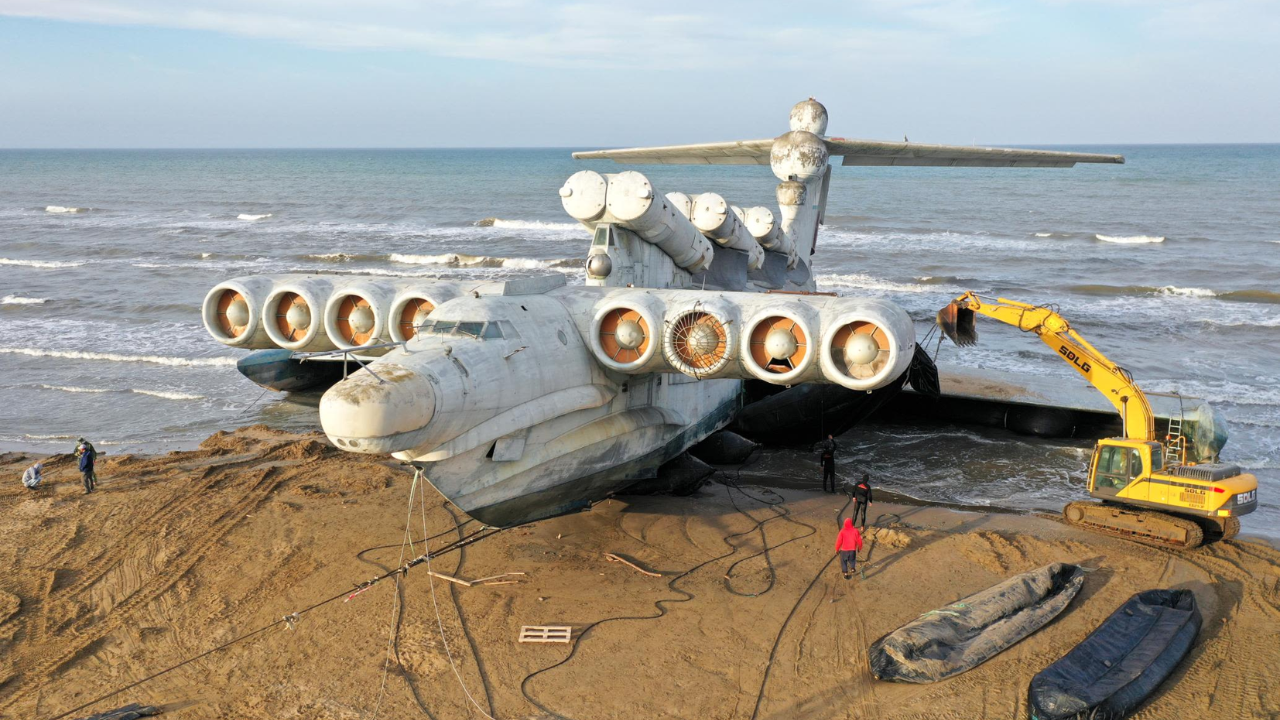
In the 1960s, as the United States and the Soviet Union competed for technological and military dominance during the Cold War, American spy satellites photographed something extraordinary along the shores of the Caspian Sea. Stretching almost 100 metres in length, the enormous craft appeared far too large to be a conventional aircraft, yet intelligence analysts observed it travelling rapidly across the water. Its unusual shape defied easy classification, it looked neither like a ship nor an aeroplane.
Get breaking news anytime, anywhere. Download the TOI app now!

Unable to identify the mysterious machine, US intelligence gave it the nickname "Caspian Sea Monster." For years, the discovery fuelled speculation that the Soviet Union had developed a revolutionary military technology capable of changing naval warfare. The truth turned out to be just as remarkable: it was neither a traditional aircraft nor a conventional vessel, but a giant ekranoplan, a craft that flew using an unusual aerodynamic principle known as ground effect.
Why the Soviet Union built an entirely new type of vehicle
The mysterious machine was eventually identified as the KM ekranoplan, an experimental wing-in-ground-effect (WIG) vehicle developed by the Soviet Union's Central Hydrofoil Design Bureau. Rather than flying at high altitudes like an aeroplane, the ekranoplan skimmed only a few metres above the water by exploiting an aerodynamic phenomenon known as ground effect.
When a wing flies extremely close to a flat surface, air becomes compressed beneath it, creating additional lift while reducing drag. This cushion of compressed air allowed the enormous craft to travel at aircraft-like speeds while carrying payloads more commonly associated with ships.
According to the US Naval Institute, Soviet engineers spent decades developing multiple WIG prototypes from the 1960s through the early 1990s. They believed these unusual vehicles could combine the speed of aircraft with the cargo capacity of ships while operating entirely from the water.
How the 'Caspian Sea Monster' challenged the rules of aviation
The KM was unlike anything that had existed before. Measuring approximately 92 metres long and powered by ten turbojet engines, it became one of the largest flying machines ever constructed. Yet many engineers hesitate to classify it as a true aircraft because it depended on remaining within ground effect, typically flying only a few metres above the sea.
Its unusual operating characteristics offered several military advantages. Flying so close to the water meant it remained below much of conventional radar coverage while travelling far faster than traditional naval vessels. It could transport troops, equipment and supplies across vast stretches of water without relying on ports or runways.
This combination of speed, carrying capacity and low-altitude operation convinced Soviet planners that ekranoplans could become valuable military transport platforms, especially across enclosed seas such as the Caspian and Black Seas.
From Cold War experiment to missile carrying sea monster
The success of the original KM prototype encouraged Soviet engineers to build several other ground-effect vehicles. Among the best known was the Lun-class ekranoplan, designed to carry anti-ship missiles, while the A-90 Orlyonok served as a military transport capable of moving troops and equipment rapidly across coastal waters.
The US Naval Institute notes that these vehicles were intended for a variety of missions rather than a single role. Their ability to move at aircraft speeds while carrying ship-like loads made them attractive for military logistics, amphibious operations and rapid transport. Soviet planners viewed them as a unique capability that neither conventional aircraft nor ships could fully replicate.
Why the revolutionary concept never became mainstream
Despite their remarkable engineering, ekranoplans also faced significant operational challenges. Because they relied on ground effect, they performed best over relatively calm water and had limited ability to operate in rough seas or over mountainous terrain. They also required specialised maintenance and infrastructure, making them less versatile than conventional aircraft.
Following the collapse of the Soviet Union, funding for ekranoplan development largely disappeared, and most programmes were abandoned before they could enter widespread service.
Interestingly, the concept has never completely vanished. Advances in modern materials, logistics requirements and military strategy could make wing-in-ground-effect vehicles relevant once again. They suggest that future WIG craft could complement traditional aircraft and ships by transporting heavy payloads rapidly without depending on vulnerable runways or large ports.
A Cold War mystery that still fascinates engineers today
What first appeared in grainy satellite photographs as an unidentified Soviet superweapon ultimately became one of the most ambitious engineering experiments of the twentieth century. The Caspian Sea Monster blurred the line between aircraft and ships, forcing engineers to rethink how heavy vehicles could move across vast bodies of water.
More than half a century after it startled American intelligence analysts, the giant ekranoplan remains a symbol of Cold War innovation and experimentation. It demonstrated that exploiting the physics of ground effect could create an entirely new class of vehicle, one that challenged conventional definitions of flight and continues to inspire military planners and aerospace engineers today.