
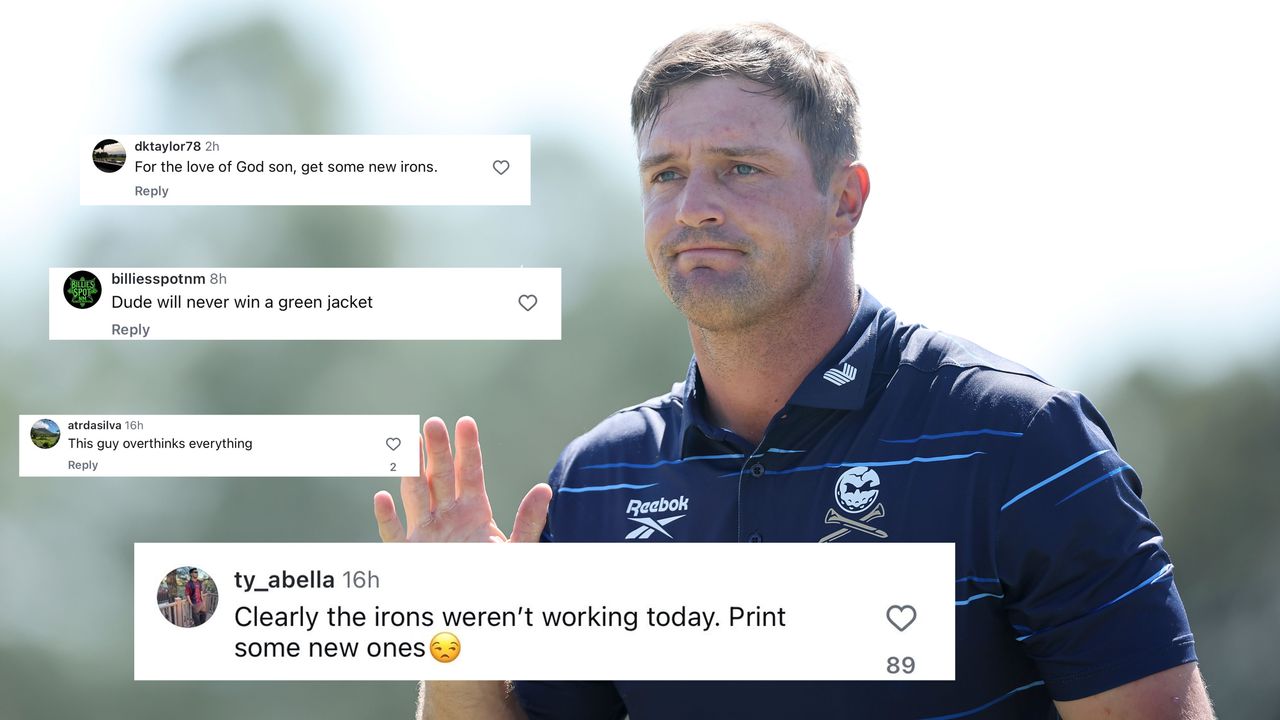
After a grueling opening round that saw Bryson DeChambeau uncharacteristically out of sorts, the predictable machinery of the golf world has whirred into motion.
Mainstream outlets and the "golf-twitter" peanut gallery have jumped on a familiar bandwagon, sharpening their knives to dissect the American’s unorthodox bag setup.
The whispers have become roars: Are the one-length irons a gimmick? Do the curved-face (bulge and roll) irons actually provide consistency, or just chaos? Are those extra-long wedges - which look more like mid-irons in the hands of a mortal - robbing him of the delicate touch required for major championship golf?

Short-Term Memory
Let’s be clear: yesterday was a poor performance. From a technical standpoint, Bryson’s iron play was objectively sub-par, and his distance control was erratic. This follows a trend some are eager to highlight, recalling his struggles over the weekend at last year’s Masters. When Bryson misses, he misses in a way that looks "different," and that difference is easy to blame on the tools rather than the mechanic.
However, the vitriol highlights how embarrassingly reactionary the golf world has become. We live in an era of 24-hour takes where a single bad round is treated as a definitive indictment of a decade’s worth of philosophy. To suggest that his equipment is the "problem" the moment he shoots over par is to ignore the reality of professional golf.

Where Was This Energy at Pinehurst?
The irony is palpable. I didn’t hear many critics crowing about the "flaws" of one-length irons when Bryson was staring down Rory McIlroy at Pinehurst No. 2 a couple of summers ago. When he hit that miraculous bunker shot on 18 to clinch the U.S. Open, he wasn't a "mad scientist with failed experiments” or using the wrong wedges; he was a genius.
When he was chalking off his recent victories on the LIV Golf circuit, dominating fields with the same equipment architecture, he was hailed as a visionary. Entering this week, almost every pundit and bookmaker had him dubbed as a tournament favorite, yet many of the same onlookers have suddenly decided his equipment is ill-suited for the task.

If his equipment were truly a handicap, he wouldn't be one of the most consistently threatening players in the world over the last five years.
The Double Standard of "Different"
This setup isn't a midlife crisis or a desperate last resort; Bryson has utilized this fundamental blueprint for years with phenomenal multi-major winning success. The golf world loves a disruptor until that disruptor hits a speed bump.
When it works, he is the "Scientist" who has decoded the game's DNA. When it doesn't, he is a "tinkerer" who has lost his way in the weeds of physics.

This binary view of his performance is incredibly lazy to me.
Every player on tour has weeks where their ball-striking metrics plummet. When Scottie Scheffler has a bad day with the putter, we call it a "cold streak." When Bryson has a bad day with the irons, critics call it a "failed experiment."
The Bigger Picture
Golf is a game of marginal gains and inevitable variance. To suggest that a Major winner and global superstar doesn't understand the physics of his own swing and equipment is the height of arrogance from the sidelines.

Bryson’s setup is designed to eliminate variables. While it may look alien to those of us used to a traditional set of clubs, it is a system tried, tested, and built on repeatable geometry.
The scrutiny he faces is less about his score and more about the golf world’s tiresome discomfort with anything that defies the "traditional" way of doing things. If you only praise the innovation when the trophies are being lifted, you don't really understand the process.
One bad round doesn't make the science wrong - it just makes him human. It's time we stopped being so reactionary and started appreciating the most interesting bag in golf for what it is: a proven winner.