For international Swiss companies, moving money across borders is a daily challenge that involves exposure to foreign currencies.
Traditional banks facilitate the exchange of currency, but they often hide their markup inside the exchange rate and charge fees on incoming SWIFT payments.
All of this can lead to unexpected fees for Swiss businesses, but luckily, there are specialist providers who are starting to close the gap. In this guide, we’ll walk you through some of the best Swiss international payments platforms to see which is best.
Let’s get right into it.
What to look for in an international payment platform
Before comparing providers, it helps to understand the levers that actually affect cost and control:
- FX transparency. Most Swiss banks add a 1–3% margin above the interbank rate, often invisibly. Specialist platforms typically charge 0.4–1%, with the spread shown upfront.
- Local IBANs and multi-currency accounts. A local EUR or USD IBAN means you receive customer payments without triggering a forced conversion. The more currencies your platform supports natively, the less you lose to round-trip conversion.
- Swiss regulation. Working with a provider supervised under FINMA's framework - directly or through a recognised self-regulatory organisation such as VQF - matters for compliance, fund safeguarding, and audit.
- Hedging tools. Forward contracts and limit orders let you lock in favourable rates for future payments and protect margins from sudden currency moves.
- Real support. A dedicated contact who understands your business is far more useful than a generic helpdesk when a six-figure transfer goes sideways.
With those criteria in mind, here are the five strongest options for Swiss companies this year.
1. SwissFx - best overall
SwissFx is built specifically for internationally active Swiss businesses, and claims the top spot in our guide.
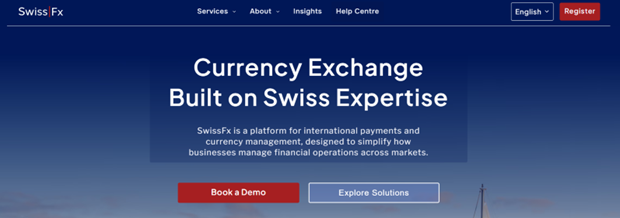
The platform combines multi-currency accounts, local IBANs in 30+ currencies, access to 140+ currencies in total, and FX risk management tools - all under Swiss regulatory oversight as a member of VQF, the FINMA-recognized self-regulatory organization.
What sets it apart from generic fintechs is the operating model. Pricing is transparent, with no forced conversions when you receive payments in supported currencies.
Each client works with a dedicated relationship manager rather than a ticket in a long queue, and client funds are held in segregated accounts at regulated financial institutions. For businesses with predictable foreign currency exposure, SwissFx offers forward contracts to lock in favorable rates and bulk payment functionality so finance teams can pay suppliers, freelancers, and overseas staff in a single batch.
After 12 months of activity, eligible clients can also access a supplier-payment line of credit, which lets them pay suppliers immediately while extending their own working capital cycle - a feature most fintech competitors don't offer at all.
- Best for: Swiss SMEs and mid-market companies with regular cross-border activity who want Swiss-regulated infrastructure and a real human point of contact.
2. Wise (formerly TransferWise)
Wise is the default option for freelancers and very small businesses with light international payment volumes. It pioneered the model of charging a transparent fixed fee plus the mid-market FX rate and remains one of the cheapest options for one-off transfers in major currency pairs.
In Switzerland, Wise is embedded into the Neon banking app, which has helped its uptake among individuals and sole traders. The downside for businesses is that it's primarily a transfer tool rather than a treasury platform. There's no relationship manager, no hedging functionality beyond holding balances, and limited support for complex flows like high-volume batch payouts.
- Best for: freelancers, contractors, and micro-businesses moving money in standard currency pairs.
3. Revolut Business
Revolut Business is widely used in Switzerland thanks to its slick app, multi-currency cards, and broad currency coverage. Pricing tiers include a monthly FX allowance at the interbank rate - typically between CHF 10,000 and CHF 50,000, depending on plan - with a 0.4% surcharge on volumes above that.
Two things to weigh up. First, Revolut operates in Switzerland under a Lithuanian e-money license and issues UK or EEA IBANs rather than Swiss ones, which can complicate domestic invoicing and supplier setup. Second, the support model is digital-first; dedicated account managers are reserved for larger enterprise plans.
- Best for: small companies with occasional foreign currency payments and a preference for app-first banking.
4. Amnis
Amnis is a Swiss-based platform pitched directly at SMEs. Its distinctive feature is a fixed FX margin per customer regardless of trade size, which works well for businesses whose volumes vary significantly month to month. Amnis supports all tradable currencies, lets you fix exchange rates in advance, and integrates with existing Swiss bank accounts so transfers are debited at the chosen value date.
The platform is closer to SwissFx in audience than Wise or Revolut, though pricing structure and the depth of relationship support differ.
- Best for: Swiss SMEs with variable monthly FX volumes who value predictable per-customer pricing.
5. PostFinance
PostFinance is the legacy choice and remains relevant for businesses that prefer a single, established Swiss provider for both domestic and international payments. Integration with the Swiss banking system is seamless, brand trust is high, and the SEPA and SWIFT infrastructure is reliable and well understood.
The trade-off is cost. PostFinance's FX margins and per-transaction fees are noticeably higher than the specialist platforms above, and it offers fewer tools for active currency management - no forwards, limited multi-currency IBAN flexibility, and no equivalent of the supplier-credit features now standard among fintech-native providers.
- Best for: businesses prioritising a single trusted Swiss banking relationship over FX cost optimisation.
How much are Swiss businesses really losing to FX?
The cost of choosing the wrong platform is easy to underestimate until you put numbers against it. Take a Swiss SME with CHF 1 million in annual international payments - a fairly typical mid-market profile. At a traditional bank's 2% FX margin, that's CHF 20,000 a year disappearing into currency conversion alone. Move the same volume onto a specialist platform charging 0.5%, and the cost falls to CHF 5,000 - a CHF 15,000 saving that goes straight to the bottom line.
This may sound bad, but it gets even worse when you factor in fees and intermediary bank charges that can appear out of nowhere..
This is exactly why it pays dividends to look at specialist providers and get quotes for your currency exchange forecast.
The bottom line
Switzerland, like most of the world, has plenty of international payment platform options.
The giants like Wise and Revolut do a pretty solid job in most cases, but you can squeeze more out of specialist providers and get real support.
Amnis is a credible Swiss alternative for SMEs with fluctuating exposure. PostFinance remains the safe but expensive default.
For internationally active Swiss businesses that want regulated infrastructure, transparent pricing, hedging tools, and a relationship manager who actually picks up the phone, SwissFx is our top pick for 2026.