
Get all your news in one place.
100’s of premium titles.
One app.
Start reading
GamesRadar
GamesRadar
Technology
Tabitha Baker

The Asus ROG Azoth 96 HE has returned to take the magnetic crown, but that price tag is going to be a problem

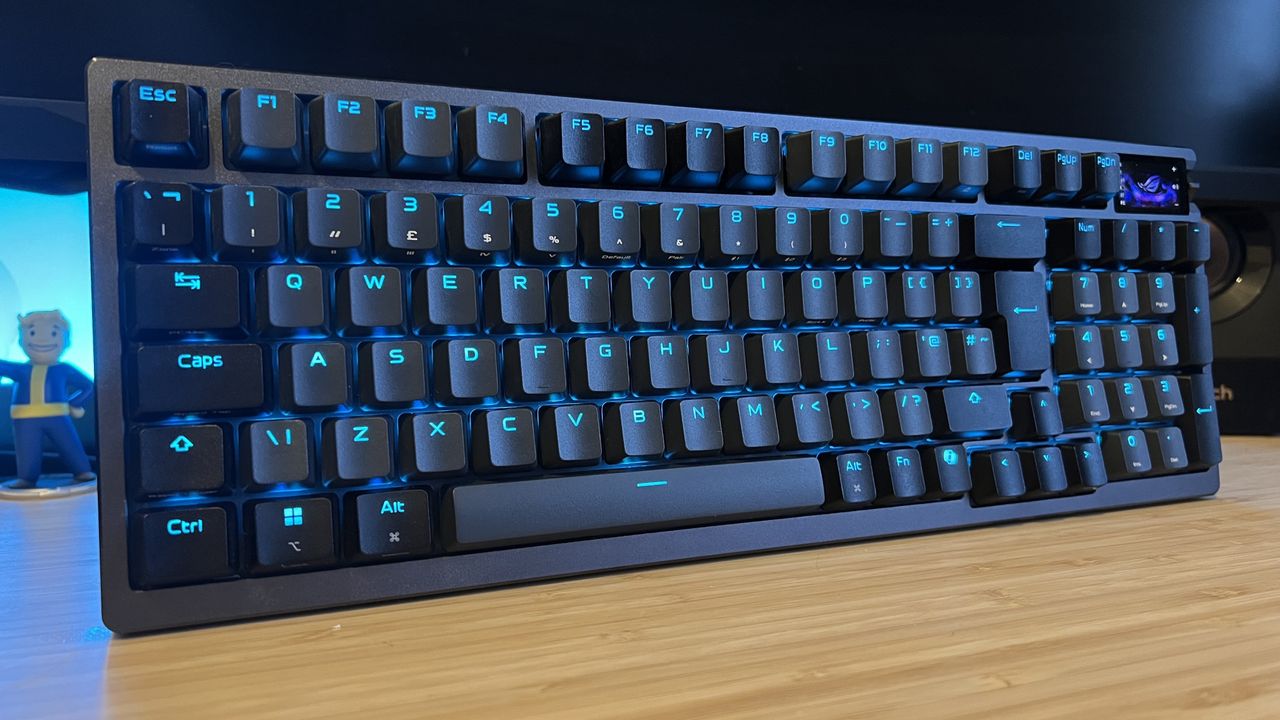
Asus ROG Azoth 96 HE gaming keyboard on a wooden desk.

I have a history with the Asus ROG Azoth line. When I reviewed the first model back in 2023, I instantly fell in love with its excellent sound dampening, hot-swappable PCB, and incredibly energetic typing feel.

That was back when the best gaming keyboards were only just learning what gasket mounting was and where to put the foam sheets. Things have moved on, though. With magnetic switches taking over the high-end market and Asus's own ROG HFX clackers representing the best I've used so far, I jumped at the chance to get the Asus ROG Azoth 96 HE on my desk.

After a string of, frankly, unnecessary releases in this range, this is the keyboard that's bringing me back to the Azoth - but goodness is it an expensive journey. Asus provided the review sample I've been testing at no cost, but when a device proves itself as the 'best' I've tested, I'm often a little more lenient around a higher price tag. After all, if something is objectively ticking more boxes and providing a better experience than something else, it is 'better'.

In this case, the Asus ROG Azoth 96 HE's $359.99 MSRP is a full $130 more than the keyboard I'd recommend after it, the Corsair Vanguard Pro 96 ($229.99). That's a serious leap in pricing.

This isn't out of the blue, though. The Asus ROG Falcata launched earlier last year at a ludicrous $429.99 starting price. That's a more niche split deck that's working a little harder for a specific set of users, but it's still a set of numbers that would have been unthinkable a few years ago.

The Asus ROG Azoth 96 HE has so much going for it. It is the best Hall effect gaming keyboard I've tested so far. Whether or not it's easy to recommend as a top-choice gaming keyboard is a slightly different matter.

Quick review

Buy it if

  • You want a no holds barred magnetic experience
  • A wireless connection is a priority
  • You want the best typing feel so far

Don't buy it if

  • You can keep a wire on your desk
  • You want extra macro buttons
Key Specs

Price

$359.99 / £349.99

Type

Hall effect

Connection

2.4GHz / Bluetooth / Wired

Size

96%

Switches

ROG HFX V2

Keycaps

PBT

Media keys

Multi-function rocker

Wrist rest

Included, detachable

USB passthrough

No

What I love

(Image credit: Future)

The best feeling magnetic switches I've used

I've been struggling with the Asus ROG Falcata of late. It's got the best magnetic switches I've used so far, but the split design and $400+ price point make it difficult to fully recommend. Thankfully, the Asus ROG Azoth 96 HE uses the same clackers, and the experience is just as smooth this time around.

Magnetic keyboards are great for extra gaming features, but the extra tension under each key makes for a slightly lethargic typing feel. Considering I loved the original Asus ROG Azoth's bouncy switches, the Hall effect version has filled some big boots in 2026. Every keypress is as smooth and rich as you'd expect from a well-tuned mechanical keyboard, no more woolly pressure under each cap.

(Image credit: Future)

That makes a world of difference in everyday typing, but it also makes for a more spritely gaming experience as well. There's a distinct snap to each keypress here and, combined with that speedy rapid trigger and the ability to set actuation points a little higher than a typical mechanical deck, I've been propelled across the deck with particular ease.

Not many mainstream gaming keyboard brands know how to get a keyboard sounding and feeling this good, but Asus has some kind of secret sauce in its factory. These folks know how to dampen a deck, and they've poured that sacred wisdom into the ROG Azoth 96 HE.

That means it's a more pleasant experience than that of the Corsair Vanguard Pro 96. Its competitor is still impressively smooth and far better than most Hall effect options, but the Azoth brings extra energy to the experience as a whole.

If you're coming to the Asus ROG Azoth 96 HE from one of the previous mechanical options, those switches are going to be the biggest change by far. You can read more about the benefits of magnetic clackers in my guide to what is a Hall effect gaming keyboard, but essentially, they're free from the on/off moving parts of a mechanical option.

(Image credit: Future)

Instead, the Azoth 96 HE allows you to set per-key customizable actuation points (the moment a keypress is registered) from 0.1mm to 3.5mm in depth. It's a little shorter than others on the market - Corsair's Vanguard Pro, for example, takes you all the way down to 4mm, as does the Glorious GMMK 3 Pro HE). That means higher sensitivities on keys you need to hit faster, and more force is required on the buttons you don't want to accidentally hit.

It also opens the door to faster, rapid trigger inputs. When a mechanical switch is pressed, it needs to fully 'reset' its position before it can register a new input (physically, a pin needs to slot back into place). With magnets, you can set where that reset point is, and the deck can even dynamically alter it while you're spamming. It essentially means much faster repeat presses.

Finally, now that your keyboard knows how far down you want to press to actuate, it can assign multiple functions to different levels of pressure. The Asus ROG Azoth 96 HE allows for four individual inputs per press (two on the way down and one on the way up). You're less likely to live and die by this feature, but it is helpful for keeping walk / run separate on the W key, for example, and Asus's implementation doubles the usual two-step inputs offered elsewhere (like the Vanguard).

Battery life keeps up with that wireless connection

The magnetic switches inside the Asus ROG Azoth 96 HE offer far greater versatility and control for gamers, but you don't see too many of the best wireless gaming keyboards moving away from mechanical clackers. There's good reason for that, and it goes a long way to explaining the Azoth's particularly high price tag.

(Image credit: Future)

Not only does the Asus ROG Azoth 96 HE manage to get away with a wireless connection (via both Bluetooth and 2.4GHz), but it's also got a battery that can keep it juiced up at the same time. That's rare - these switches are hungry for charge and can often eat up a full battery in just over a day.

The Ducky One X, for example, will barely last 15 hours on my desk before needing to be plugged in. I've been running the Azoth 96 HE for about a week of work and play on a single charge, equating to roughly 45 to 50 hours.

It's nowhere near the seemingly immortal battery life of the original model, which I can often forget needs charging at all, but it's certainly above the average of all the Hall effect keyboards I've tested over the last couple of years.

Well designed key spacing

The Asus ROG Azoth 96 HE makes another major change compared to previous iterations. The 96% form factor means it's closer to a full-sized keyboard in functionality while still keeping a more compact design on the desk. A few decks (most notably the Corsair Vanguard) are adopting similar practices these days, which means you get access to all those right-hand numbers and a few nav keys (minus home, insert, and end) while still keeping space for mouse swipes to the side.

Asus gets its spacing right, though. There's a small line of separation between the main deck and the arrow keys, with a little extra buffer to the number pad. It's an extra piece of top plate that might not seem like much, but compared with the Corsair Vanguard that simply squishes everything into a more homogenous cluster, it makes for a far more relaxed experience.

Above: Asus ROG Azoth, Below: Corsair Vanguard Pro 96 (Image credit: Future)

Just that bit of extra spacing delineates the different key zones enough to make sure I always know where I am on the deck, and can hit arrow keys more reliably. Sure, it still takes a second to get used to, but it's far easier to re-learn than Corsair's implementation. It also makes for a more visually appealing keyboard overall.

OLED display feels more useful than others

Top gaming keyboards have been adding OLED displays to their spec sheets for years now, and the Asus ROG Azoth nailed its iteration back in 2023. Nobody seems to have caught up, though, and Asus has simply doubled down on what made its original panel so great.

While Corsair limits its screen to a few images and animations, and the SteelSeries Apex Pro TKL Gen 3 adds more functionality without the luxury of colour and far fewer pixels, the Asus ROG Azoth 96 HE takes everything a step further.

Onboard switch sensitivity and actuation settings can be accessed and controlled via the button and rocker switch to the right of the display, with everything from hardware vitals to keystrokes per second on the screen itself. That's far more useful than the rest of the market, which seems content to keep the display as a neat extra rather than a core piece of the puzzle.

What to consider

We're in another price bracket now

The Asus ROG Azoth 96 HE packs a rare wireless connection with the battery to support it, offers the best magnetic switches I've used so far, and makes its extra features work a little harder for it than the competition. It's also priced well above the rest of the market.

The Logitech G Pro X TKL Rapid and Razer Huntsman V3 Pro Mini can offer you adjustable switches for less than $200, albeit while dropping that premium typing feel and wireless connection.

I was beginning to think the top end of the market sat with the Keychron Q1 HE 8K and Corsair's $229.99 MSRPs, but Asus is looking to push those prices a little higher than the rest of the gang. At $349.99, the Azoth isn't as expensive as the Falcata, but it's still the third most premium deck I've tested so far. That's taking the fully-configured Glorious GMMK 3 Pro HE with all bells and whistles and a launch day price tag into account - that deck can be found for between $200 and $300 these days.

Yes, the Asus ROG Azoth 96 HE offers a better experience than these alternatives, but are those benefits worth $130? That's largely down to you. I love this typing feel, keyboards are a real passion of mine, and I'm happy to invest in something that ticks all my boxes. I would still wait for a sale on this one.

The problem is this. The Asus ROG Azoth 96 HE is in a different price league to the rest of the market, but its benefits don't quite justify that jump.

Should you buy the Asus ROG Azoth 96 HE?

(Image credit: Future)

The Asus ROG Azoth 96 HE is an expensive gaming keyboard, and it's only going to make sense for those who prioritize a high-end typing feel more than anything else. Every other combination of features is already served by cheaper decks.

How I tested the Asus ROG Azoth 96 HE

I used the Asus ROG Azoth 96 HE as my main daily keyboard for a period of two weeks, with a day's worth of side-by-side testing against the Corsair Vanguard Pro 96, Cherry XTRFY MX 8.2 TKL TMR, Asus ROG Azoth, and Asus ROG Falcata. That's eight hours of typing per day, with a couple hours of gaming in the evening and more involved play over the weekend. In that time, I tested in CS2 and Doom: The Dark Ages, with additional time spent in Planet Coaster. For more information on how we test gaming keyboards, check out the full GamesRadar+ Hardware Policy.

For more switch options, check out the best hot-swappable keyboards or the best membrane gaming keyboards for something a little cheaper. We're also rounding up all the best gaming mouse models on the market for a full refresh.

Sign up to read this article
Read news from 100’s of titles, curated specifically for you.
Already a member? Sign in here
Related Stories
Top stories on inkl right now
One subscription that gives you access to news from hundreds of sites
Already a member? Sign in here
Our Picks
Fourteen days free
Download the app
One app. One membership.
100+ trusted global sources.