What do you use AI for the most?
For most people, it is content creation. Almost everyone trying to stay visible online ends up producing content constantly, using AI. In this environment, AI has quietly become a practical helper.
Speed plays a big role in content creation. However, there's another idea that tends to be skipped; the AI slope.
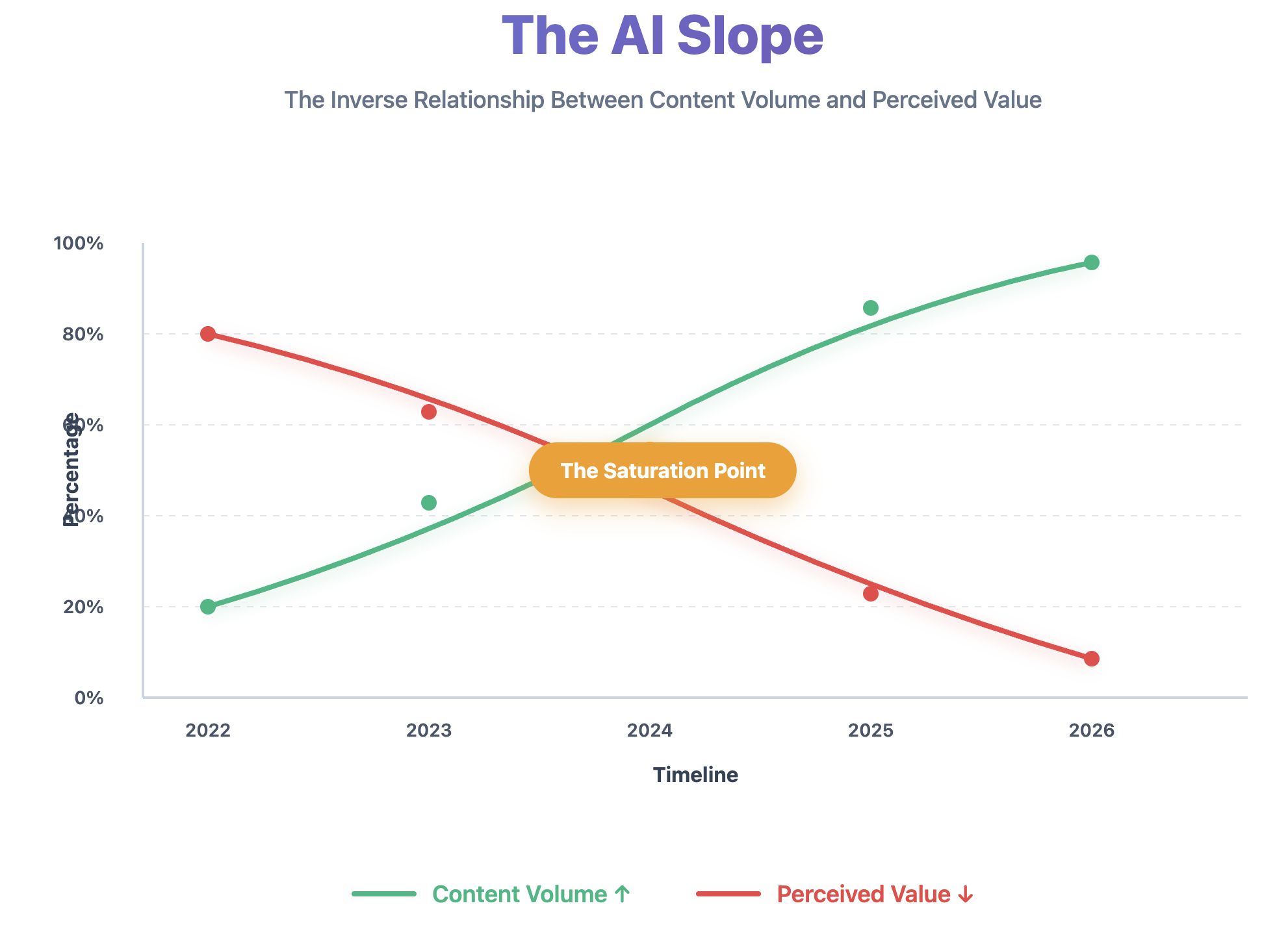
It describes the loss of originality and perceived value as AI-generated content becomes easier to produce, cheaper to repeat, and harder to tell apart. Think of it as a downward curve: as production costs drop by 90%, perceived value drops by 70%.
Why it matters?
New technology feels like a relief. When deadlines are tight and budgets are limited, anything that saves time feels like progress. The internet did this. The Industrial Revolution did it too. AI is simply the next step in that pattern.
But every shift has side effects, even when the benefits are obvious. So it’s worth asking a straightforward question:
How can brands stay recognizable and believable when everyone is producing the same type of content?
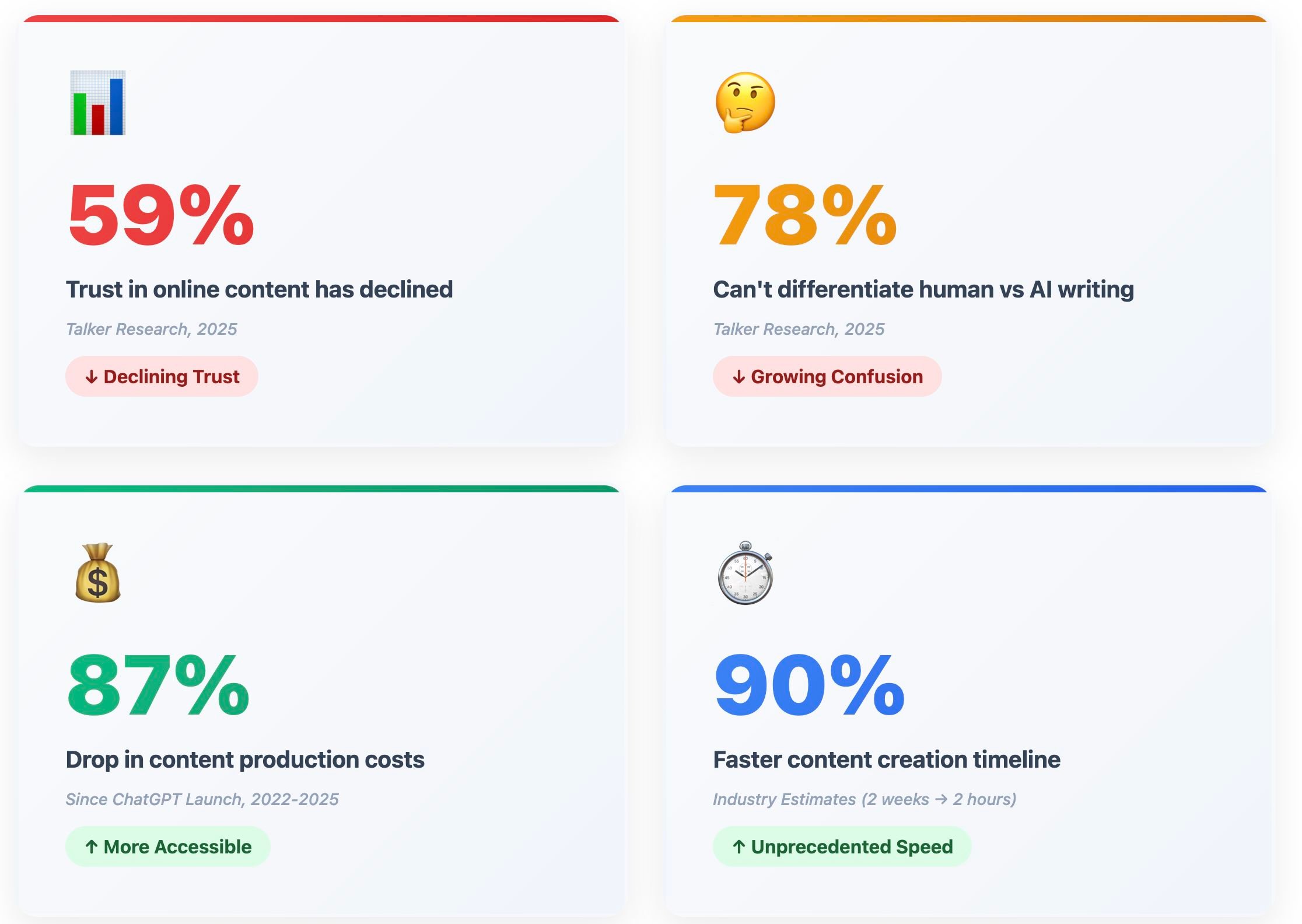
A 2025 study by Talker Research touches upon a growing trust issue. Among 2,000 participants, 59% said their trust in online content has declined. 78% said it’s becoming harder to tell whether something was written by a human or generated by AI.
This isn't just a preference shift, it's a market signal. As content volume increases, trust weakens. People no longer judge content only by the information it provides. It is noticeable in the tone, intent, and depth of the message. Is the content really helpful in solving a problem?
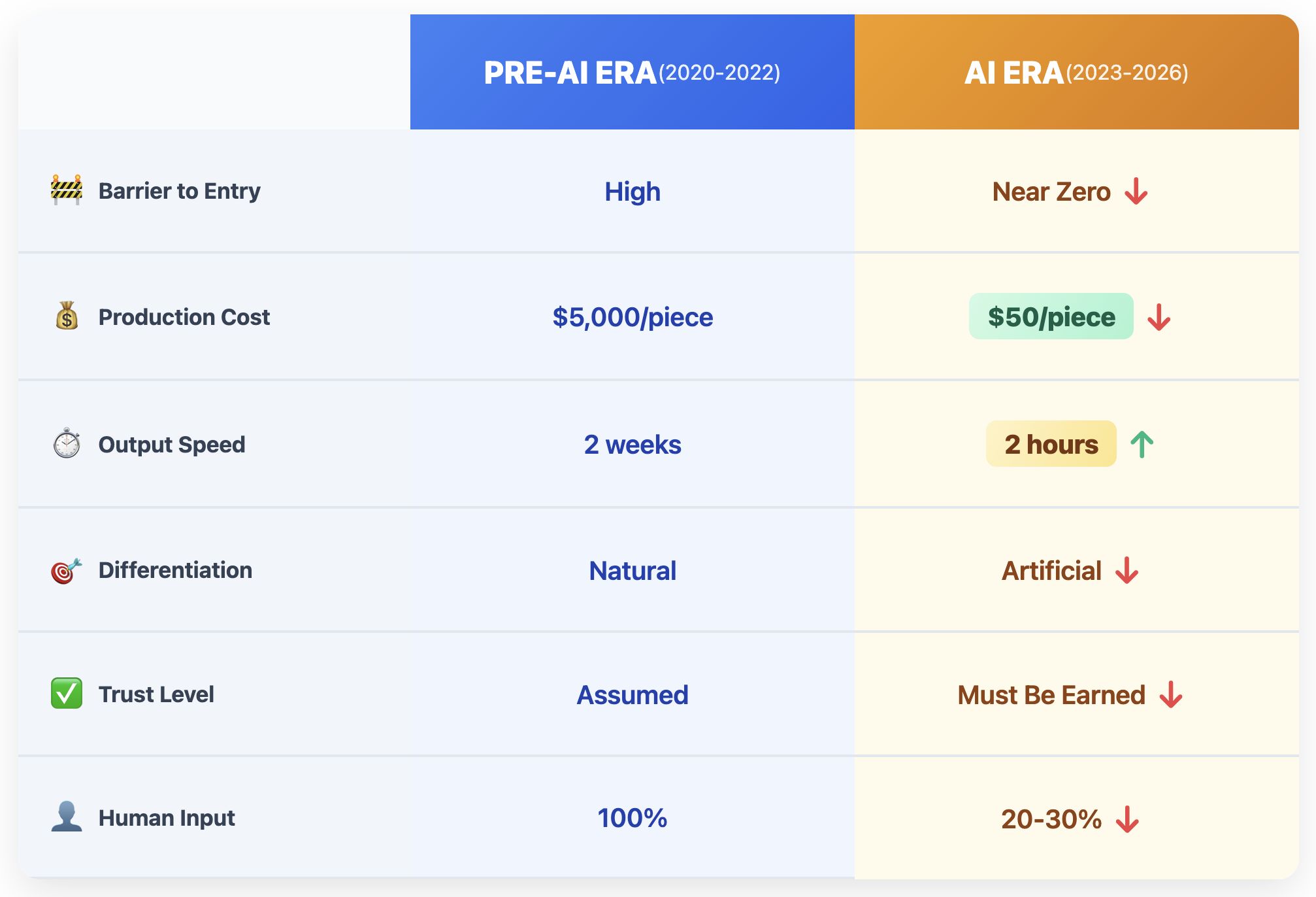
When AI-generated content is everywhere, being unique is now about credibility rather than design or format. The rarest resource in 2026 isn't information. It's believability.
5 pros of AI:
If we look at the main advantages of AI in content creation, they usually appear like this:
- Budget: Lower production costs
- Time efficiency: Work that once took days can now be finished in hours
- Speed: Faster responses to changing content needs
- Volume: Easy scaling across formats and variations
- Automation: Repetitive tasks become easier to handle
These benefits are real. But they come with a hidden cost.
What about the cons?
The biggest risk is uniformity. AI depends on existing patterns, which means outputs often feel familiar. As more people rely on the same tools, content starts to resemble itself. When everyone sounds the same, nobody gets remembered.
Accuracy and context are other issues. AI can make mistakes, and it does. So, it is important to take this into consideration. Fully AI-generated content can feel distant or too neutral. It weakens trust and emotional connection. For shorter-term and simpler problems, AI can be very helpful, but the same cannot be said for long-term brand building.
As content volume increases, trust declines. Audiences no longer evaluate content based solely on information; it's about who is speaking, how they speak, and whether the message feels authentic.
What happens in the short term?
In the short run, production accelerates. Brands publish more articles, post more often, and launch campaigns faster than before. But speed brings a familiar problem: sameness. Same ideas. Same wording. Same structure.
Eventually, content blends into the background instead of standing out. This is the visibility paradox: everyone is creating more, but no one is being seen.
What happens in the long term?
Google's E-E-A-T framework makes one thing clear: Content without real experience, visible expertise, authority, and trust will struggle to perform over time.
Before AI-generated content, brands invested heavily in organic growth without depending entirely on ads. Blogs, reports, videos, and social channels were all important, especially in B2B. In B2C, agencies focused on visuals and copy to protect brand identity.
Today, content is cheaper and faster to produce. With new content creation tools, many brands risk losing the qualities that once made them stand out. The barrier to entry dropped to near zero. So did the barrier to forgetting.
Here's how to put it simply:
Fast + cheap ≠ good content
Good + fast ≠ cheap
Content that lacks lived perspective or trust eventually fades. Storytelling and relationship-building still matter. They always will.
Shouldn’t you use AI?
The real question is how you're using it. Are you creating content only to stay active, or are you trying to build something that lasts?
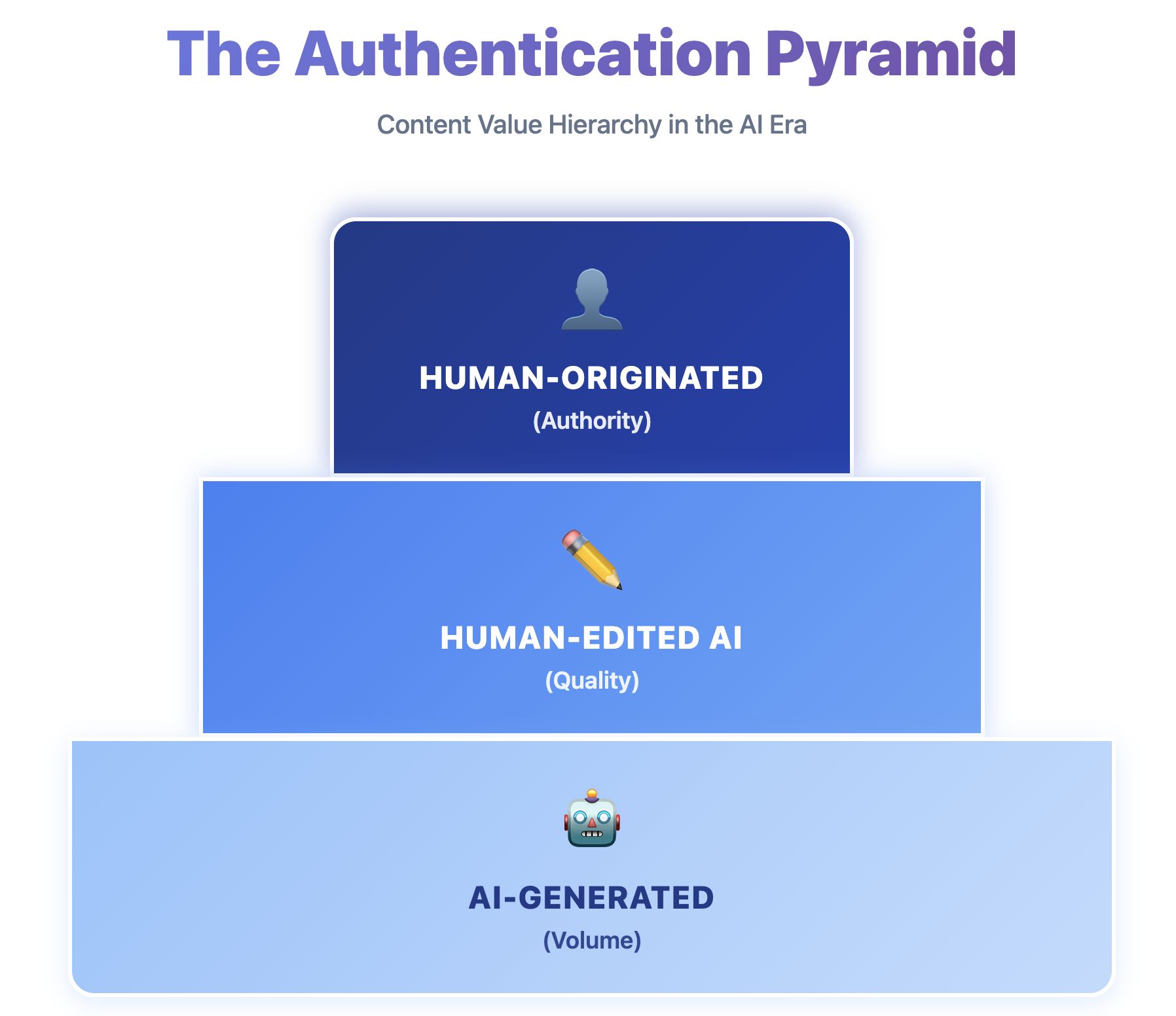
AI can still be helpful, especially for small businesses. It allows fast output without large teams or agencies. But AI doesn't define strategy. At least not yet. That part still belongs to people.
If the goal is brand recognition and networking, content needs to be direct, clear, and human. The question isn't whether to use AI. It's whether AI is using you.
Is there a scenario for good + fast + cheap?
Your brand voice deserves more than recycled patterns, and audiences can sense when content feels automated. The closest path to good, fast, and affordable content comes from combining human judgment with AI support.
Humans decide what matters, set the tone, and define intent. AI helps with execution and iteration. AI carries the load, while people make the calls. That balance turns speed into something useful rather than forgettable.
The winning formula:
- AI handles research synthesis, format variations, and first drafts
- Humans bring strategic direction, original thinking, and final judgment
Case: Hermès Draws a Line Against Automation
Did you know that Hermès redesigned parts of its website using hand-drawn illustrations? This was made intentionally, emphasizing the human touch in a digital environment.
While everyone was using AI for the "perfect content," Hermès chose a different path. In selected campaigns, the brand leaned into hand-drawn visuals, accepted imperfections, and highlighted human presence.
This is the Hermès Principle: strategic imperfection beats algorithmic perfection.
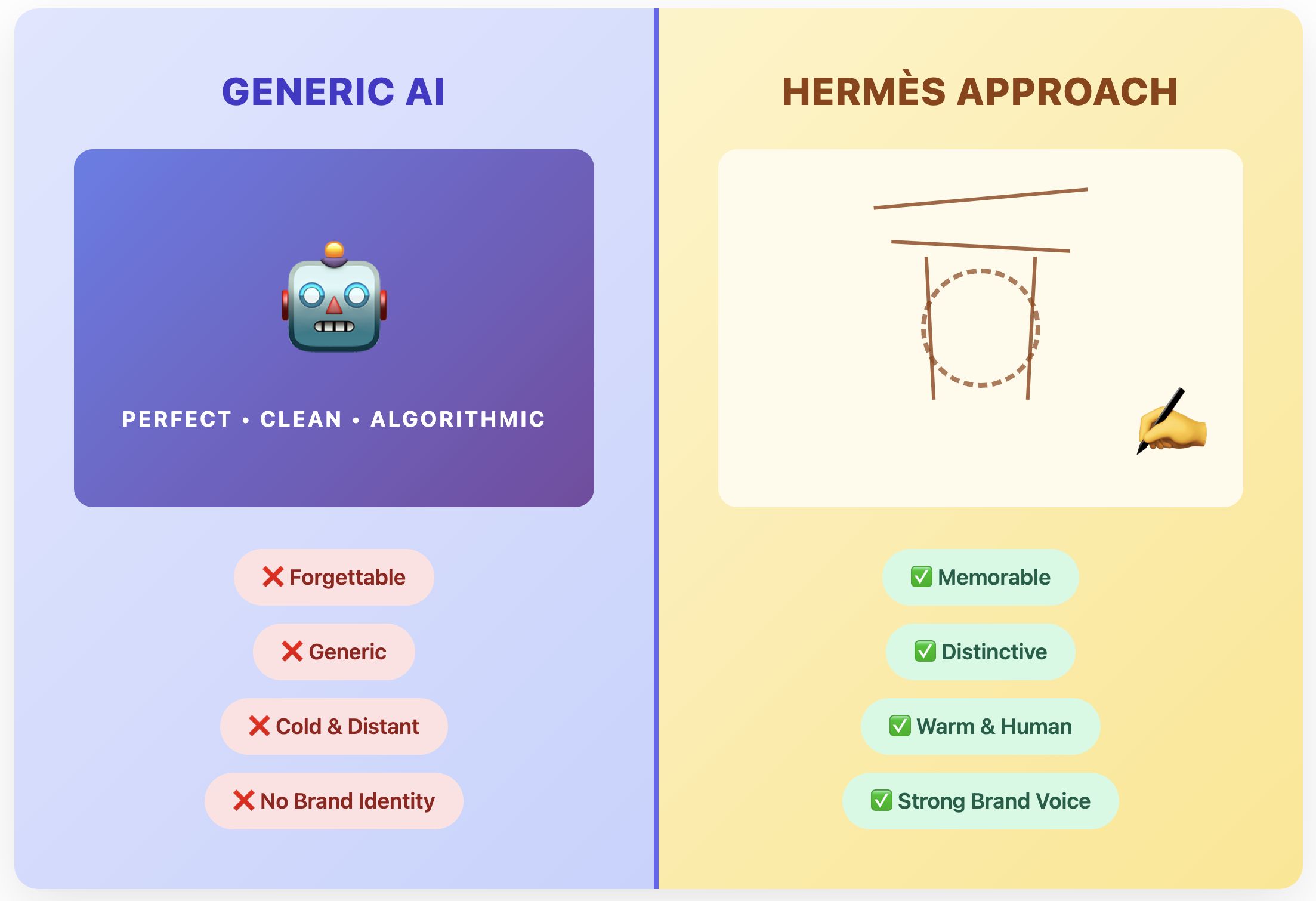
The lesson learned from this is:
As technology develops, real differentiation comes from what only humans can bring. This includes experience, judgment, and meaning.
The Path Forward
The brands that win aren't abandoning AI. They're refusing to let AI abandon them.
Your move: Open your last 5 published pieces. Read them without your logo. Can you tell which company wrote them?
If not, you're already on the slope.