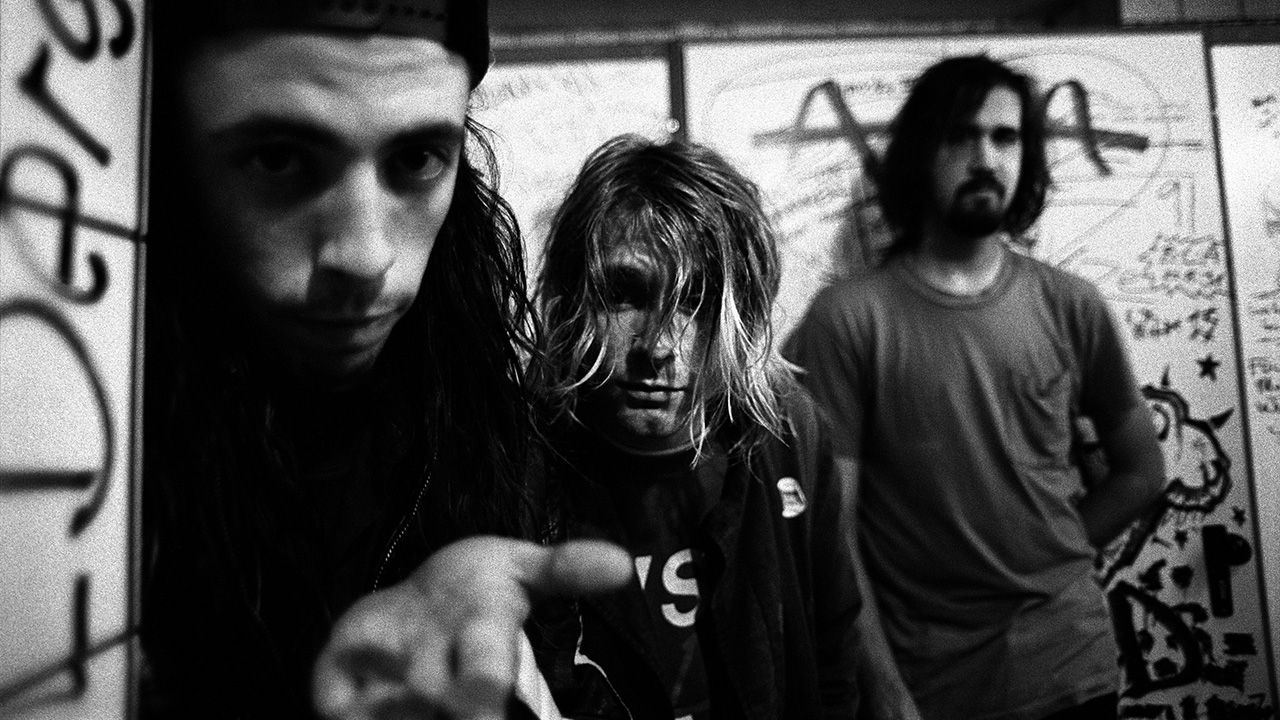
In September 1991, three socially-awkward slacker kids from Seattle changed the world. It’s genuinely difficult to overstate the impact Nirvana had – not just on music, but on popular culture as a whole – when their second album, Nevermind, dropped in the autumn of that year. Not since a certain Liverpudlian quartet had a phenomenon torn through the mainstream with such power; that bandleader Kurt Cobain had formed Nirvana with the idea of “mixing really heavy Black Sabbath with The Beatles” is no coincidence.
Flanked by Krist Novoselic on bass and Dave Grohl on drums (original drummer Chad Channing left after recording their debut album), Nirvana released three studio albums in their seven years together (1989’s Bleach, 1991’s Nevermind, 1993’s In Utero). Along with their MTV Unplugged live album and ‘92 B-sides compilation Incesticide, Nirvana created some of alternative music’s most fundamental touchstones. With the help of their quiet-loud template – which Cobain famously admitted to stealing from The Pixies – they made good on the promise that all you need is three chords and the truth, distilling disaffected teenage angst into art, and influencing everyone from Weezer to Tori Amos and Take That.
“I think Kurt was a great songwriter, because it’s not easy to take something simple and make it sound interesting,” Chad Channing told us in 2016. “If you can put together a song that has three or four chord changes in it and keep people interested, that’s a trick. It’s a trick to make things simple sound good. And one of his best qualities was his writing. Not just musically, but vocally; he had great vocal melody ideas. And that to me is key, in any good songwriting. You can have a really cool-sounding song, but you also need a really good vocal melody. He was really good at coming up with that sort of stuff in Nirvana.”
With all Nirvana’s songs important in their own right, picking out their 30 best was always going to be a struggle. So, we deferred to the wisdom of the public, and asked our readers what they thought. From a long-list of all of Nirvana’s 102 recorded songs, these are the tracks our voters designated the jewels in the band’s crown. As always, there are worthy omissions of songs that just didn’t quite make the cut, but in a back catalogue as influential as Nirvana’s, there just wasn’t space for everything. As our self-appointed judges judge, it turns out teenage angst really did pay off well...
30) Love Buzz
Nirvana covered a whopping 64 songs in their time as a performing band, a dozen of which made it onto record. The band lavished their covers with open-minded innovation, and this version of Shocking Blue’s 1969 album track is no different. Released as Nirvana’s debut single in 1988, the song set out the band’s musical stall, drenching the acid-laced original with fuzzed out guitars and Cobain’s signature drawl – and marked the first time Nirvana were noticed by the UK press when it was made Single Of The Week in Sounds. It also showcased the band’s now famously esoteric tastes, plucked as it was by Krist Novoselic from the back catalogue of an obscure Dutch psych-rock band.
Sub Pop founder Bruce Pavitt told Song Facts about the track: “Kind of a little-known fact about the band is their first appearance in Seattle was actually at the Central Tavern – at this little showcase that they did for us in April of '88 that nobody really showed up for. In listening to their whole set, Love Buzz was the only song that really jumped out, and it was a cover. But, the hypnotic feel of that was kind of an indicator of some of their direction in songwriting. And it's just an incredible recording. They totally nailed it... Nirvana were famous for doing covers. They had good taste. They actively helped educate their crowd as well as promote cool music.”
29) Dive
Allegedly Courtney Love’s favourite Nirvana song on account of its “sexy” qualities, this bass-heavy, rough and ready track from 1992 compilation album Incesticide was originally released as the B-side to 1990 non-album single Sliver, and marked the first time the band would collaborate with Nevermind producer Butch Vig.
“In 1991 Sub Pop included the track on the label compilation The Grunge Years, which – in keeping with its penchant for in-jokes about "world domination" – had a pair of important businessmen doing something resembling a big deal on the cover,” wrote Rolling Stone of the track in 2015. “That compilation's implied irony would come full circle a few months later, when the video for Smells Like Teen Spirit would debut on MTV.”
Bruce Pavitt said of the song’s power: “The arrangements, the minimalism of both Dive and Breed and are very, very hypnotic… You would go into a trance during those tracks in particular. It's one of the things that made their live shows so incredible. They were really stepping into their power at that time – it was a pretty awesome time.”
28) Milk It
It’s widely accepted that Cobain’s songwriting showcased a knack for teasing out the ‘pretty’ lurking within even the gnarliest of tunes. But that approach was all but abandoned with this In Utero album track, which went heavy on relentless noise rock, with Cobain himself using it as an example of the more experimental tack the band’s music began to take in the lead up to the In Utero sessions.
Nirvana biographer Michael Azerrad noted in his 1993 book, Come As You Are: The Story Of Nirvana, that: “The Beatlesque Dumb happily coexists beside the all-out frenzied punk graffiti of Milk It, while All Apologies is worlds away from the apoplectic Scentless Apprentice. It’s as if [Cobain] has given up trying to meld his punk and pop instincts into one harmonious whole. Forget it. This is war.”
Novoselic agreed with sentiments that the song played on the band’s “arty, aggressive side”, telling Rolling Stone of the track in 2013: “The aesthetic [was] like the beautiful orchids, and then there's this raw meat around them. It's the same thing. Dumb is a beautiful song. All Apologies is really nice. And then there are songs like Milk It that are completely wicked. There is something for everybody on [In Utero], although it's not for everybody.”
27) Radio Friendly Unit Shifter
Starting off life under the name Nine Month Media Blackout, this song was a fiery, tongue-in-cheek retort to a Vanity Fair article about Cobain and his wife, Courtney Love, which Cobain deemed to be such a cynical hatchet job – the sole intention of which was to shift magazine units – that he threatened to split up Nirvana in order to protect Love’s reputation. Instead, the band went on a media hiatus for the following months, where interviews where scarce. It’s a bold move to open a song with this title with a wall of squalling guitars and ear-splitting feedback, but then Nirvana were a bold band, and Cobain clearly enjoyed the mischievous juxtaposition.
In Gillian G. Gaar’s 33 1/3 book on In Utero, she writes: “Radio Friendly Unit Shifter was titled both You Said A Mouthful and Nine Month Media Blackout on the tape box, and elsewhere was referred to as Four Month Media Blackout (though while interviews with the band were limited from 1992 on, there was never any official media blackout). A ‘Radio Friendly Unit Shifter’ refers to songs that are both accessible and strong sellers – a hit single, in other words. In any case, the lyrics don’t really reflect any of the titles, and are more reflective of what Cobain insisted was his usual songwriting method – stringing together lines he found in his journals. But there are more than a few lines that hint at a more personal meaning. There’s a pointed reference to privacy, as well as the childbirth imagery (‘my water broke’). And the desperation of the chorus, which repeatedly begs to know what’s wrong, is matched by a bridge that expresses a measure of hopefulness – find where you belong, and the truth shall set you free.
"The song begins with a wailing guitar note, then, as Novoselic admits, ‘There’s just one riff through the whole song! I pretty much just play the same riff through the whole song.’ Nonetheless, the song’s propulsive energy is undeniable, and through Novoselic calls the title ‘cynical, sarcastic,’ there’s also some truth in it – the song has a catchiness that is accessible (something the group recognised by opening virtually every subsequent show with the song). Tellingly, the song didn’t get its final title until after the band’s label had told the group that the album wasn’t ‘radio friendly’ enough.”
26) Serve The Servants
Kicking off In Utero with a blast of discordant noise was a clear a statement that Nirvana could make that their first post-superstardom album was to be precisely as visceral and challenging as anything that came before it. Much has been made of the lyrics of this song, which discuss Cobain’s childhood and take aim at his absentee father. They’re said to be some of Cobain’s most personal writings. He denied that, of course, telling The Observer in 1993 that “For the most part, In Utero is very impersonal.”
But as Michael Azzerad noted in Come As You Are...: “Serve The Servants also contains a very direct and personal message to Don Cobain that will be heard from Iceland to Australia, from Los Angeles to London. ‘I tried hard to have a father, but instead I had a dad, I just want you to know that I don’t hate you anymore, there is nothing I could say that I haven’t thought before’. The second line is a rather cruel thing to say – that Kurt won’t tell his father what he really thinks of him. The lines got put in at the last minute. ‘They just happened to fit really well’, says Kurt.
“‘I just want him to know that, that I don’t have anything against him anymore. But I just don’t want to talk to him because I don’t have anything to share with him. I’m sure that would probably really upset him, but that’s just the way it is.”
25) Polly
Despite earning its place as Bob Dylan’s favourite Nirvana song, this gently sinister Nevermind album track has become one of the more controversial and misunderstood songs in the Nirvana canon. Based on the grisly true story of a young girl abducted after leaving a rock show in Seattle, you can see why the story disturbed Cobain enough to inspire him to commit it to song – having been snatched from a show on his home turf, the girl was then said to have been held captive in the perpetrator’s mobile home, suspended upside down, raped and tortured with a blowtorch, only managing to escape when her tormentor stopped for gas.
However, the confusion surrounding the song grew from the fact Cobain chose to tell the song’s story from the perpetrator’s point of view, leading some to accuse him of glamourising the crime, or, worse, assuming he had a sort of sympathy for the assailant – despite the fact it was written at a time when Cobain was actively exploring feminist ideas with help from his then-girlfriend, Bikini Kill founder Tobi Vail. The tensions came to a head when Cobain learned two men had raped a woman while singing the song’s lyrics at her, leading Cobain to write in the Incesticide liner notes: “At this point I have a request for our fans. If any of you in any way hate homosexuals, people of different color, or women, please do this one favor for us — leave us the fuck alone! Don’t come to our shows and don’t buy our records. Last year, a girl was raped by two wastes of sperm and eggs while they sang the lyrics to our song Polly. I have a hard time carrying on knowing there are plankton like that in our audience.”
24) On A Plain
This Nevermind album track is one of the best examples we have of Cobain’s often ramshackle approach to songwriting. The hooks are sturdy but infectious and dripping with poppy sheen, Grohl joining Cobain on an upbeat dual-harmony chorus. But the chaotic, thrown together lyrics – complete with the ‘I start this off without any words’ opening gambit – seem to affirm the fact they were, apparently, written in five minutes before being hastily recorded as the final instalment in the Nevermind sessions. Still, it didn’t harm the song any, confirming Grohl’s assertion that nailing a killer melody was always Cobain’s prime concern (“music comes first, lyrics come second”).
What’s more, Cobain’s sometimes indecipherable lyrics often only added to the weight of the song, allowing room for listeners to add their own interpretations and meaning. Telling British journalist Jon Savage in 1993 that the song was about “classic alienation, I guess,” he also added: “Every time I go through songs I have to change my story, because I’m as lost as anyone else… For the most part, I write songs from pieces of poetry thrown together. When I write poetry, it’s not usually thematic at all. I have plenty of notebooks, and when it comes time to write lyrics, I just steal from my poems.”
“In a lot of ways it parodies the person Cobain became,” wrote Mike Powell for Rolling Stone in 2015. “A junkie too lost in his own pain to realise he has control over it, the voice of a generation wondering what the hell he's trying to say.”
23) Scentless Apprentice
Grohl brought this shamelessly Seattle riff to the table, with Cobain telling Michael Azerrad in Come As You Are… that “it was such a cliché grunge Tad riff that I was reluctant to even jam on it… I just decided to write a song with that just to make him feel better, to tell you the truth, and it turned out really cool.”
The second track on In Utero, with Cobain’s shredded vocals and its impenetrable bursts of thick, squalling distortion, made clear of the band’s intentions to make their third, and ultimately final album quite unlike anything that had come before it. It shifted the focus onto spontaneous, unapologetic noise rock, upping the lo-fi dirge and unpredictable song structures, and purposefully left the radio-friendly, globally-embraced sounds of Nevermind for dust. But, Cobain being Cobain, he managed to sneak a ton of hooks in under the surface, too.
Inspired by Patrick Süskind’s 1985 novel Perfume: The Story Of A Murderer, in which a Parisian apprentice perfume maker is born without any scent of his own, but with a highly developed sense of smell, which leads him to feel alienated by the general population (and kill a load of women as a result), Cobain admitted to resonating with at least one part of the story: “I felt like that guy a lot,” he told Azerrad. “I just wanted to be as far away from people as I could – their smells disgust me. The scent of human.”
22) Sappy
One of the few songs which was written into Nirvana folklore long before it was properly released, this is about as close to a Nirvana deep-cut as you’re likely to get. Versions of this track have been knocking around since as long ago as 1987, before it was officially released as part of AIDS benefit compilation album No Alternative in 1993. Legend has it that Nirvana recorded versions of this song at each of the recording sessions for their three albums, only for Cobain to reject it from the final cut every time.
The final version’s producer, Steve Albini, stated it was left off In Utero’s finished version thanks to the multiple failed attempts meaning the song “wore out its welcome on the band, apparently”. So, he Albini-fied the whole thing: shifted its key, cranked the tempo up, and finally its official version was born.
Novoselic told Gillian G. Gaar in In Utero that “We liked to play the song… Something just drove Kurt to keep busting it out. He had some kind of unattainable expectations for it.”
It quickly became a frequently requested song once it received an official release, particularly on the band’s final 1994 tour.
21) Something In The Way
If at least three of your schoolmates didn’t have “It’s okay to eat fish because they don’t have any feelings” daubed onto their rucksacks in Tippex, did you even go to school in the 90s? This Nevermind finale became an anthem for the angstiest of teens across the globe upon its release in ‘91, with its gloomy acoustic guitar, slow tempo, maudlin strings and bittersweet harmonies telling the story of Cobain’s time sleeping under a bridge in Aberdeen.
In Come As You Are…, Michael Azerrad notes: “[Nevermind producer] Butch Vig says that Something In the Way – written just a week before it was recorded – was probably the most difficult song on the album to record. They tried it a few times with the rest of the band playing along, but it didn’t really work. Finally, Vig called Kurt into the control room and asked how he thought the song should go. Kurt sat down on the couch with his nylon-string acoustic guitar and sang the song in a barely audible whisper. ‘Stay right there,’ Vig said as he dashed out to the office and told them to turn off every phone and every fan and every other machine in the whole place. Vig recorded the song that way.” The rest of the band cut their parts later on.
While the Nevermind cut is the no doubt song’s definitive version, the acoustic version on MTV Unplugged In New York, with all its crackling, intimate intensity, is a worthy contender.
20) Frances Farmer Will Have Her Revenge On Seattle
This In Utero loud-quiet, slow-build masterclass tells the true story of poorly-treated 30s actress Frances Farmer, the song’s protagonist apparently chosen for the similarities Cobain saw between her and his wife, Courtney Love. Much like Radio Friendly Unit Shifter, the song is unapologetically rife with thinly-veiled jabs at Vanity Fair writer Lynn Hirschberg; the journalist responsible for the unflattering profile of Love that almost drove Cobain to abandon his band.
In Everett True’s Nirvana: The True Story, he notes: “The brilliantly titled Frances Farmer Will Have Her Revenge On Seattle – inspired by the celebrated story of the Thirties film star, institutionalised after she rebelled against her studio’s star system, and subjected to electroshock treatment – boasts an opening bass line that unconsciously echoed the minimal, spooked sound of Young Marble Giants. It’s an uncomfortable song. Kurt saw parallels between the way the actress was demonised by the mainstream press and the media’s treatment of his wife. ‘The conspirators are still alive and well in their comfortable, safe homes,’ Kurt wrote in his journal. ‘Gag on her ashes. Jag on her gash. Uh, God is a woman and she’s Back in Black.’”
“Before Cobain had lyrics for it, it was an instrumental the trio jammed on in Dave Grohl's basement sometime before In Utero,” wrote Kory Grow for Rolling Stone in 2015. "Grohl has said: ‘When I heard Frances Farmer, I thought, Oh, my God, there's going to be another record.'”
19) Sliver
We at Louder predict that this placing will rankle a few fans, given that this is one of Nirvana’s most jubilantly gleeful pop songs – musically at least – and has become a firm fan favourite. What was perhaps seen as a throwaway, simple pop-punk tune at the time has taken on a life of its own, and was one of Cobain's favourite Nirvana songs, with him noting he “wanted to write more songs like that”. Released as a single on Sub Pop in 1990, while the band was between drummers, it’s the only recorded track to feature Mudhoney drummer Dan Peters behind the skins.
Everett True wrote in his review of the song for Sounds in 1990 that: “It surprises me that lesser critics are taken in by the seeming slothfulness of bands like Nirvana, and mistake it for some kind of attitude problem, or laziness. Sure, that on its own isn’t an excuse for anything, this the band have so many fucking tunes lurking underneath their outer shell it’s damn near impossible not to trip over them as they flood out of the speakers. Take Sliver, for example. Sure, the vocals are lazily throat splitting, the guitars belligerently grungy, the bass up and out of the place… but check the melodies, damn fools, check the melodies.”
Lyrically, the song is said to channel one of Cobain’s childhood experiences, telling the story of a child who’s left with their grandparents for the evening when his parents go “to a show”, and is defined by its snotty, repetitive ‘Grandma take me home’ chorus.
18) The Man Who Sold The World
Nirvana’s take on this dark, H.P. Lovecraft-inspired David Bowie number, as performed on the MTV Unplugged In New York album, is another prime example of Cobain’s keen ability to take a song and transform it into something else entirely. You can see why the song appealed to Cobain: like so much of his own work, Bowie’s lyrics tap into feelings of social and emotional isolation. Cobain's version shifts in key, but preserves the quintessentially glam arpeggiated bass sequence of Bowie’s ‘70s original, while Cobain trades his eerie synths for mournful acoustic guitars. The song became a live favourite following its release, and Cobain ranked The Man Who Sold The World at number 45 in his now-famous list of his top 50 albums discovered in his journals.
The band discovered this track through original drummer Chad Channing, who told Everett True in Nirvana: The True Story that: “I kind of turned them onto David Bowie. I found a copy of The Man Who Sold The World in perfect vinyl condition that I recorded on to tape and played in the car. Kurt was like, ‘Who’s this?’”
In Nirvana: The Chosen Rejects, by Kurt St Thomas and Troy Smith, Bowie talks warmly about the cover: “I was simply blown away when I found that Kurt Cobain liked my work, and have always wanted to talk to him about his reasons for covering The Man Who Sold the World… it was a good straight forward rendition and sounded somehow very honest. It would have been nice to have worked with him, but just talking with him would have been real cool.” However, in Nicholas Pegg’s The Complete David Bowie, Pegg reports years of misunderstandings as having soured his opinion somewhat: “Kids come up afterwards and say, 'It's cool you're doing a Nirvana song.' And I think, 'Fuck you, you little tosser!’”
17) Negative Creep
One of a small number of songs on this list to make it in from Nirvana’s debut album, Bleach, is its nihilistic standout Negative Creep: a riff-driven stomper condensed into three minutes of snarling, dirgy grunge. Dubbed the “Sub-Poppiest grunge song ever written” by Chuck Crisafulli in his 1996 book Teen Spirit: The Stories Behind Every Nirvana Song, the reference to Mudhoney’s Sweet Young Thing Ain’t Sweet No More clearly didn’t evade many. The lyrics were some of the first explicitly spell out Cobain’s preoccupation with being an outsider, social isolation and alienation.
“Negative Creep is a first-person narrative from an anti-social person,” writes Azerrad in Come As You Are. “‘I’m a negative creep and I’m stoned,” goes the chanted chorus – the kind that hangs out on the smoker’s porch, scowling and sporting long greasy hair and black T-shirts touting dubious metal bands. According to Kurt, that person is himself. ‘I just thought of myself as a negative person’ is his simple explanation.”
Josh Homme told Rolling Stone in 2014: “The first time I heard Bleach, I remember turning to my friends and saying, "We gotta start writing better songs." Listening to Negative Creep and School and Love Buzz, I thought there were three different singers in the band. It was a total perspective-changer – it definitely ripped a sheet of paper off of my mental notepad.”
Buzz Osborne of Melvins also told MP3.com in 2011, “I think I like this riff of theirs more than any other.”
16) Rape Me
“It’s an anti – let me repeat that – anti-rape song,” said Cobain of this track in 1993. “I got tired of people trying to put too much meaning in my lyrics – it was beginning to not make any sense, so I decided to be really blunt and bold. I just thought it’s kind of a funny just reward for a guy who rapes a woman, violates her, and then he goes into jail and gets raped. I think it’s kind of a justice.”
One of In Utero’s crowning glories, Cobain began work on Rape Me when the band were wrapping up their Nevermind sessions, so it makes sense that this song – and its obvious similarities to a certain worldwide number one – is about as close as the band ever got to recapturing that era again.
Of course, despite Cobain’s intentions to be as clear about the song’s misogyny-bating message of female empowerment as possible, it was scrutinised by many and misunderstood by some – the eventual result that, at some point down the line, the song’s name briefly got changed to Waif Me.
In Nirvana: The True Story, Everett True offers an alternative explanation for the song – that it was an attack on the relentless media attention he was struggling with as his music continued to take over the world – the effects of which he eventually referenced in his suicide note: “Kurt started writing its caustic lyrics while the band were still mixing Nevermind – the sweet guitar motif merely served to add poignancy to the song’s dark message to all the fans, the record industry people, the media who Kurt perceived as wanting a part of him.”
15) Pennyroyal Tea
Despite being written around the same time as Nirvana started writing for Nevermind, and debuted at the same show as Smells Like Teen Spirit made its first live appearance, this song didn’t appear on record until its final version was included on In Utero. Like the elusive Sappy, it was another track Cobain was perpetually unhappy with, telling Rolling Stone in 1993 that Albini’s final version still didn’t make the grade: “[It] was not recorded right. There is something wrong with that. That should have been recorded like Nevermind, because I know that's a strong song, a hit single.” Due to be released as the third single from In Utero in April ‘94, the single was pulled following Cobain’s death in the same month – making its plaintive ennui all the more poignant.
Gillian G. Gaar writes in In Utero: “The verses convey a profound sense anomie, with each one mentioning some ailment or at the very least disaffectedness (as in the second verse’s wonderful longing for a ‘Leonard Cohen afterworld’). The final verse, with its references to warm, laxatives and antacids, touches on Cobain’s well-documented stomach problems, which caused him pain throughout much of his life, but were never properly diagnosed… The song’s title refers to a home abortion method, though the lyric extended what Cobain called its ‘cleansing theme’ to a hope it would wash away one’s inner demons, in addition to being a means of eliminating something that was ‘in utero.’ And while the song has the Nirvana formula of quiet verses/loud choruses, Cobain’s vocal during the chorus still has a lugubrious feel… This element was something that would be even more apparent in the Unplugged performance of the song.”
14) About A Girl
Apparently written about Cobain’s dysfunctional relationship with an ex-girlfriend (‘I take advantage while / You hang me out to dry’), this Bleach album track went widely unnoticed until it was chosen as the only single to be released from MTV Unplugged – AKA, the first single the band released following Cobain’s death (as he comments as the song begins, “This one’s off our first record... most people don’t know it”). The song – one of Cobain’s earliest forays into pop-based, Beatlesque experimentation – was easily overlooked in an album that was noted for its riff-driven hard rock, but its posthumous release put it in front of a brand new audience. It also provides interesting insight into his lyrical and personal progression – from shitty, juvenile boyfriend to vocal feminist.
“Now, Bleach sounds vibrant and buzzing with melody: it’s an album that’s matured well,” wrote Everett True in Nirvana: The True Story. “Back then only the jangling love song, About A Girl, with its plaintive acoustic guitar intro, stood out… ‘I think Kurt felt nervous about putting About A Girl on [Bleach],’ [producer] Jack Endino told Gillian G. Gaar. ‘But he was very insistent on it. He said, ‘I’ve got a song that’s totally different from the others, Jack, you’ve gotta just humour me here, because we’re gonna do this real pop tune.’’ The question was raised at some point, gee, I wonder if Sub Pop’s going to like this, and we decided, ‘Who cares?’ Sub Pop said nothing. In fact, I think they liked it a lot.’”
13) Where Did You Sleep Last Night
Cobain’s chilling take on this bluesy American folk standard is guaranteed to send a shiver down your spine every time. The closer to the band’s MTV Unplugged set, it's said MTV producer Alex Coletti attempted to get the band to perform an encore, only to be rebutted by Cobain telling her ‘I can’t top that last song’. She acquiesced when she realised he was completely right. The version Nirvana were referencing in their Unplugged session is the one laid down by US blues musician Lead Belly, who Cobain describes on the recording as his and the band’s “favourite performer,” before adding “Oh, yeah, this guy representing Lead Belly’s estate wants to sell me Lead Belly’s guitar for $500,000… I even asked David Geffen personally if he’d buy it for me… he wouldn’t do it,” – perhaps a little barb towards his Geffen Records boss, with whom he shared a sometimes tricky relationship.
“When Nirvana appeared on MTV Unplugged back in 1993, the grunge band’s frontman, Kurt Cobain, delivered a song that to their fans would have been not only fresh in their repertoire but also seemed to come from completely out of the left field,” wrote Tony Russell for The Blues Magazine in 2015. “He was introduced to it by a fellow Seattle musician, Mark Lanegan, who played him Lead Belly’s 1944 recording and other Lead Belly numbers from his collection. The two men, with some colleagues, even recorded an album’s worth of Lead Belly songs. It was never issued, but from those sessions Where Did You Sleep Last Night?made it on to Lanegan’s 1990 album The Winding Sheet. This, in turn, provided a template for Cobain’s Unplugged recording three years later, even down to the sudden shift, about two thirds of the way through the song, from quiet storytelling to impassioned screaming. ‘My girl, my girl, don’t lie to me,’ Cobain almost croons over a jagged acoustic guitar. ‘Tell me, where did you sleep last night?’ His straying lover replies: ‘In the pines, in the pines, where the sun never shines… I would shiver the whole night through.’ It remains a mesmerisingly haunting moment more than 20 years on from the performance; Seattle grunge shading beautifully into Southern Gothic – through the medium of an old Lead Belly song.”
12) Lounge Act
Said by Novoselic to be an ode to Cobain’s former girlfriend, Tobi Vail – the line ‘I'll arrest myself, I'll wear a shield’ referring to the K Records logo Cobain got tattooed onto his arm to impress her – it was from Novoselic’s opening bass riff that the song got its name, reminding the band as it did of the sort of thing you might expect to hear from a lounge band. That’s about as upbeat as you’re going to get here, though, as this song gets increasingly more ferocious as it progresses – both musically, as the last minute devolves into frantic, throaty screams, and lyrically with its focus sharpening on the jealousy and dysfunction of a failing relationship.
In his 2001 book, Heavier Than Heaven: The Biography Of Kurt Cobain, Charles R. Cross suggests that Cobain had composed, but never sent, a bitter letter to Vail about the song in late 1993 – when he was already married to Love – reading: “Every song on In Utero is not about you. No, I am not your boyfriend, No, I don’t write songs about you, except for Lounge Act, which I do not play, except for when my wife’s not around.” Ouch.
“Nirvana have emotion, raw emotion, the sort where the singer bares his soul all the way down the line, and with the use of but a few simple words and phrases, communicates way deeper with the listener than this sort of music is meant to,” wrote Melody Maker in 1991. “Take Drain You and Lounge Act, for example, with the words coming from Kurt Cobain’s cracked, hurt voice almost indecipherable, but dreadfully moving nonetheless. And when he starts screaming, unable to bear whatever demons he sees crushing down on top of him, it’s like your worst nightmares about babies crying and buses crashing and skyscrapers falling come true all at once. Never underestimate the power of a good scream.”
11) Territorial Pissings
‘C’mon people now, smile on your brother, everybody get together, try to love one another right now’ comes Novoselic's crazed drawl, dripping in irony – if there’s a better opener in the Nirvana back catalogue, we want to know about it. Cobain and Grohl had a well documented love for the intelligent, high octane punk rock of bands like Husker Du and Black Flag, and this track – a thrashing punk workout, just shy of 2 and a half minutes long – is the best recorded example of that. Its gleeful, rebellious racket captured the imagination of fans, and it also contains some of Cobain’s best and most-referenced lyrics (try moving 5 ft in Camden market without seeing a T-shirt reading ‘Just because you’re paranoid doesn’t mean they’re not after you’ in the late ‘90s).
“Nirvana made extremely loud statements every opportunity they could get,” writes Shaun Scott in his book A Cultural History Of The U.S From 1982-Present. “Bassist Krist Novoselic began Territorial Pissings with a satirical citation of the Youngbloods’ baby boomer anthem Get Together… Novoselic's interpretation of [that] is the most important part of the song. He distorts the song to make it sound like a piece of bullshit idealism – a hopeless dream, as hippie parents sold out and went corporate just like everyone before and after them. I think the band was saying the carefree times of the 60s are gone, and have left those growing up in the 90s in its wake. ‘Maybe some baby boomers will hear that and wonder what happened to those ideals,’ said Novoselic."
“Territorial Pissings was written within an hour or so,” Cobain told Karen Bliss in ‘91. “I had some ideas and I have a lot of notebooks that I can just use as references, and I can take lines out of it, that was written before. I write a lot of poetry and stuff like that. So I use that stuff. I did take my time on ...Teen Spirit. It took me about two days, but I did write them during the week that we were recording the album.”
10) You Know You’re Right
Cobain’s last known composition, this was one of the final songs recorded by Nirvana at their final studio session on 30th January 1994, as the band prepared to lay down a fourth album. Having been available only via various bootlegged versions, it was finally released as the lead single for compilation album Nirvana in 2002. It’s fitting that this song should serve as the final offering from this remarkable band – it distills all their most cherished trademarks into its three-and-a-half minutes, swaying powerfully between quiet and loud, channelling Cobain’s flourishing sensitivity, and devolving into a distortion-drenched feedback-fest for the final minute.
“Unlike most post-mortem rock releases, You Know You're Right is not B-side material or the result of recording studio wizardry – it's a real Nirvana song that was recorded less than three months before Cobain's famous suicide,” wrote Slate Magazine in 2002. “If his life was a mess, Cobain was at the peak of his powers as a vocalist and songwriter – the most gifted and popular writer that rock music had seen since Lennon/McCartney. You Know You're Right is a defiant movement away from the surface softness of ballads like Dumb and All Apologies that he had written for In Utero and then recorded again – softly, with cellos – for MTV Unplugged. It was a song for the kids who grew up in places like Aberdeen, Wash., the logging town where Kurt was born – kids who slept on friends' couches, listened to Black Sabbath, and found work cleaning floors, just like Kurt did before he became famous.”
But celebrated as the song was, it was also emblematic of another, far uglier aspect which came to define the band’s post-Cobain legacy: that of the growing tensions between the band's remaining members and Cobain's widow, Courtney Love. When Novoselic and Grohl suggested releasing the song as part of a box set, Love, on behalf of Cobain’s estate, blocked the release, suggesting it would be a “waste” of a “potential 'hit' of extraordinary artistic and commercial value”. A bitter, and highly publicised, legal struggle ensued. Eventually, a compromise was reached, but not before relations between the parties had irrevocably soured.
9) In Bloom
The irony that this song – a scathing takedown of what Cobain perceived to be the fair-weather fans his band were attracting from the Seattle underground – would appear on the album that catapulted them into superstardom and beyond hasn’t diminished over the years. With its major key pop hooks and singalong chorus making it one the most accessible songs the band wrote, its brazen cajoling of fans who “like to sing along” but “don’t know what it means” seems all the more audacious. But in retrospect, it’s also a slightly wistful listen: as this song was released into the world, Nirvana’s star began to rise beyond anyone’s control, marking the beginning of the relentless media attention – and frenzied fans – Cobain found so difficult to manage.
“The great unspoken fact of music is how uncomfortable musicians get with their audiences,” wrote Michael Hann for The Guardian in 2016. “It’s not that they don’t want to be admired and recognised – rare is the artist who craves obscurity – but more that once their image is formed in the public mind it becomes a straitjacket, or an iron lung, as Thom Yorke put it. It’s what gives them a livelihood, but it’s also what confines and suffocates them. ‘I always assumed it was written about the distance Kurt felt from his fans, as well,’ says writer Everett True, a friend and frequent interviewer of Cobain. ‘I assumed it was directed towards the fans who would show up at concerts with signs saying Evenflow [a Pearl Jam song] on one side and Rape Me – I think – on the other: the fans who did not understand there was a point of difference between Nirvana and other Seattle bands or media representations of grunge. I’ve always associated the song with [In Utero single] Rape Me. Like they’re a pair.’”
Novoselic also used the song to highlight the changes in Cobain's songwriting between Bleach and Nevermind, pointing out to David Fricke in 2002 that "When we first started playing [In Bloom], it sounded like a Bad Brains song" – miles away from the poppy sheen of Nevermind's final version.
8) Breed
Originally going by the name Imodium, after the specific brand of anti-diarrhoea medication their Seattle pals TAD used on the road, this fast-paced, propulsive attack on Republican, middle class America (‘Even if you have, even if you need, I don’t mean to stare, we don’t have to breed’) is one of Cobain’s many jubilant ‘fuck yous’ to the status quo he found so alien. It's also another classic example of Cobain's ability to take a grunge rock stomper and tease out its lurking inner melody.
In Classic Rock Albums: Nevermind, Charles R. Cross and Jim Berkenstadt write: “The tune was designed to capture the mood of many a middle class teen trapped by fear and apathy. To drive this point home, Kurt sings ‘I don’t care’ five consecutive times within a single-note verse. On Nevermind: It’s An Interview, Kurt described the sentiment of hopelessness conveyed in the song: ‘I was helpless when I was 12, when Reagan got elected, and there was nothing I could do about that. But now this generation is growing up, and they’re in their mid-twenties; they’re not putting up with it.’ Kurt’s sentiments about Reaganism support one rock critic’s theory that no landmark album has ever been recorded when the liberal party has been in power in the Uniter States – that it takes a conservative, status-quo government to drive artists to rebel and craft great rock’n’roll.”
“Breed is old-school Aberdeen,” wrote Everett True in ...The True Story. “It wouldn’t have sounded out of place on Bleach. [Melvins drummer] Dale Crover’s influence is to the fore, as Grohl hammers his way through several skins in support of Krist and Kurt’s battering rhythm. The guitar solo is twisted and atonal, and out of key. ‘I never practice solos,’ Kurt said. ‘For every guitar solo I’ve ever recorded, I’ve always just played what I wanted to at the time and then just picked the best takes.’”
Sub Pop boss Bruce Pavitt told Song Facts of the track: “Breed was very hypnotic and repetitive and trance-inducing… our audiences would become ecstatic. They were experiencing Nirvana. And when you're experiencing really good, primal rock'n'roll, you break into a trance.”
7) Drain You
Perhaps the closest Cobain ever got to writing a proper love song – though in his own typically askew way – this is said to be one of the songs Cobain wrote for Tobi Vail as their relationship began to disintegrate (opening line ‘One baby to another says I’m lucky to have met you’ was allegedly something Vail once told Cobain – other references to their relationship are peppered throughout). Prefacing the bitter dysfunction of Lounge Act, the two songs are generally taken as a pair; Drain You setting up the context of an increasingly difficult relationship, Lounge Act watching it burn to the ground (Cobain’s thoughts on the matter once we reach Stay Away are pretty self-explanatory).
“Hurt and plagued by insecurity, Kurt was in the perfect frame of mind to write more songs,” writes Everett True. “His new numbers were self-indulgent and full of loathing – both for himself and for others, where anyone could make sense of them: angry, petulent and heartbroken. Although it was Kurt who’d broken up with Tobi, he was reacting as if it had been the other way round. The fact the split wasn’t clean increased the misery on both sides. ‘One baby to another says I’m lucky to have met you,’ he wrote in Drain You, touching on the way that love can make its participants feel like they’re children again, such is the feeling and wonder of the awe-engendered.’”
As Cross and Berkenstadt note in Nevermind, Drain You was one of Cobain’s favourite songs: “Despite the success Teen Spirit would ultimately enjoy, Cobain cited Drain You as one song that he preferred as a songwriter, telling Rolling Stone, ‘I think there are so many other songs I’ve written that are as good, if not better, than that song [Teen Spirit], like Drain You.’”
“While I can do a lot by switching channels on my amp, it’s Dave who really brings the physicality to the dynamics,” Cobain told Chuck Crisafulli in 1992 when discussing the song’s power. “Krist is great at keeping everything going along at some kind of even keel. I’m just the folk singer in the middle.”
6) Aneurysm
The B-side to history's most popular grunge single, this gloriously dirgey slice of self-indulgent, gritty grunge-pop was colossally overshadowed by its accompanying A-side until its inclusion on Incesticide the following year. Another song written about Cobain’s former girlfriend Vail – or, if conflicting accounts are to be believed, about Cobain’s worsening relationship with heroin – this was said to be the first time Cobain referenced the relationship in song. You can hear his desperation over the whole situation setting in already, as he shreds his vocal chords over choruses which only increase in intensity as the song progresses – dissolving into pained screams as the final minute mark hits. Despite all the angst, this song's infectious, sleazy hooks make it one of Nirvana's most seductive achievements.
“Aneurysm was one of the first Nirvana songs to address the relationship [between Cobain and Vail], having been written before the break-up,” writes Everett True. “‘Love you so much it makes me sick,’ Kurt pleaded, referring back to the first night he spent with Tobi, unashamed to sound neurotic.”
But Vail herself insisted the song was open to interpretation, telling True: "The songs were confusing… who really knows what they are about? They sound great and some of the imagery is strong, but as far as them being about any one person or thing or situation – it’s not clear, is it?”
“It ain’t Shakespeare, but Aneurysm is Kurt Cobain at his tangled, tortured best – a monument to emotional sickness and depravity, and beloved object of our obsession with the voyeuristic,” wrote SongMango of the track in 2014. “Cobain’s dark, seething artistic voice is deeply personal and reflective, a product of both struggling with – and revelling in – his vulnerabilities, anxieties, immorality and dog-hungry appetite for self-destruction (including a $400-a-day heroin habit). Aneurysm, more than any other song in the Nirvana catalog, captures Cobain’s bedraggled, sullen brilliance: his smouldering, razor-abrasive vocal delivery, his “disheveled junkie” authenticity, and his endearing willingness to bare his soul (track marks and all). Aneurysm gets its name from the artery-swelling medical condition that can be caused by intravenous drug use (among other things)… Whether the song is a brooding ballad to former girlfriend Tobi Vail, or a love-hate ode to heroin, or both, it offers a glimpse inside the mind of grunge’s ‘anti-Rock star’ Rock star.”
5) All Apologies
Perhaps the most vulnerable and beautifully soft song in Nirvana’s back catalogue, it was this track which famously prompted Dave Grohl to tell Harp magazine in 2005: "[This was] something that Kurt wrote on [a] 4-track in our apartment in Olympia. I remember hearing it and thinking, 'God, this guy has such a beautiful sense of melody, I can’t believe he’s screaming all the time.'" Of course, both its proximity to Cobain’s death and its self-effacing lyrics drew many to accept this as Cobain’s most public goodbye.
In Utero producer Steve Albini favoured the track over others on the record, telling Gillian G. Gaar: “’[I really liked] the sound of that song as a contrast to the more aggressive ones on In Utero… it sounded really good in that it sounded lighter, but it didn't sound conventional. It was sort of a crude light sound that suited the band.” Cobain agreed, calling it a representation of “the lighter, more dynamic" sound he wanted Nirvana to adopt in subsequent albums.
“Like Radio Friendly Unit Shifter, the number is deceptively simple, with a single insinuating melodic line played throughout most of it,” writes Gillian G. Gaar in In Utero. “But again, the strength of the performance keeps the song from from sounding repetitive, due in part to the addition of a bittersweet cello line (played by Kera Schaley, the only other musician to appear on [In Utero]).
“Cobain’s lyric and resigned delivery also invest the song with an elegiac quality. In the verses, the singer effectively takes all the problems of the world on his shoulders assuming all the blame, even turning his back on his work, in song that’s wracked with guilt (though Cobain insisted it was ‘a very, very sarcastic song’). As in Dumb, the narrator is caught looking in from the outside, torn between the desire to be included and the urge to maintain the independence of standing alone. It was a conflict Cobain never worked out, and after his death, more than one observer described this song as being akin to a suicide note.”
But Cobain's own feelings towards the song seemed to conflict with the public's subsequent reading. Having dedicated the song to Courtney Love and their daughter Frances Bean Cobain during their turn at Reading Festival 1992, Cobain told Michael Azerrad in ‘93 that: “I like to think the song is for them, but the words don't really fit in relation to us... the feeling does, but not the lyrics. [The feeling is] peaceful, happy, comfort – just happy happiness.”
“Listen to the moving sorry note All Apologies and try denying its effect all these years down the line,” writes Everett True. “‘I wish I was like you,’ sings a jaded Kurt, wanting nothing more than an end to all the shit. ‘Easily amused. Everything is my fault. I’ll take all the blame.’ God, he tried so desperately to believe in Love.”
4) Come As You Are
Even working out this song’s musical lineage is a task in itself – did Nirvana pinch that iconic riff from cult post-punks Killing Joke? Had they, in turn, originally lifted it from The Damned? Listen and decide for yourselves; the real answer, of course, is that it doesn’t really matter – with this track, Nirvana seized on the Zeitgeist they’d fashioned from thin air and ran with it. Sure, ...Teen Spirit lit the fuse, but with Come As You Are the band distilled teen angst and social suspicion with such clarity – the lyrics, Cobain said, being about “people and what they're expected to act like” – that it was with this that the band truly established a place from which they’d change history.
“Come As You Are was another strong yet lyrically confused track,” write Cross and Berkenstadt. “For Nevermind: It’s An Interview, Cobain explained ‘The lines in the song are really contradictory. You know, one after another. They’re just kind of confusing, I guess.’
"The recording, which starts with Kurt’s solo guitar for the first eight seconds, opens with the first verse in a low, moody style, and then the chorus explodes at full volume and locks in the listener. This musical style – dynamic changes between quiet and raucous passages – perfectly complements the conflicting lyrical phrases. It was a style that Nirvana would use on many of their songs.”
It can also, it’s said, be read as an ode to Cobain’s prolonged struggles with heroin addiction. After a campaign ran in 90s Seattle which encouraged heroin users to soak their needles in bleach to reduce the risk of spreading HIV, the tagline of which was ‘If doused in mud, soak in bleach,’ Cobain used it as inspiration for the song’s lyrics. The words ‘As a friend, as a trend, as a known enemy’ seemed to confirm the song’s undertones.
It also prefaced Cobain’s own struggles with his perceptions of how he would ultimately be portrayed by the press, with its pleas to accept people as they are, free of judgment. Cross and Berkenstadt write: “[As] Cobain explained to one journalist, ‘I always knew to question things. All my life, I never believed most things I read in history books and a lot of things I learned in school. But now I’ve found I don’t have the right to make a judgment on someone based on something I’ve read. I don’t have the right to judge anything. That’s the lesson I’ve learned.’ In many ways, Come As You Are represented a newly mature form of songwriting for Cobain, more metaphorical, less direct.”
“Nirvana’s advantage was the songs,” wrote Christopher Sandford in Kurt Cobain. “By the first weeks of 1991 the near-nightly rehearsals in Tacoma had yielded Come As You Are and Smells Like Teen Spirit, both in the accessible mould of Dive and bulging with the promise of mass appeal. ‘We knew that the stuff we were coming up with was catchy and cool and just good strong songs,’ says Grohl.”
3) Heart-Shaped Box
If rumours are to be believed, which they very often aren’t, this furious and haunting In Utero track was in fact written about Courtney Love’s vagina, which gives its original title of Heart-Shaped Coffin a slightly different tilt. Whether or not her genitalia provided its precise inspiration, it is widely accepted that the song was written for Love, originally assumed to be about a heart-shaped box, filled with trinkets and dolls, which Love had given to Cobain before they were married. It was written at a time when Cobain and Love were already firmly ensconced, sharing a writing journal in which they both penned lyrics, and its lyrical style has been said to be largely influenced by Love’s own songwriting – in fact, the title of In Utero itself was lifted from one of Love’s poems.
“Many of the songs Kurt had written in 1992 were affected by his marriage,” wrote Charles R. Cross in Heavier Than Heaven. “As is common in the marriage of two artists, they began to think alike, share ideas, and use each other as editor… Courtney was a more traditional lyricist, crafting tighter and less murky lines, and her sensibility greatly shaped Heart-Shaped Box. She made Kurt a more careful writer, and it is not by accident that these stand as some of Nirvana’s most accomplished works: they were crafted with more intent than Kurt had spent on the entire Nevermind album.
“No song on In Utero ranked with Heart-Shaped Box. ‘I wish I could eat your cancer when you turn black,’ Kurt sang in what has to be the most convoluted route any songwriter undertook in pop history to say ‘I love you’. Like all great art, Heart-Shaped Box escaped any easy categorisation and offered many interpretations to the listener, as apparently it did to its author.”
“Cobain wrote the song in early ‘92, but but then had trouble developing it with the band,” writes Gillian G. Gaar in In Utero. “Before putting it aside for good, he decided to have the band jam on it once again and this time it came together, ‘instantly,’ Cobain said.
“Heart-Shaped Box was the Nirvana formula personified, with a restrained, descending riff played through the verse, building in intensity to the cascading passion of the chorus. Cobain told Azerrad the song’s ‘basic idea’ was about children with cancer, a topic which made him unbearably sad. But while the song does reference the illness, the lyrics appear more to address the physical and emotional dependencies inherent in relationships. The imagery is particularly striking, with phrases like ‘tar pit trap,’ ‘meat-eating orchids,’ and ‘umbilical noose’. That these female symbols each hold a potential danger means they all convey a fear that ultimately equates intimacy with a suffocating claustrophobia.”
2) Lithium
‘I’m so ugly, that’s okay ‘cos so are you...’ the third single to be released from Nevermind, Lithium’s awkward, insular tale of a man who turns to religion as an escape from depression carried the band's buzz from two-hit wonders to bona fide, world-conquering rock stars. Its soft verses and chaotic choruses perfected upon the loud-quiet template, and it produced not just some of the band’s most iconic lyrics, but also Nevermind’s true outsider anthem – but it took a while to get there.
“The recording session for Lithium was one of the most arduous for Butch and the band,” say Cross and Berkstadt in Nirvana – Nevermind. “The lyrics are filled with images of Kurt’s past, appropriate for a song named after a prescription antidepressant. The protagonist struggles with themes of happiness, insecurity, loneliness, religion and sanity throughout. It was one of the few songs that Cobain would admit he worked hard to complete, approaching it with a greater concern for meaning than other work. ‘[It’s] just a story that I made up,’ he told Patrick MacDonald in 1991. ‘It was one of the songs I actually did finish while trying to write it instead of taking pieces of my poetry and other things. Not only was it a hard song for Kurt to write, it also provided one of the biggest struggles during the recording of Nevermind. Despite the stress and adversity involved in completing this song, the session would yield a song called Endless, Nameless.”
“Kurt wanted to be able to play the guitar very… not methodical,” says Nevermind producer Butch Vig. “It needed to have this space – it had to be relaxed. We’d get a sound for the verse and then work on the chorus sections.”
“Lithium is pure genius with its Big Muff fuzz sound and dark call-to-arms about turning to religion when all else fails,” writes Everett True. “‘In the song, a guy’s lost his girl and his friends and he’s brooding,’ Kurt explained – clearly reflecting his own state of mind. ‘He’s decided to find God before he kills himself. It’s hard for me to understand the need for a vice like that,’ he added, conveniently forgetting his own fondness for heroin, ‘but I can appreciate it too. People need vices.’
“It was during a take of Lithium, where Kurt got so frustrated at his own ability to get his part right that he smashed his guitar on the studio floor, that Vig left the mic running and used the resulting noise as a bonus track, Endless Nameless – put on the finished version of the album, hidden at the end… ‘A cool, loud prank,’ according to Novoselic. The methodology of the song’s inclusion was partly inspired by Kurt’s old friend Jesse Reed: back when the pair were sharing a flat in Aberdeen, Kurt recorded himself one time saying, ‘Jesse… Jesse… I’m coming to get you,’ towards the end of a blank 90-minute cassette. Just as Jesse was about to go to bed, Kurt put the tape into the stereo and pressed ‘play’...”
1) Smells Like Teen Spirit
Okay, okay, we know: topping a list like this with Teen Spirit is boring and predictable and pedestrian – but it’s also the only result that makes any reasonable sense. If we tasked you with naming a song which has bettered – or even matched – the profound effect this one song had on musical history since it was released in 1991, our money says you wouldn’t be able to do it. So for it not to take its place here, as the singularly definitive song to be released by Seattle’s favourite sons, would be misguided at best. It’d also be downright wrong.
The unexpected success of Smells Like Teen Spirit didn’t just make stars of Nirvana, but lit a fire under all of Seattle’s alternative music scene. Seemingly overnight, the goalposts of the mainstream shifted to make space for this messy, awkward, anti-everything trio and all they represented, including the scene they dragged along with them. Record labels were suddenly clamouring to sign alt.rock bands and release their records in the hopes of stumbling across another Nevermind. It’s not hyperbolic to state this record changed everything.
As expected, folklore has all but re-written the story of Teen Spirit. Famously gaining its title from graffiti daubed on Cobain’s wall by Bikini Kill founder Kathleen Hanna (she spraypainted ‘Kurt smells like Teen Spirit’ on his bedroom wall – Cobain, misinterpreting it as some sort of revolutionary slogan, didn’t realise she was referring to the Teen Spirit deodorant her bandmate Tobi Vail used until months after its release), the song became an anthem for apathetic kids of Generation X and beyond. It seemed to spin opaque stories of bored, self-destructive youth, entertaining themselves into oblivion in America’s forgotten suburbs. But, like much of the material that made it onto Nevermind, the song was actually written about Cobain’s ex-girlfriend, Vail.
“Of course, there was Smells Like Teen Spirit with its famous ‘Over-bored and self-assured’ reference to both Tobi and Kurt’s personalities,” writes Everett True. “‘Boredom: the desire for desires,’ as Russian philosopher Leo Tolstoy once wrote. What was there to do in life, now that the adults had grabbed all the fun adolescent stuff for themselves? No point growing up, that’s a crock... The original draft of Teen Spirit included a line later picked up on by his future wife Courtney Love, used to highlight her status as Rock Royalty with her husband – ‘Who will be the the king and queen of the outcast teens?’ Clearly, it was intended for Tobi.”
But the song took on a life of its own, thanks to an initially reluctant US rock radio. Assuming the track would put off daytime listeners, they agreed only to broadcast it during the nighttime slots. The track soon became one of the most requested songs on the radio. The rest, as they say, is history.
“I remember listening to Teen Spirit after Kurt did the vocals,” Novoselic told Charles Cross. “I said to myself, ‘Whoa, this is really raw.’ There was a lot of energy there.”
Ultimately, along with overwhelming success Nevermind brought, the song became a burden for Cobain. “I don't even remember the guitar solo on Teen Spirit,” he told Rolling Stone in 1994, after they quizzed him about his refusal to play it live. “It would take me five minutes to sit in the catering room and learn the solo. But I'm not interested in that kind of stuff. I don't know if that's so lazy that I don't care anymore or what. I still like playing Teen Spirit, but it's almost an embarrassment to play it.”
- RELATED READING: The 10 worst Nirvana songs