So, as the smart glasses guy on the Tom’s Guide team, my main beef has always been with the Nintendo Switch just making things awkward with its video out on the USB-C connector.
With literally any other gaming handheld, it’s a seamless dream — plug your AR glasses in, and see the picture in front of your eyes. The Switch (and Switch 2) requires jumping through hoops of tricking your console into thinking it's in docked mode to bypass the complicated encryption.

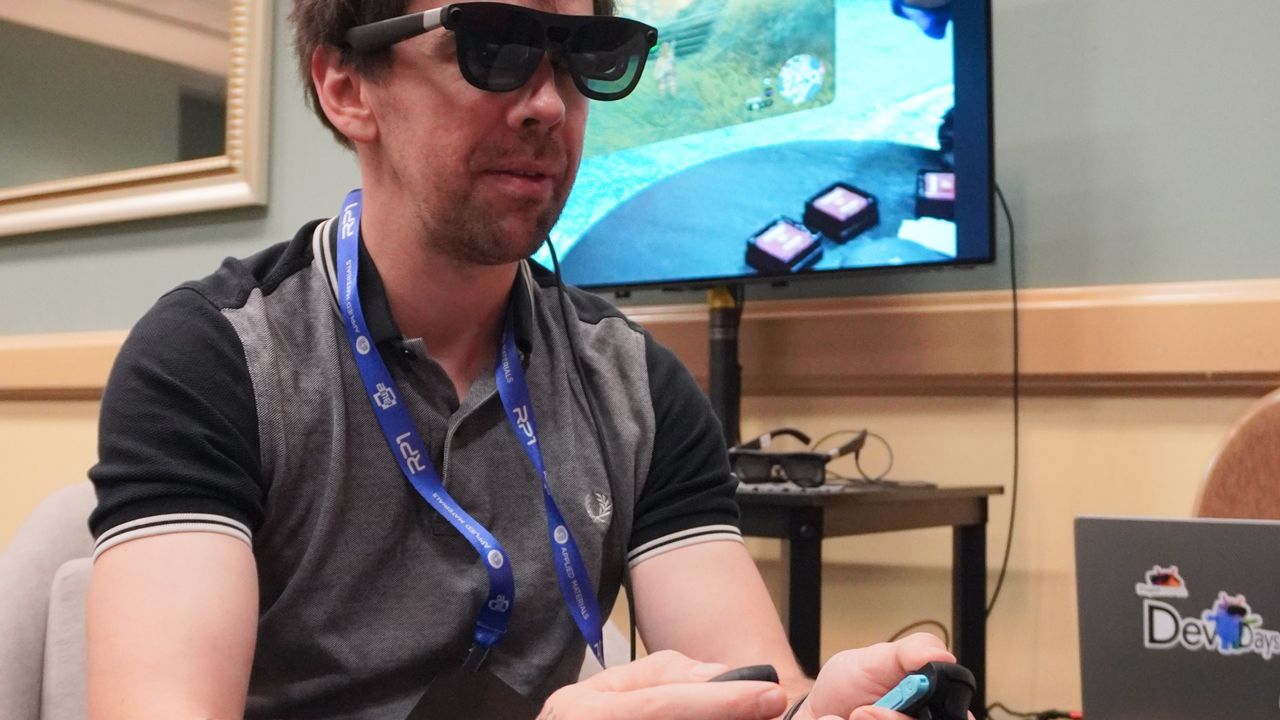
Well, when I tested Xreal Aura some more here at AWE 2026, the team literally mentioned in a passing conversation that they’d cracked Switch compatibility in Android XR. Before they could say another word about local AI, I stopped the talk in its tracks and asked for a demo.
And hot dang, they did the thing! Not only is there full Switch support over USB-C, but with no real noticeable latency, and you can use Gemini to ask questions about the games you’re playing!
Fixing the problem with brute force
So the problem is one of compatibility and protocols (boring, I know). 99% of the market uses DisplayPort Alt Mode through that USB-C socket, which natively supports just plugging the glasses straight in. Meanwhile, Nintendo is using Mobility DisplayPort (MyDP) — a standard that was typically used with micro-USB ports back in the day. Why? God knows.
For years now, the fix has been something like the Viture Switch Dock: trick the Switch into thinking it’s in docked mode via a big battery pack to keep it alive at higher wattages and simulate an HDMI connection.
And now, a simple USB-C connection into the Aura’s compute puck does the trick… “HOW!?” I excitedly asked Qualcomm’s team, to which they couldn’t help but chuckle and give me cheeky grins.
Truth is, they can’t tell me exactly how they did it, so all I can do is theorize. You’ve got a strong, open, and versatile development platform like Android XR, paired with a monster spatial computing chip in Snapdragon Reality Elite. I think it’s not too much of a stretch to assume that this high-performance chip is able to transcode that signal in real-time in a well-written Android XR app.
What does it feel like to play?
One common issue with this workaround for the current Switch docks for AR glasses is latency. It’s not terrible, but it can be noticeable in faster titles. None of that exists here, and in my time playing Zelda, it all felt nicely responsive.
On top of that, given it’s a floating window within Android XR, there’s the Gemini Live edge too! Fire it up, look at your screen, and ask away — Gemini was quick to let me know where to go next in the forest.
That is a real value-unlocker vs going to GameFAQs for the answer I need to get ahead in my gameplay whenever I’m stuck.
Take that, Nintendo!
Yes, I know the Switch 2 is great and everything, but this whole USB-C compatibility issue is a pet peeve I’ve been super vocal about for a long time now! Whether it’s so that Nintendo can make its own AR glasses, I don’t know. But the fact that I can’t save myself from neck pain playing the damn thing on long-haul flights seems crazy to me when it’s literally the easier (and better) standard to support.
However, with some brute force of Snapdragon Reality Elite and some coding know-how in Android XR, that’s no longer a problem, and not only that, it’s latency-free compared to the other workarounds we’ve seen.
Low key, this is the biggest winning feature I’ve seen for Xreal Aura. I know there’s so much more to talk about here in what Android XR can do in an optical see-through (OST) environment vs a VR headset, and Gemini’s capabilities in spatial computing. But to 1-UP Nintendo’s limitations? You just love to see it.
More from Tom's Guide
- I went eyes-on with Snap Specs and saw Evan Spiegel wear them — they look way better than I feared, but there's one massive comfort flaw
- I just tested the phone everybody thinks is a preview of the iPhone Fold — God, I hope they’re wrong
- 'No one has a crystal ball': Lexar execs have a plan to reduce our RAM dependency if the AI data boom lasts 'for years'