The UK terrorism threat level has been raised to “severe” in the wake of the Golders Green stabbings, meaning a terror attack is “highly likely”.
The Joint Terrorism Analysis Centre announced the decision on Thursday, the day after two Jewish men were stabbed in north London and in the wake of a spate of attacks in Jewish neighbourhoods in recent weeks.
The body, which is based in MI5 but makes independent assessments, previously set the threat level at “substantial”, meaning an attack was “likely”.
The decision is not solely a result of the Golders Green attack, the Home Office said, adding that the terrorist threat level in the UK has been “rising for some time, driven by an increase in broader Islamist and extreme right-wing terrorist threat from individuals and small groups based in the UK”.

It also comes against a backdrop of “increased state-linked physical threats which is encouraging acts of violence, including against the Jewish community”, it added.
Head of Counter Terrorism Policing Assistant Commissioner Laurence Taylor said officers have seen an “elevated threat” to the Jewish community.
Speaking outside New Scotland Yard, he said: “Our casework is increasing across a number of ideologies, and within that, we are seeing an elevated threat to Jewish and Israeli individuals and institutions in the UK.
“We’re also working against an unpredictable global situation that has consequences closer to home, including physical threats by state-linked actors.”
The senior officer declined to comment on a Channel 4 News report that the suspect – named earlier as Essa Suleiman – left a psychiatric hospital run by South London and Maudsley NHS Foundation Trust in recent days.
Asked about whether a major London pro-Palestine demonstration planned for next month will be allowed to go ahead in light of the heightened threat level, he said: “As part of our review into the change in the threat level, policing will be reviewing all events across the country.
“My teams will be working with forces to ensure that we have appropriate protective security measures in place, that the appropriate mitigations are put in place, and we will be engaged with communities who will be affected by large events, as well as those involved in the events, so that we can keep them safe as they can be.”
Home Secretary Shabana Mahmood urged people to be “vigilant”.
“I know this will be a source of concern to many, particularly amongst our Jewish community, who have suffered so much,” she said.
“As the threat level rises, I urge everyone to be vigilant, as they go about their daily lives, and report any concerns they have to the police. And I can assure everyone that our world-class security services and the police are working, day and night, to keep our country safe.”
The last time the level was raised to severe was in November 2021 after two attacks in the space of a month, with a bombing outside Liverpool Women’s Hospital on Remembrance Sunday and the murder of Conservative MP for Southend West Sir David Amess in October.

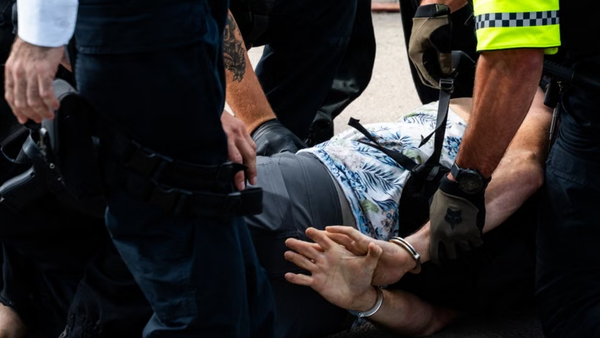
Police tasered and arrested a 45-year-old man after the double stabbing which saw two Jewish men – Shloime Rand, 34, and Moshe Ben Baila, 76, named locally as Moshe Shine – taken to hospital.
Speaking from hospital, Mr Rand told the BBC it is a “miracle” he survived.
“I’m very happy that I survived and I can talk,” he told the broadcaster. “I’ve had a stab to my chest.”
Mr Rand said he was walking down the street when the attacker came towards him and “just stabbed me in the chest”.
“I managed to jump back, so thank God he didn’t manage to take my life,” he added.
Prime Minister Sir Keir Starmer acknowledged that Jews in the UK were “scared” during a speech from Downing Street on Thursday, having been heckled earlier as he visited the scene of the stabbing.
Sir Keir, who is facing calls to ban pro-Palestine marches, backed the prosecution of people at such events chanting “globalise the intifada”.
But the Prime Minister declined to apologise to UK Jews following a string of attacks on the community.
Police have confirmed the suspect in the attack was reported to Prevent, the Government’s anti-extremism programme, in 2020 but the case was closed the same year.
He was born in Somalia and came to the UK legally as a child in the 1990s, Home Secretary Shabana Mahmood has said.
Commissioner Mark Rowley previously said the suspect had a “history of serious violence and mental health issues”.