Get all your news in one place.
100's of premium titles.
One app.
Start reading
Sports Illustrated
Sports Illustrated
Jon Wertheim

Tennis Mailbag: A Late Submission to the GOAT Debate

Submissions have been lightly edited for brevity and clarity.

As it is written, Wednesday is mailbag day.

• Here’s the latest Served podcast :

• The first unsolicited friend’s book recommendation: Matthew Futterman’s The Cruelest Game.

• The second: Julie Kliegman’s Finding Renée Richards.

Onward …


Dear Jon,

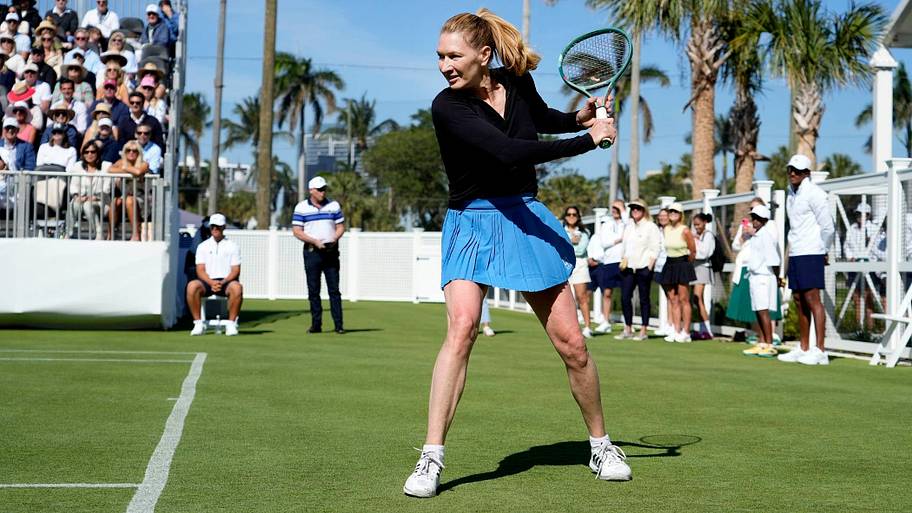
Yes, 1990s ace-fests increased the popularity of women's tennis. (I just started rereading Venus Envy where you make this astute point in the opening chapter.) This got me thinking: Has Steffi Graf been forgotten? I’ve noticed it’s fashionable to call Serena Williams “the GOAT,” as if there’s no argument. It can’t be just the one extra major; nobody calls Margaret Court better than Serena. Graf is comfortably ahead in titles won (107–73), weeks at No. 1 (377–319), winning percentage (88–84), winning percentage vs. top 10 players (77–71), and years finished at number one (8–5). There is a perception Graf had easier competition, but I don’t find this to be so. The bulk of her major finals were against players named Navratilova, Evert, Seles, Sanchez-Vicario, and Hingis. Yes, she beat a Natasha Zverev here, a Mary Joe Fernandez there; but Serena had major wins over the likes of Lucie Safarova and Vera Zvonareva. And despite the popular myth that Seles dominated Graf before the stabbing, Graf led the rivalry 6–4 before that fateful day (and 4–1 after it.)

Thanks for the good work,
Jesse, Wisconsin


• Thanks. Let me give you two (somewhat conflicting) thoughts on Steffi Graf:

A) She suffers from her absence from the spotlight. She has made a choice—one we should respect immensely—to divorce herself from tennis. She’s not in the commentary booth. She’s not doing sponsor grip-and-grins. She’s not showing up at events coaching, schmoozing, and, for the love of all things holy, playing in legends events. She’s moved on. She’s a mother, wife and occasional pickleball player. I wrote this piece a few years back. She chose not to speak for it, unsurprisingly. A friend of hers claims a great Graf-ian pleasure is going to a big-box store, picking up dinner or just being a normal civilian. This is awesome, but it has exacted a price on her legacy, at least among casual fans. She has almost triple the majors of John McEnroe. I suspect most normie fans would be shocked to hear that. Why? He is everywhere and has been since the 90’s—talking about past battles, predicting, opinionating, addressing corporate groups and coaching. She is nowhere.

B) I do think there is something to be said for longevity. Graf basically exited the sport when she was 30. Djokovic, on the other hand, is out there challenging for majors a decade older; or, for a better example, Serena Williams won 10 majors in her 30s.


Jon I was surprised to see your tweet about Coco Gauff and her comments when she was asked about the WTA gender testing. Do tell: What did you find so impressive? Or did you just like it because it was basically the position you laid out in your column?

Name withheld at reader request.

• Here’s the post that contains Gauff’s remarks.

First: here is my interpretation: I do not challenge the policy and its underpinnings. I do worry that this narrow restriction—made in service of fairness for competition—is going to be exploited by bad-faith actors to demonize a wider community.

Yes, this aligns closely with what I wrote a few weeks ago. Except she is 22, speaking on a live mic and putting herself out there in a way she doesn’t have to.

Again, this has gone from a narrow sports topic to a wider front in the culture wars. There are people who have never—and will never—watch a point of women’s tennis who suddenly have very strong opinions. I have great respect for the way Gauff acknowledged the nuance and didn’t shy from defending the underlying policy, while acknowledging that this is a wedge issue that, too often, brings pain (and, disproportionately, violence) to a group of people.


Hi Jon. Towel question for you. I’ve been to a lot of matches this year (and shout out to you for the Wimbledon tips) and [name redacted] is the ONLY player I’ve seen who has the ball guys bring him towels. Aside from how gross it is to ask others to handle your sweaty towels, it seems unfair that one player gets them brought and the others don’t. Is he breaking the rules or just, well, not very thoughtful?

Elise Rabekoff

• Because I am getting soft in my old age—and didn’t see this faux pas firsthand; though it is entirely believable—I am redacting the name of the alleged offender. But the point stands: It is beyond—medical term here—gross to ask anyone to handle your sweaty linens.

Even the fanciest gyms have towel bins. Even the most imperious bosses would never think of wiping their noses and handing their tissues to a subordinate. The optics here are just terrible. I also find the “pace of play” argument specious. Plenty of players go over to their bin to towel off and get back in position before the serve clock winds down. This no-touch policy was enacted during the peak of the COVID-19 pandemic and should have stayed on the books.


Hi Jon,

I see that Bernard Tomic recently played in the Los Cabos Open. I read that his match in the quarterfinals against Cameron Norrie lasted less than 50 minutes and he was subsequently criticized for lack of effort. I also note that it was his 16th career defeat in a match lasting less than 50 minutes. Which brings me to my point. Wouldn’t it be appropriate for Tomic and Nick Kyrgios to start a tennis academy together? They could call it the Knucklehead Tennis Academy.


Jim Yrkoski, Silver Creek, Neb.

• Remember what I said about getting soft? I will zig where most in tennis seem to zag. I’m sympathetic here. Tomic is well into his 30s, more than a decade removed from his peak. His various acts of alleged commission and omission (i.e., tanking) have been well-documented.

He has made around $7 million in prize money for his career, but tax that out and note that he turned pro in 2008, the travel costs coming and going to Australia, that he wasn’t exactly an appealing endorsement candidate, that his apparent consumption habits do not exactly suggest he is a value investor, and you worry. Then factor in his father, notorious even by tennis parent standards, and here is a figure worthy of sympathy.

His recent results are his career in miniature. He qualified for the main draw of the Los Cabos Open, winning one match 7–6 in the third and another 6–1, 6–0. He beat Karen Khachanov in straight sets, a strong result, registering a win against a pro’s pro. Then, you mention that abysmal quasi-match against Norrie in which he won just one more game than you and I.

In composite? It’s all quite sad. But whether it’s for reasons of recommitment or desperation, I give Tomic credit for grinding and, in his mid-30s, making this last push.


Hello Jon,

Id like to officially suggest that we bury the Court Speed Argument, and a headstone that reads “fun while it lasted.”


Why?? There are these things called composite customizable nano fiber racquets, co-poly strings, advanced nutrition and fitness, core strength, yoga, recovery … put these together and they’ll adapt to any Court Speed. The nostalgia is nice and all, but when Wimbledon homogenized Court bounce (that reduced speed a bit), they knew EXACTLY what they were doing. We’ve got 20+ years of pulsating battles between the naturally talented (Fed, Murray, Tsonga, Carlitos, Kyrgios) and the masters of “adapt and overcome” (Rafa, Novak, Sinner, Thiem). Athleticism has been off the charts.

They knew any Court Speed can be overcome by simply tightening the co-poly strings and the players can go to town on it with their athleticism. Players are routinely hitting 100 mph plus shots regardless of court surface, on FH and BH. Try S&V against that as a strategy! Go ahead!! Have your lunch stolen! So, let’s give the planners at Wimbledon and other slams their credit (wayyyy overdue!!!), and move on. They knew.

Vijay

• I’m not sure I quite follow all of this, but you make several good points worth considering. I can play with poly strings, do yoga, fly privately and eat right and still sense a difference in court speed. I’m not sure advances in technology, training and science nullify differences in bounces. But can court speed be confronted, if not altogether overcome, with a variety of hacks, starting with string tension? Absolutely.

In a related tangent: In part because of anti-trust rules, and in part because they are so competitive with each other, it’s always surprising to me how little the majors interact. Do I think the four majors adjust court speed to benefit marquee players, mitigate fluky upsets and perhaps benefit the local players? Sure. Do I think there is some conspiracy among the four to work closely in concert toward homogenization? No.


Hi Jon,

One of your readers suggested artificial turf as a solution to the degradation of the grass courts by the end of Wimbledon. I agree this wouldn’t work, but I think it’s a worthy goal to have players competing on grass rather than dirt in the later rounds. With the Wimbledon expansion on the horizon, I’ve got an idea. Build a duplicate of Centre Court on the expanded grounds. Use those courts only for the quarterfinals through the finals. It would be akin to switching to new balls during a match. How feasible do you think this would be?

Ted Cornwell, Minneapolis

• Putting aside the prohibitive cost, here’s a deep, dark secret: Tournaments hate upsets. For any number of reasons (better media ratings and engagement, and more corporate hospitality, marketing and exposure), they vastly prefer reliable bankable stars. Short of changing the score, events go to great lengths to advantage the stars, including court surfacing (see above), roofs that obviate rain delays and negotiated scheduling. (Funny, we never hear of the No. 29 seed storming into the tournament office and demanding to play at night on a hot day.)

Familiarity with a court is also an advantage. Between the sight lines, real estate behind the baseline and the acoustics, there’s an advantage to being familiar with the environment. When, say, Novak Djokovic plays on Centre Court, it’s old hat. Not so for most opponents. I suspect this is reason enough for Wimbledon to resist efforts to use a new and different venue for the latter rounds.


Shots

• It’s Maxime Cressy, and it ain’t pickleball:

• The USTA announced that No. 10 Amanda Anisimova, No. 11 Marta Kostyuk and rising men’s stars Arthur Fils and Alex Michelsen will complete the lineup for the Stars of the Open exhibition event, held Thursday, Aug. 27, at 6 p.m. ET inside Arthur Ashe Stadium. They join Alex Eala, João Fonseca, Iva Jovic and Learner Tien.

• The USTA today announced that the USTA’s strategic investment initiative USTA Ventures has invested in Rec Technologies (“Rec”), the company modernizing how Americans discover and access places to play.

Sign up to read this article
Read news from 100's of titles, curated specifically for you.
Already a member? Sign in here
Related Stories
Top stories on inkl right now
One subscription that gives you access to news from hundreds of sites
Already a member? Sign in here
Our Picks
Fourteen days free
Download the app
One app. One membership.
100+ trusted global sources.