Get all your news in one place.
100's of premium titles.
One app.
Start reading
The Conversation
The Conversation
William Ross, Professor of Mathematics, University of Richmond

Taking a leap of faith into imaginary numbers opens new doors in the real world through complex analysis

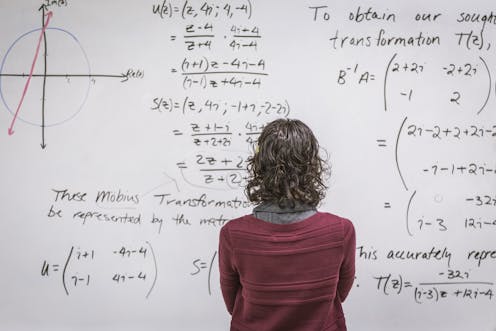
Imaginary numbers push the boundaries of calculus and other branches of math. Hill Street Studios/DigitalVision via Getty Images

To a nonmathematician, having the letter “i” represent a number that does not quite exist and is “imaginary” can be hard to wrap your head around. If you open your mind to this way of thinking, however, a whole new world becomes possible.

I’m a mathematician who studies analysis: an area of math that deals with complex numbers. Unlike the more familiar real numbers – positive and negative integers, fractions, square roots, cube roots and even numbers such as pi – complex numbers have an imaginary component. This means they are made of both real numbers and the imaginary number i: the square root of negative 1.

Sign up to read this article
Read news from 100's of titles, curated specifically for you.
Already a member? Sign in here
Related Stories
Top stories on inkl right now
One subscription that gives you access to news from hundreds of sites
Already a member? Sign in here
Our Picks
Fourteen days free
Download the app
One app. One membership.
100+ trusted global sources.