Swiss Defence Minister Martin Pfister said on Monday in Berlin that "Switzerland wants and is ready to take responsibility for its own security, but also to meet the expectations of other European countries that Switzerland, too, should contribute to the security of our continent. We want to live up to this aspiration as a reliable partner."
He was speaking at a meeting of the DACH countries, a region of shared economic and cultural heritage that comprises of Germany, Austria and Switzerland.
Countries that in the past spent relatively little on their defence have changed course in recent years following the outbreak of Russia's full-scale invasion of Ukraine in 2022. Among them is traditionally neutral Switzerland, which is neither a member of the EU nor of NATO.
Switzerland currently spends about 0.7% of its GDP on defence, putting it well below many European NATO states. Bern plans to increase spending gradually to 1% of GDP by 2032. By comparison, Germany currently invests around 2.4% of its GDP in defence.
According to Pfister, Switzerland "still has a well-functioning militia army with about 140,000 servicewomen and men" making it "a respectably large army" by European standards.
Pfister also points to Switzerland’s equipment, which he says "is still available" but concedes that the Swiss army also needs to be modernised in terms of materiel and, in particular, "to close the gaps in air defence."
The air defence gap
At the DACH meeting in Berlin, German Defence Minister Boris Pistorius stressed that both Austria and Switzerland are part of the "European Sky Shield" initiative and together with Bern, Berlin is currently procuring an IRIS-T SLM air defence system.
The "European Sky Shield Initiative" (ESSI) was launched in summer 2022 by Germany as a multinational project to build joint air and missile defence systems. Its goals are to close capability gaps, cut costs through joint procurement and increase interoperability within NATO.
Asked by Euronews, Dr Marcel Berni, a lecturer in strategic studies at the Military Academy at the Swiss Federal Institute of Technology in Zurich (ETH Zurich), explains that systems such as IRIS-T alone are not enough.
"IRIS-T SLM is important against medium-range threats, especially aircraft, cruise missiles and larger drones. But it is not a sensible answer to cheap drones. Anyone who fights a drone costing a few thousand francs with an expensive guided missile loses the cost equation. IRIS-T therefore needs to be complemented. More generally, much more extensive protective measures against attacks from the air are needed," says Berni.
In principle, Switzerland is following a European trend, the strategic studies lecturer at the Military Academy adds.
"The gaps in ground-based air defence in particular are glaring. Switzerland is therefore investing in modern air defence and air warfare capabilities with the F-35, Patriot and IRIS-T SLM. That is appropriate, because threats from the air have increased significantly. At the same time, however, there is a risk of a gap when it comes to cheap drones deployed in large numbers and cyberattacks. The current procurements are aimed primarily at high-end systems."
For Berni, the most important lesson is that air defence must be layered and rapidly deployable. "Ukraine shows how central drones, electronic warfare, ammunition, secure communications and rapid adaptation are. The Middle East shows that missile and drone defence only works in conjunction with partners and sensors," he explains, adding, "For retrofitting, you need industrial capacity, accelerated procurement, personnel, ammunition and staying power. For Switzerland, that means: stop buying prestige platforms and instead build up and expand civil resilience and train co-operation for wartime, at which point neutrality would in fact become obsolete."
How real is the drone threat to Switzerland?
Switzerland is a landlocked country, entirely surrounded by other states and with no access to the sea. Besides Liechtenstein and Austria, it borders three NATO states: Italy, Germany and France. Nevertheless, Switzerland is not spared a potential drone threat.
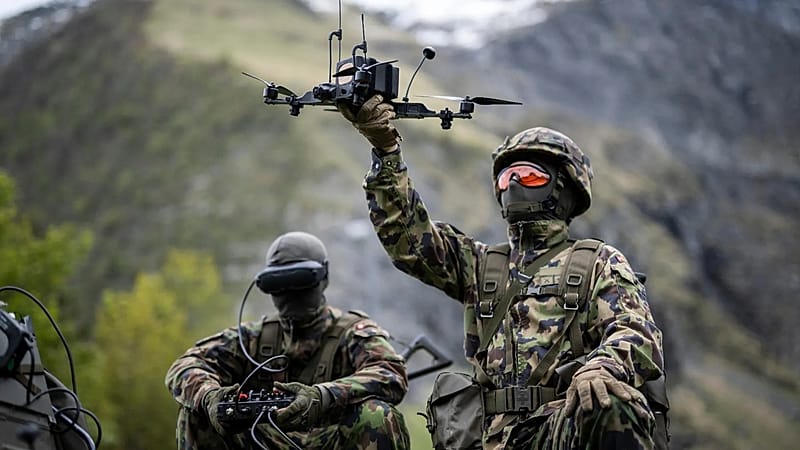
According to Swiss portal 20 Minuten, the army is massively expanding its drone capabilities and is, for the first time, integrating a "drone flying school" into the summer recruits’ course. The aim is that in future every platoon will have several trained drone pilots. Initially the focus is on reconnaissance drones, but in the long term attack drones are also to become part of the forces. Among other things, so-called FPV or kamikaze drones are being tested, like those used on a massive scale in the war in Ukraine.
These small, fast drones can carry explosive charges or be steered directly to their target. The army no longer sees drones merely as a supplement, but as a fixed component of modern warfare. Switzerland is also examining the use of drones for transport tasks or clearing unexploded ordnance. A total of 70 million francs (€76 million) is to be made available for drones and counter-drone systems in the 2026 armaments package, twice as much as had been planned the year before.
According to Dr Berni of ETH Zurich, the threat from mini-drones and drone swarms is real, "especially because a great deal of infrastructure of European importance is located in Switzerland."
"In the short term, it is therefore much less about drone swarms attacking cities and more about attacks on key infrastructure and logistics. Cheap FPV and mini-drones in particular are changing the cost ratio: a very cheap offensive weapon forces the defender into expensive countermeasures. That is why the Swiss army wants to improve its defence against mini-drones quickly," Berni tells Euronews.
FPV drones are so-called "first-person-view" drones, small unmanned systems that are controlled by an operator using an on-board camera.
According to the Swiss Federal Office of Civil Aviation (FOCA), a total of 68 drone overflights had been reported by October last year. Around half of them concerned control zones around airports. It is, however, unclear what types of drones were involved.
The protection of critical infrastructure does not, however, fall within the remit of the Swiss army, as an army spokesperson confirms. It is the responsibility of the operator or the competent civil authorities. As in Germany, the Swiss army can support civil authorities in exceptional security situations or at major events, should the police and other bodies reach their limits. Such subsidiary security deployments include, for example, the protection of critical infrastructure, air surveillance or disaster relief. Responsibility, however, remains with the civil authorities.
What does the security issue mean for neutrality?
Switzerland officially adopted neutral status in the 19th century, after European powers recognised its neutrality at the Congress of Vienna in 1815. The aim was to create a stable buffer state in Central Europe and keep Switzerland out of major conflicts.
Swiss neutrality has since survived several wars and world wars. "Switzerland remains neutral, but it is still attached to a concept of neutrality from the time of the 1907 Hague Convention," says Dr Berni, adding that this is why "with regard to the war in Ukraine, perpetrator and victim are treated in the same way."
"Nevertheless, neutrality is very popular among the population and is therefore likely to endure. At the same time, the security situation is forcing Switzerland into closer co-operation with European partners, for example on air defence, armaments and exercises. Exactly this, however, is what a current popular initiative seeks to prevent. It aims to write strict neutrality into the Swiss constitution," Berni tells Euronews.