
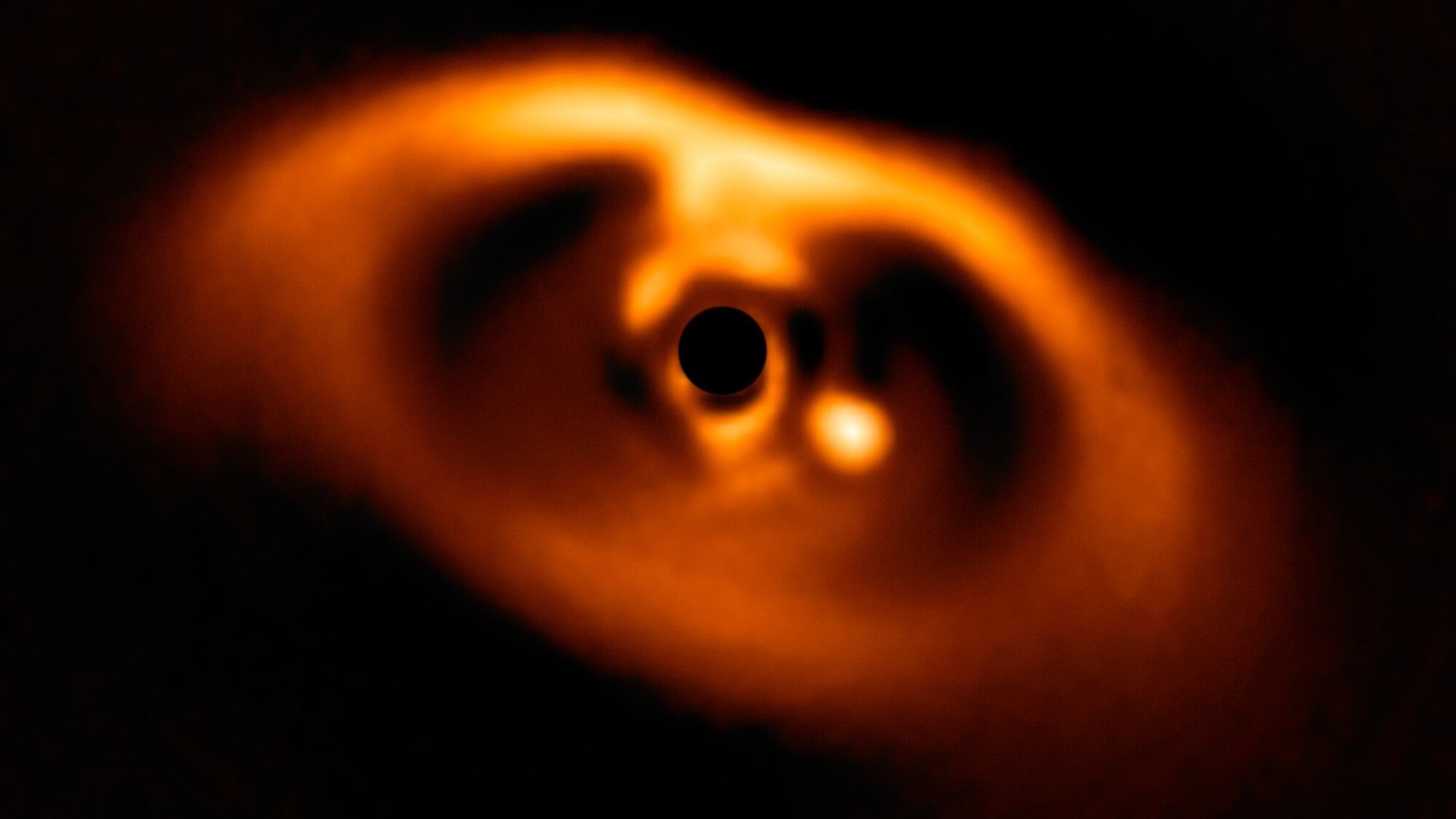
Scientists' best theories on how planets form could be wrong, new research suggests. Astronomers studying a still-forming planet beyond our solar system have found that its chemical makeup doesn't fully match the swirling gas and dust disk from which it formed. The finding challenges standard models of planet formation and implies they may be overly simplistic, the researchers say.
The budding planet, called PDS 70b, is a world nearly thrice as big as Jupiter and resides about 400 light-years from Earth in the constellation Centaurus. It is part of a two-planet system — one of the few known where planets are still coalescing, providing a valuable environment for astronomers to examine the link between newborn planets and their natal disk. PDS 70b circles its host star at a distance similar to Uranus' orbit around the sun, and previous observations have hinted that it could be nearing the end of its newborn era after accumulating mass for about 5 million years.