
Get all your news in one place.
100's of premium titles.
One app.
Start reading
Space
Space
Science
Robert Lea

Supermassive black holes in 'little red dot' galaxies are 1,000 times larger than they should be, and astronomers don't know why

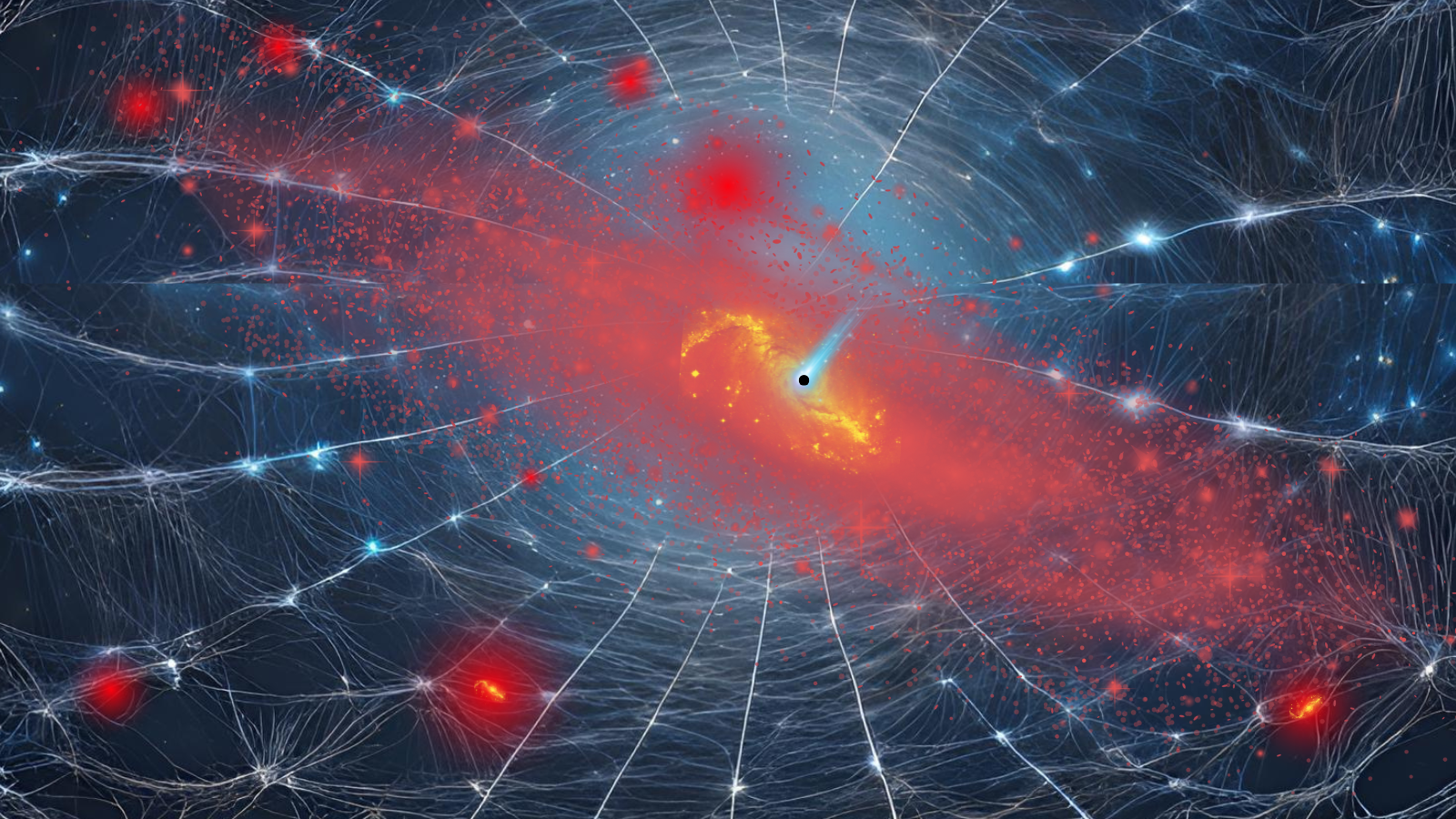
An illustration shows seven little red dot galaxies embedded in the cosmic web, one of which is dominated by a supermassive black hole.

Using the James Webb Space Telescope (JWST), astronomers have discovered distant, overly massive supermassive black holes in the early universe. The black holes seem way too massive compared to the mass of the stars in the galaxies that host them.

In the modern universe, for galaxies close to our own Milky Way, supermassive black holes tend to have masses equal to around 0.01% of the stellar mass of their host galaxy. Thus, for every 10,000 solar masses attributed to stars in a galaxy, there is around one solar mass of a central supermassive black hole.

Sign up to read this article
Read news from 100's of titles, curated specifically for you.
Already a member? Sign in here
Related Stories
Top stories on inkl right now
One subscription that gives you access to news from hundreds of sites
Already a member? Sign in here
Our Picks
Fourteen days free
Download the app
One app. One membership.
100+ trusted global sources.







