
Get all your news in one place.
100's of premium titles.
One app.
Start reading
The Conversation
The Conversation
Fan Zou, Graduate Student in Astronomy and Astrophysics, Penn State

Supermassive black holes have masses of more than a million suns – but their growth has slowed as the universe has aged

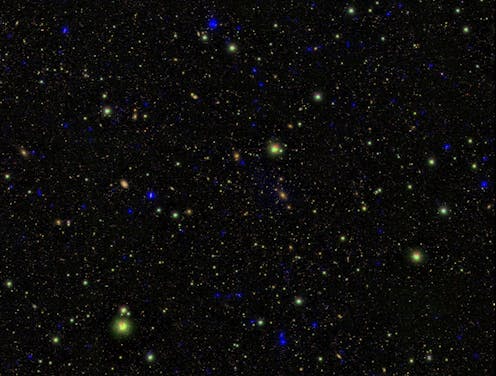
Most of the blue points in this sky survey image are accreting supermassive black holes emitting strong X-rays. Fan Zou (Penn State) and the XMM-SERVS Collaboration

Black holes are remarkable astronomical objects with gravity so strong that nothing, not even light, can escape them. The most gigantic ones, known as “supermassive” black holes, can weigh millions to billions times the mass of the Sun.

These giants usually live in the centers of galaxies. Our own galaxy, the Milky Way, contains a supermassive black hole in its heart as well.

Sign up to read this article
Read news from 100's of titles, curated specifically for you.
Already a member? Sign in here
Related Stories
Top stories on inkl right now
One subscription that gives you access to news from hundreds of sites
Already a member? Sign in here
Our Picks
Fourteen days free
Download the app
One app. One membership.
100+ trusted global sources.






