
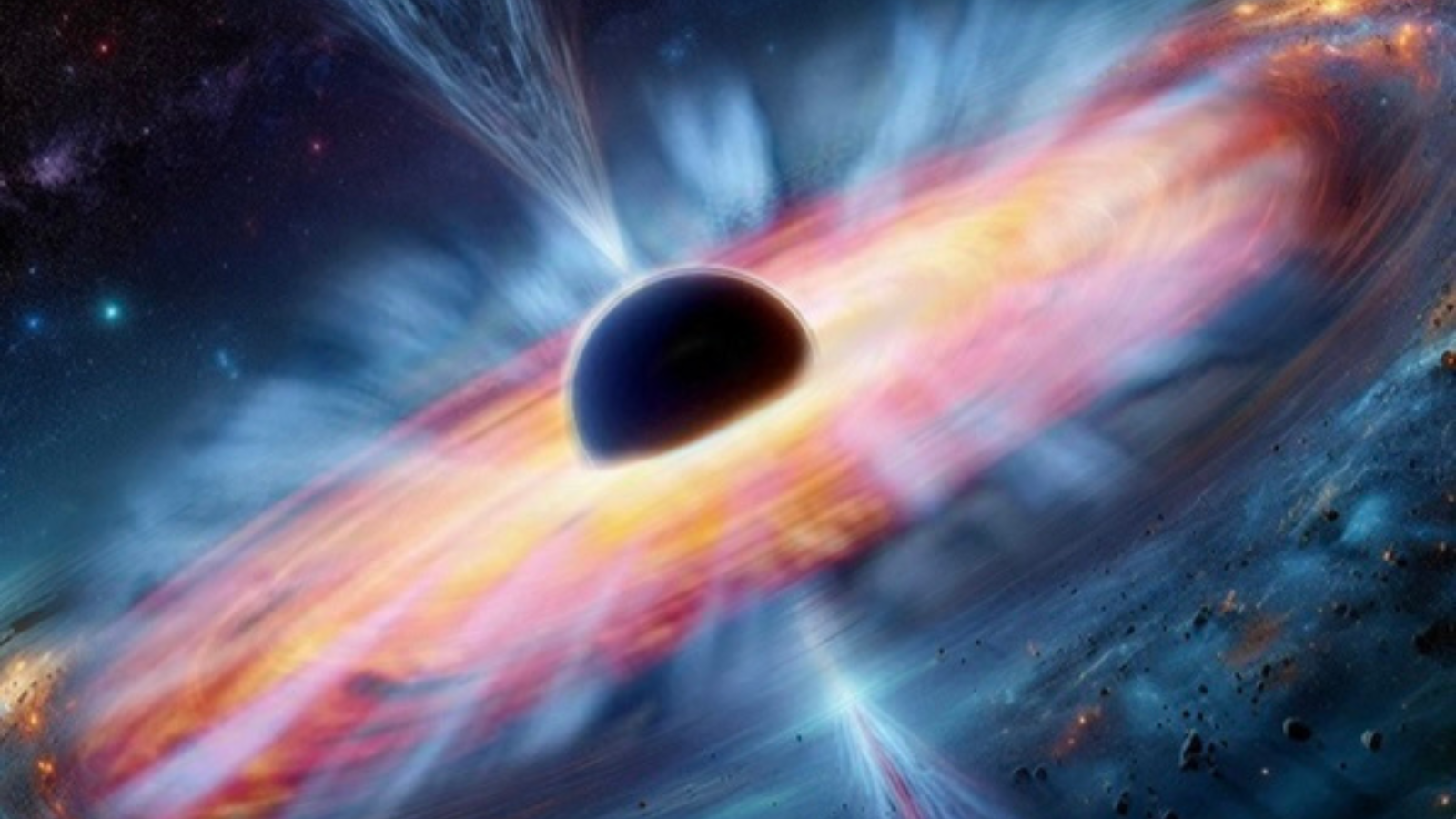
Scientists have found evidence that black holes that existed less than 1 billion years after the Big Bang may have defied the laws of physics to grow to monstrous sizes. The discovery could solve one of the most pressing mysteries in space science: How did supermassive black holes in the early universe grow so big, so fast?
Supermassive black holes with masses millions, or even billions, of times that of the sun are found at the hearts of all large galaxies. They are thought to grow from a chain of mergers between progressively larger black holes, as well as sometimes through feeding on matter that surrounds them. Such feeding supermassive black holes cause the material that surrounds them (in flattened clouds called "accretion disks") to glow so brightly they are seen at vast distances. Such bright objects are referred to as "quasars" and can outshine the combined light of every star in the galaxies they live in.














