
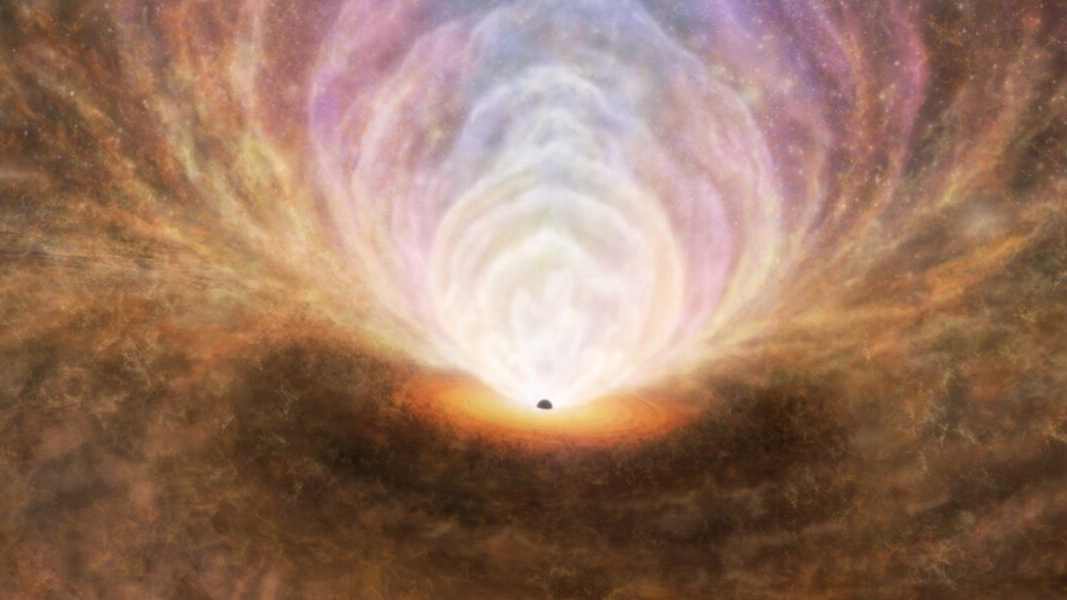
Astronomers have peered into the active heart of a distant galaxy to observe the feeding habits of a supermassive black hole — in short, they discovered that it recycles material. These findings could help us better understand the dynamics of how supermassive black holes grow.
Supermassive black holes exist at the hearts of most, if not all, galaxies, with masses of millions or even billions of times that of the sun. In some cases, these black holes are surrounded by matter they feed on, in the form of plate-like disks called accretion disks, and scientists think it's those disks that enable them to grow. The gravitational force of the central black hole whips the accretion disk matter around at incredible speeds and generates immense tidal forces in the gas and dust. As this matter is churned, it glows so brightly it can often outshine the combined light of every star in the galaxy around it. These luminous central galactic regions are called active galactic nuclei (AGNs).














