
Get all your news in one place.
100's of premium titles.
One app.
Start reading
The Conversation
The Conversation
Science
Chris Impey, University Distinguished Professor of Astronomy, University of Arizona

Super-Earths are bigger, more common and more habitable than Earth itself – and astronomers are discovering more of the billions they think are out there

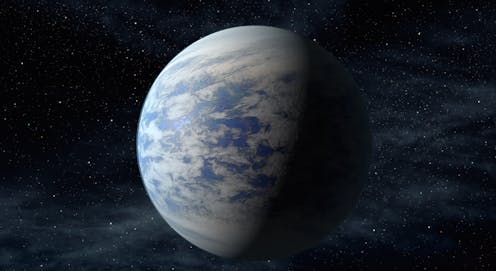
Astronomers think the most likely place to find life in the galaxy is on super-Earths, like Kepler-69c, seen in this artist's rendering. NASA Ames/JPL-CalTech

Astronomers now routinely discover planets orbiting stars outside of the solar system – they’re called exoplanets. But in summer 2022, teams working on NASA’s Transiting Exoplanet Survey Satellite found a few particularly interesting planets orbiting in the habitable zones of their parent stars.

One planet is 30% larger than Earth and orbits its star in less than three days. The other is 70% larger than the Earth and might host a deep ocean. These two exoplanets are super-Earths – more massive than the Earth but smaller than ice giants like Uranus and Neptune.

Sign up to read this article
Read news from 100's of titles, curated specifically for you.
Already a member? Sign in here
Related Stories
Top stories on inkl right now
One subscription that gives you access to news from hundreds of sites
Already a member? Sign in here
Our Picks
Fourteen days free
Download the app
One app. One membership.
100+ trusted global sources.







