
Get all your news in one place.
100's of premium titles.
One app.
Start reading
Golf Monthly
Golf Monthly
Sport
Emma Booth

Suffering From 'Card In Hand Panic'? 5 Tips Before Your Next Round

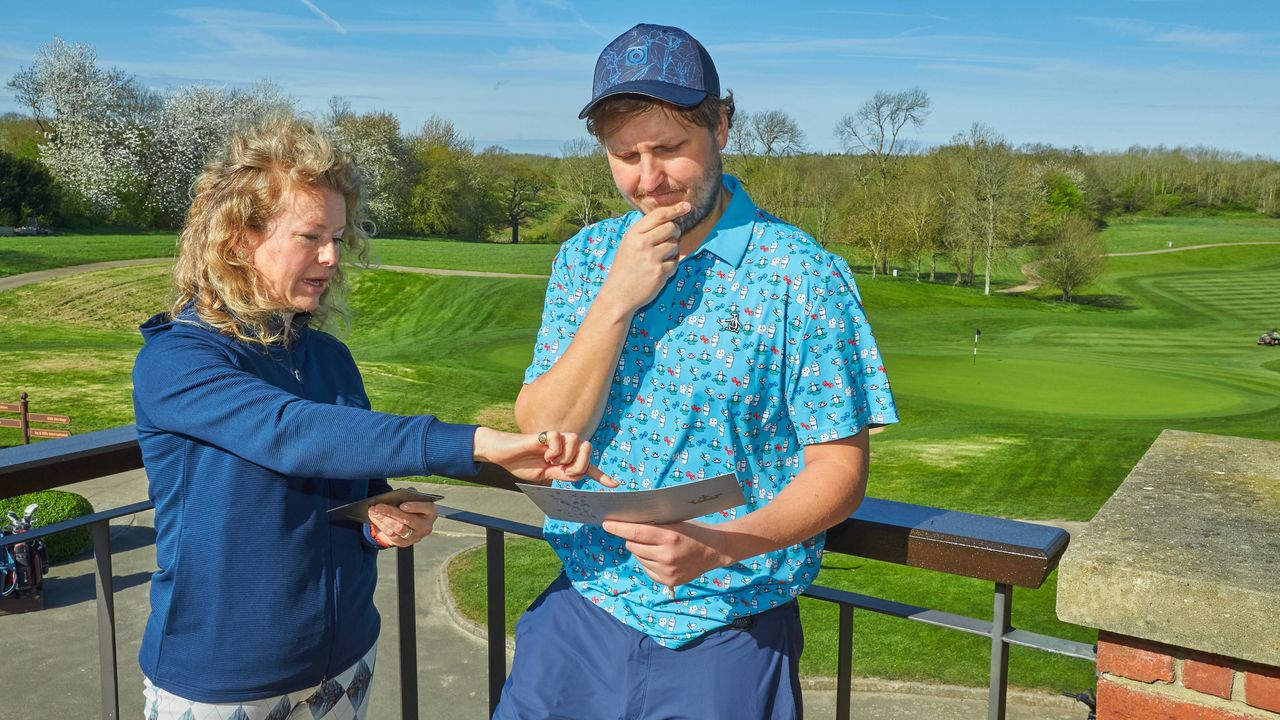
Two golfers looking pensively at a scorecard.

When you have a card in hand there is nowhere to hide. Everyone will be able to see how terrible at golf you really are! You scored 6 on that short par-3? Hmm, are you sure that was just a bad day and not a true reflection of your game? Golf is very hard, maybe you should try Pickle Ball? You should give up on the 12th now and NR…

If those spiralling, chaotic thoughts sound in any way familiar, this article is for you. As a golfer who played to a high level as an amateur and now a golf coach with over 20 years experience, I know how it feels to get the scorecard nerves and have seen over and over again how the fear of a scorecard can wreak havoc on people’s enjoyment of the game. Here are my top 5 tips for navigating scorecard nerves.

Understand And Accept

You are nervous because you care and it means something. Feeling anxious does not make you weak, it makes you human and means you are challenging yourself by doing things outside of your comfort zone.

Understanding that nerves are normal and actually good, is the first step in freeing you from thinking of them as a negative thing. So accept and embrace the nerves, it makes completing the challenge all that bit sweeter.

It’s The Hope That Kills You

Or rather in golf, it’s the expectation, and there is no other sport I’ve come across where the gap between people’s expectations of what they think they ‘should’ be able to do and ‘can’ actually do are bigger.

Golf doesn’t care if you were hitting it well at the range yesterday, it doesn’t care if you used to be really good a few years ago, golf only cares about the here and now and will quickly highlight any weak areas of your game. Remember goals are good, expectations will weigh you down. So be realistic about what you’d like to achieve.

(Image credit: Future)

Exposure Therapy

Exposure therapy is the process of gradually and repeatedly facing the situations, thoughts or feelings that make you anxious instead of avoiding them. Over time, your brain learns that the situation is not as dangerous as it is first believed and the anxiety about it begins to lose its power.

An example of this is often people who are scared of spiders, following the steps of first being in the same room as one, to then being closer, to then building up to holding one. Just as someone with a fear of spiders might gradually learn to hold one, you can learn to become comfortable with scorecards by facing the discomfort rather than avoiding it.

Like being in the same room as a spider, start slowly by setting yourself small challenges; keeping your score for 6 holes during a round. Having a friend mark your card for 9. Entering more 9-hole competitions. You will undoubtedly experience some bad scores that make you feel uncomfortable, but you will also start to feel less anxious about it because you have experienced the nerves, done it anyway and realised it is just another part of the game.

Stay On Task

There’s a reason why the best golfers in the world have set pre-shot routines. A routine gives your mind something to focus on and acts as an anchor when nerves start to build.

Think of your attention like a torch, wherever you point and shine the light is where your attention goes, so shine it on what you are trying to do. That’s not to say you won’t still have nerves but bringing your attention back to the task in hand keeps the mind busy and gives you less time to let doubts creep in. Being able to focus is a skill and one of the most powerful tools to have when playing golf under pressure.

(Image credit: Future)

There Is The Possibility…

Scorecard golf might not be for you. For many golfers, keeping score and competing is what golf is all about, it is certainly the traditional image of the game. But golf has changed, nowadays there are more ways than ever to enjoy the game and not all of them revolve around scorecards and competition.

Playing socially with friends, driving range and simulator golf, or just being outside and hitting balls are all ways golf is enjoyed. So if keeping score consistently causes stress, takes away your enjoyment and is not something you want to overcome, that is absolutely more than okay and good that you know that about yourself. Find the version of the game that makes you happy and keeps you coming back.

(Image credit: The Golf Groove)

Parting Thoughts

The scorecard is often treated as a judgment of our ability, but in reality it’s simply a record of one day’s golf. The problem isn’t usually the numbers on the card, it's the stories we attach to them. We worry about what a bad score says about us, what others might think, or whether we’ve lived up to our own expectations. It is also always worth remembering that other people care very little about your golf and far more about their own!

So the more we can separate our self worth from our score, the more freedom we give ourselves to enjoy the game. Golf will always contain uncertainty, mistakes and the occasional disaster hole. That’s the nature of the game and what makes it so challenging.

The most important point with all of this is to remember you are meant to be playing for fun, this is where you are spending your precious leisure time. If the pursuit of scorecard golf makes you nervous in an excited way, embrace the tips above, but if it doesn’t light your candle, find and embrace the golf that does.

Sign up to read this article
Read news from 100's of titles, curated specifically for you.
Already a member? Sign in here
Related Stories
Top stories on inkl right now
One subscription that gives you access to news from hundreds of sites
Already a member? Sign in here
Our Picks
Fourteen days free
Download the app
One app. One membership.
100+ trusted global sources.