
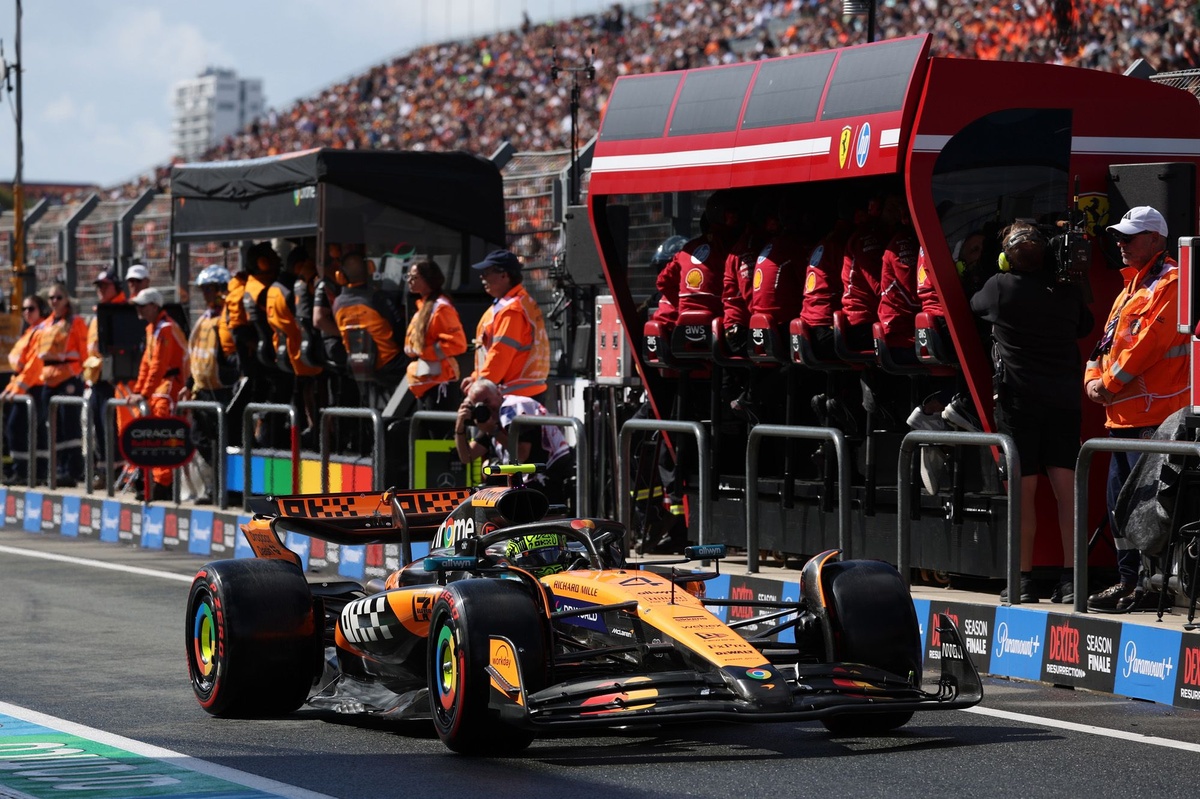
Pirelli’s ongoing quest to provide strategic variation has come up short at Zandvoort, largely owing to the relatively short lap (4.259km) and the narrowness of its layout. Overtaking hasn’t been easy here given the speed of modern F1 cars, even with the conversion of the final corner to a banked profile.
A narrow, crowded lap naturally prompts teams to default to a one-stop strategy here to protect track position. To militate against that, the speed limit in the similarly cramped pitlane has been raised from 60km/h to the standard 80km/h and Pirelli has gone a step softer in its tyre compounds.
The pitlane time loss is now 19 seconds rather than 22.
Even so, Saturday’s running made it clear most teams are targeting a one-stop race, even if it is theoretically slower than a two-stop; the speed advantage of the two-stop remains theoretical if your driver is stuck behind a one-stopper. But there is still room for surprise given the threat of rain, plus the intriguing possibilities provided by McLaren and Aston Martin having an extra set of hard-compound Pirellis available, while Max Verstappen risked compromising his Q3 performance to have a set of new softs in his pocket.
“All the teams are customising their strategy based on track position, grid position and other elements,” said Pirelli motorsport manager Mario Isola in his regular post-qualifying briefing.
“So we cannot make a strategy for each single car. We try to give a flavour, an idea of what can be the most popular strategy in the race.”














