Get all your news in one place.
100’s of premium titles.
One app.
Start reading
LiveScience
LiveScience
Sharmila Kuthunur

'Stop and re-check everything': Scientists discover 26 new bacterial species in NASA's cleanrooms

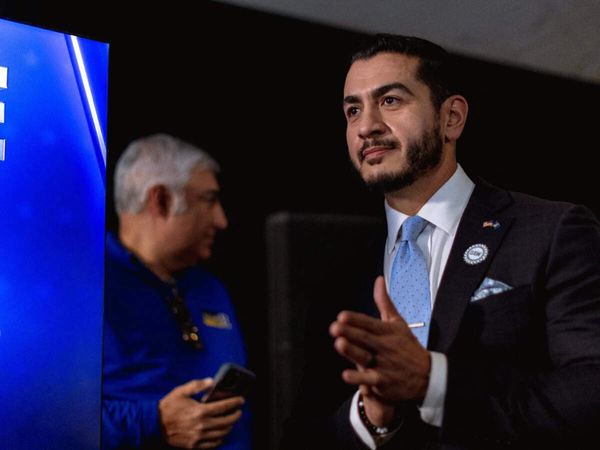
Photo of the Perseverance rover taken by the rover from above. The Martian landscape makes up most of the photo—reddish brown rocks and dirt. .

NASA's cleanrooms rank among the cleanest spaces on Earth, and for good reason — these sterile spaces are fortified to prevent even the hardiest Earth microbes from hitching a ride to other worlds aboard NASA spacecraft. Yet even in the most sterile places on Earth, life finds a way.

Now, experts plan to test these newfound bugs inside a "planetary simulation chamber" that could reveal whether these microbes, or ones with similar adaptations, could survive a trip through space to Mars, possibly contaminating the alien worlds on arrival.
Earlier this year, scientists identified more than two dozen previously unknown bacterial species lurking in the Kennedy Space Center cleanrooms in Florida, where NASA assembled its Phoenix Mars Lander in 2007. The discovery showed that despite constant scrubbing, harsh cleaning chemicals and extreme nutrient scarcity, some microbes evolved a suite of genetic tricks that allowed them to persist in these punishing environments.

"It was a genuine 'stop and re-check everything' moment," study co-author Alexandre Rosado, a professor of Bioscience at King Abdullah University of Science and Technology in Saudi Arabia, told Live Science about the findings, which were described in a paper published in May in the journal Microbiome. While there were relatively few of these microbes, they persisted for a long time and in multiple cleanroom environments, he added.

Identifying these unusually hardy organisms and studying their survival strategies matters, the researchers say, because any microbe capable of slipping through standard cleanroom controls could also evade the planetary-protection safeguards meant to prevent Earth life from contaminating other worlds.

When asked whether any of these microbes might, in theory, tolerate conditions during a journey to Mars' northern polar cap, where Phoenix landed in 2008, Rosado said several species do carry genes that may help them adapt to the stresses of spaceflight, such as DNA repair and dormancy-related resilience. But he cautioned that their survival would depend on how they handle harsh conditions a microbe would face both during space travel and on Mars — factors the team didn't test — including exposure to vacuum, intense radiation, deep cold and high levels of UV at the Martian surface.

To explore that question, the researchers are now building a planetary simulation chamber at the King Abdullah University of Science and Technology in Saudi Arabia to expose the bacteria to Mars-like and space-like conditions, Rosado said. The chamber, now in its final assembly phase, with pilot experiments expected to begin in early 2026, is engineered to mimic stresses such as the low, carbon-dioxide-rich air pressure of Mars, high radiation, and the extreme temperature swings the microbes would face during spaceflight. These controlled environments will allow scientists to investigate how hardy microbes adapt and survive under combinations of stresses comparable to those encountered during spaceflight or on the Martian surface, said Rosado.

The planetary simulation chamber at King Abdullah University of Science and Technology in Saudi Arabia. Scientists will soon use it to recreate Mars-like and space-like conditions and test how the newly discovered microbes survive and adapt. (Image credit: Niketan Patel and Alexandre Rosado/King Abdullah University of Science and Technology)

'Cleanrooms don't contain 'no life"

NASA's spacecraft-assembly cleanrooms are engineered to be hostile to microbes — a cornerstone of the agency's efforts to prevent Earth organisms from hitchhiking to worlds beyond Earth — through continuously filtered air, strict humidity control and repeated treatments using chemical detergents and UV light, among other measures.

Even so, "cleanrooms don't contain 'no life,'" said Rosado. "Our results show these new species are usually rare but can be found, which fits with long-term, low-level persistence in cleanrooms."

During the Phoenix lander's assembly at the Kennedy Space Center's Payload Hazardous Servicing Facility, a team led by study co-author Kasthuri Venkateswaran, who is a senior research scientist at NASA's Jet Propulsion Laboratory, collected and preserved 215 bacterial strains from the cleanroom floors. Some samples were gathered before the spacecraft arrived in April 2007, again during assembly and testing in June, and once more after the spacecraft moved to the launch pad in August, according to the study.

At the time, researchers lacked the technology to classify new species precisely or in large numbers. But DNA technology has advanced dramatically in the 17 years since that mission, and today scientists can sequence almost every gene these microbes carry and compare their DNA to broad genetic surveys of microbes collected from cleanrooms in later years. This allows scientists "to study how often and for how long these microbes appear in different places and times, which wasn't possible in 2007," said Rosado.

Further analysis revealed a suite of survival strategies. Many of the newly identified species carry genes that help them resist cleaning chemicals, form sticky biofilms that anchor them to surfaces, repair radiation-damaged DNA or produce tough, dormant spores — adaptations that help them survive in tucked-away corners or microscopic cracks, the study reports. This makes the microbes "excellent test organisms" for validating the decontamination protocols and detection systems that space agencies rely on to keep spacecraft sterile, Rosado said.

From a broader research standpoint, Rosado said the next step is coordinated, long-term sampling across multiple cleanrooms using standardized methods, paired with controlled experiments that measure microbes' survival limits and stress responses, said Rosado.

"This would give us a much clearer picture of which traits truly matter for planetary protection and which might have translational value in biotechnology or astrobiology," he said.

Sign up to read this article
Read news from 100’s of titles, curated specifically for you.
Already a member? Sign in here
Related Stories
Top stories on inkl right now
One subscription that gives you access to news from hundreds of sites
Already a member? Sign in here
Our Picks
Fourteen days free
Download the app
One app. One membership.
100+ trusted global sources.