
Get all your news in one place.
100's of premium titles.
One app.
Start reading
Space
Space
Science
Keith Cooper

Starlight warped in the fabric of spacetime could help us find hidden black holes dancing together

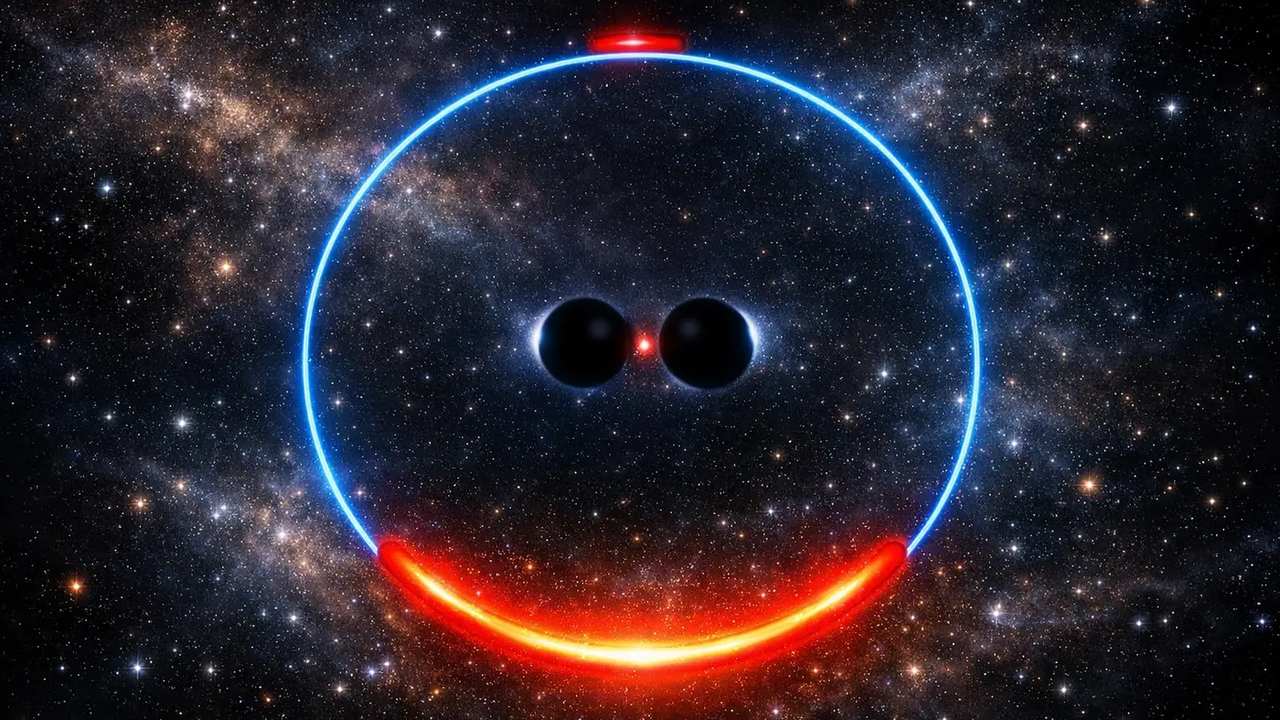
An illustration of two black circles in the center of the screen separated by a red dot. There's a glowing blue circle around both black circles and a red semi-circle at the bottom.

Two supermassive black holes on a dizzying death spiral could soon become visible to astronomers after researchers worked out how, while rotating around each other, these dark, massive behemoths could gravitationally lens the stars behind them.

Pretty much every large galaxy hosts a supermassive black hole, ranging in mass from millions of times that of our sun (for example the black hole in our Milky Way galaxy, Sagittarius A*) to billions of solar masses. Ordinarily, galaxies have just one supermassive black hole at their hearts, but when two galaxies merge, their black holes can fall towards each other, eventually coming into each other's orbit and, long after that happens, merging in a burst of gravitational waves.

Sign up to read this article
Read news from 100's of titles, curated specifically for you.
Already a member? Sign in here
Related Stories
Top stories on inkl right now
One subscription that gives you access to news from hundreds of sites
Already a member? Sign in here
Our Picks
Fourteen days free
Download the app
One app. One membership.
100+ trusted global sources.




