Get all your news in one place.
100's of premium titles.
One app.
Start reading
The Economic Times
The Economic Times
Team Global

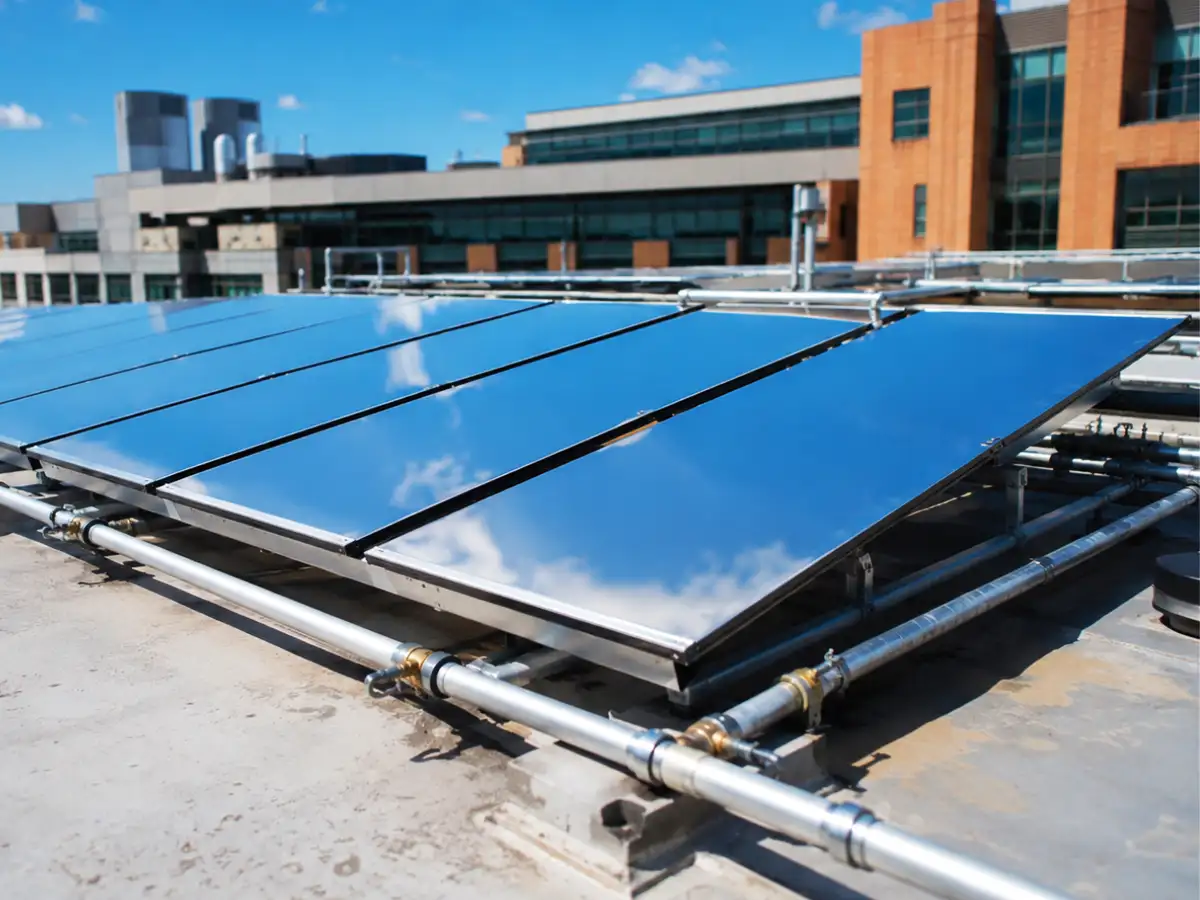
Stanford ran water beneath mirror-like rooftop panels; they cooled it 3–5°C below the surrounding air by sending heat into space

Somewhere on a Stanford rooftop, water got colder than the air around it, and nothing was plugged in to make that happen. No compressor hum, no electricity-meter spike, nothing. It was just pipes, sunlight, and a very clever mirror. In 2017, Stanford researchers Eli Goldstein, Aaswath Raman and Shanhui Fan published a study titled ‘Sub-ambient non-evaporative fluid cooling with the sky’ in Nature Energy describing rooftop panels that cool flowing water without using electricity. The panels were tested on the roof of Stanford’s Packard Electrical Engineering Building, and they lowered the water temperature 3 to 5 degrees Celsius below the outside air temperature, with no compressor, no refrigerant and no power cord. They just sent the water's excess heat outward into space.

How do you send heat into space?

Everything on Earth emits heat in the form of infrared radiation that passes through the atmosphere into the cold vacuum of space. Roads often lose heat rapidly after sunset, even before the air cools. This is called radiative cooling of the sky. Sunlight has always been the catch, heating things faster than radiative cooling can cool them, the study said. Fan, the paper's senior author, described space as a giant cold reservoir: if you dump heat into it, it cools without requiring electricity.

The mirror trick that beats the sun

That daytime obstacle is exactly what the panel's coating is designed to cancel out. The panels use a multilayer optical film that reflects about 97 percent of incoming sunlight, which keeps the surface from absorbing solar heat in the first place, while a narrow atmospheric window still lets the panel's own infrared radiation escape outward. So even on a bright afternoon, the surface stays cool enough that heat continues flowing out faster than the sun can add it back in. A 2014 study titled ‘Passive radiative cooling below ambient air temperature under direct sunlight,’ by the same team, demonstrated the underlying idea using small optical wafers about 8 inches across, which cooled only the surface and did not use fluids. The 2017 study scaled this up into an actual fluid-cooling system.

Sign up to read this article
Read news from 100's of titles, curated specifically for you.
Already a member? Sign in here
Related Stories
Top stories on inkl right now
One subscription that gives you access to news from hundreds of sites
Already a member? Sign in here
Our Picks
Fourteen days free
Download the app
One app. One membership.
100+ trusted global sources.