
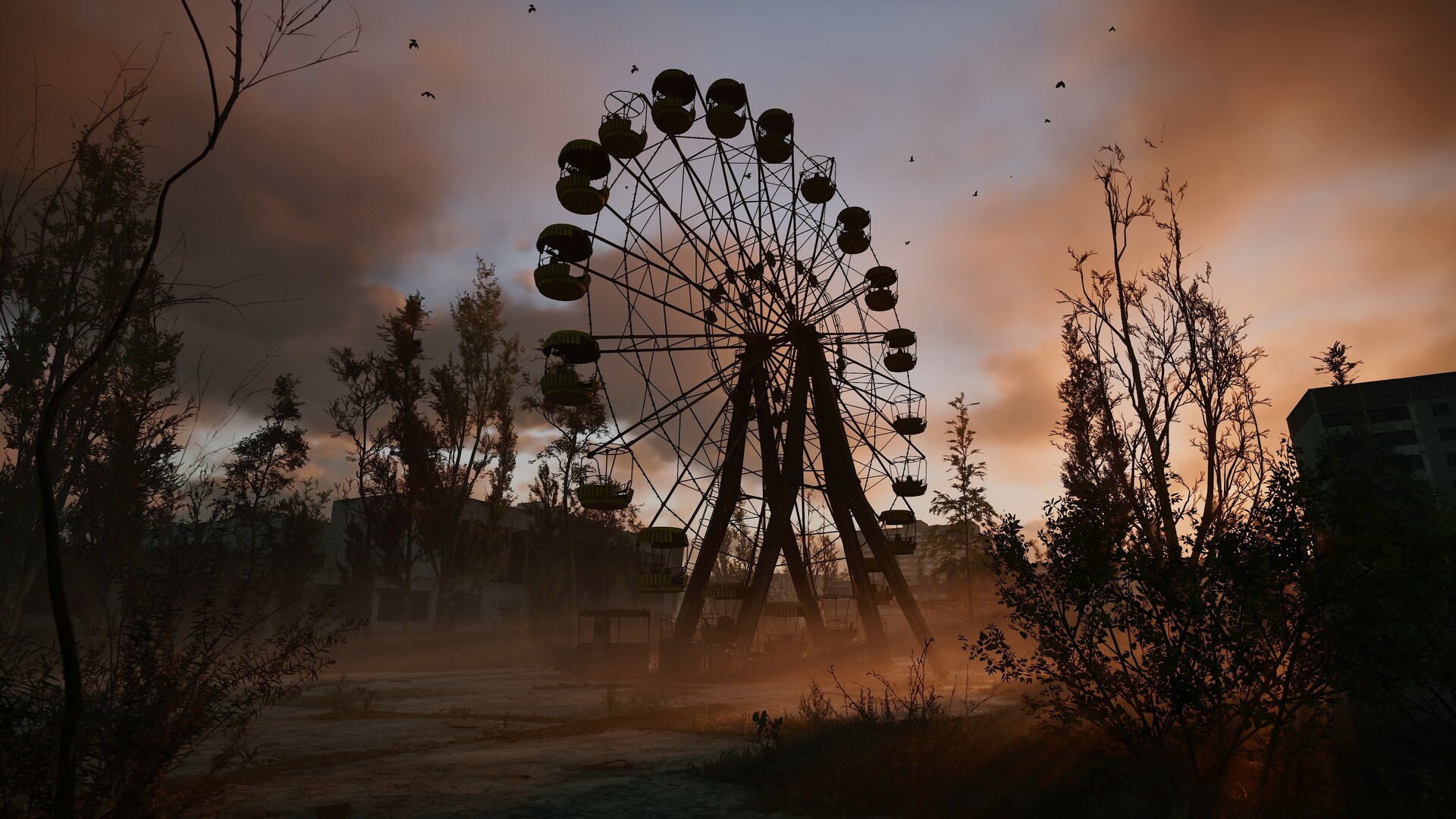
Stalker 2 returns to the zone after a long absence
Stalker 2: Heart of Chornobyl finally marks a return to the zone after a 15 year absence. It leverages Epic's Unreal Engine 5 for some impressive visuals, and it also punishes lesser PCs. We've been running benchmarks and this is a game that needs both GPU and CPU horsepower — and don't neglect the VRAM if you're planning to run with maxed out settings. Our testing will look at many of the latest Nvidia, AMD, and Intel GPUs that are among the best graphics cards, and we'll provide a few CPU benchmarks as well. Let us know in the comments what other hardware you'd like to see tested, and we'll try to make it happen.
A lot has changed since Call of Prypiat, Clear Sky, and the original Shadow of Chornobyl came out in the late 00s (note that the spelling was officially updated after the Russian invasion of Ukraine). A state-of-the-art PC back in 2009, when Prypiat launched, consisted of a Core i7-965 or 975 Extreme Edition, or an overclocked i7-920 that was just as fast. The top graphics cards of the era were Nvidia's GeForce GTX 285 AMD's newly launched Radeon HD 5870. Windows 7 was also brand-spanking-new, having launched in October 2009, which means DirectX 11 had also just gone live. Call of Prypiat was one of the first (or perhaps the first) games to use DirectX 11, though it was also compatible with DX9 and DX10 GPUs.
Now, Windows 7 has officially been retired, along with the Windows 8 sequel, and Windows 10 is on its last legs. GPUs that were top of the line models 15 years ago often can't even run modern games. Stalker 2 as an example (and yes, we're going to skip the caps and periods rather than writing "S.T.A.L.K.E.R. 2" every time, since it's not even an acronym) requires at least a GTX 1060 6GB or RX 580 8GB graphics card — those arrived in 2016 and 2017, respectively. It also requires a Core i7-7700K or Ryzen 5 1600X or better, 16GB of RAM, and 160GB of disk space. That's for a target of 1080p with the low preset and 30 fps.
The recommended hardware — and based on our testing, you don't want to come up short — lists a Core i7-11700 or Ryzen 7 5800X, GeForce RTX 3070 Ti / 4070 or Radeon RX 6800 XT, and 32GB of RAM. That's for the high preset and 60 fps at 1440p. Also, an SSD is "required" — though I suspect the game can still load (slowly) from a hard drive. And those framerate targets? That's with TSR, DLSS, FSR, or XeSS upscaling and related technologies, including framegen.
Steep requirements might be an understatement, and once again we can only shake our heads sadly at the default enablement of upscaling and frame generation. We prefer to have those as ways to boost performance to higher levels and smooth out framerates, not as baseline requirements. To that end, we'll be testing at native resolution, as well as with upscaling only, and finally with upscaling and frame generation. So let's see how Stalker 2 runs on current PC hardware.










