Get all your news in one place.
100’s of premium titles.
One app.
Start reading
Golf Monthly
Golf Monthly
Sport
Joe Ferguson

Srixon ZXiR Irons Review: A Must-Try For High-Handicap Golfers

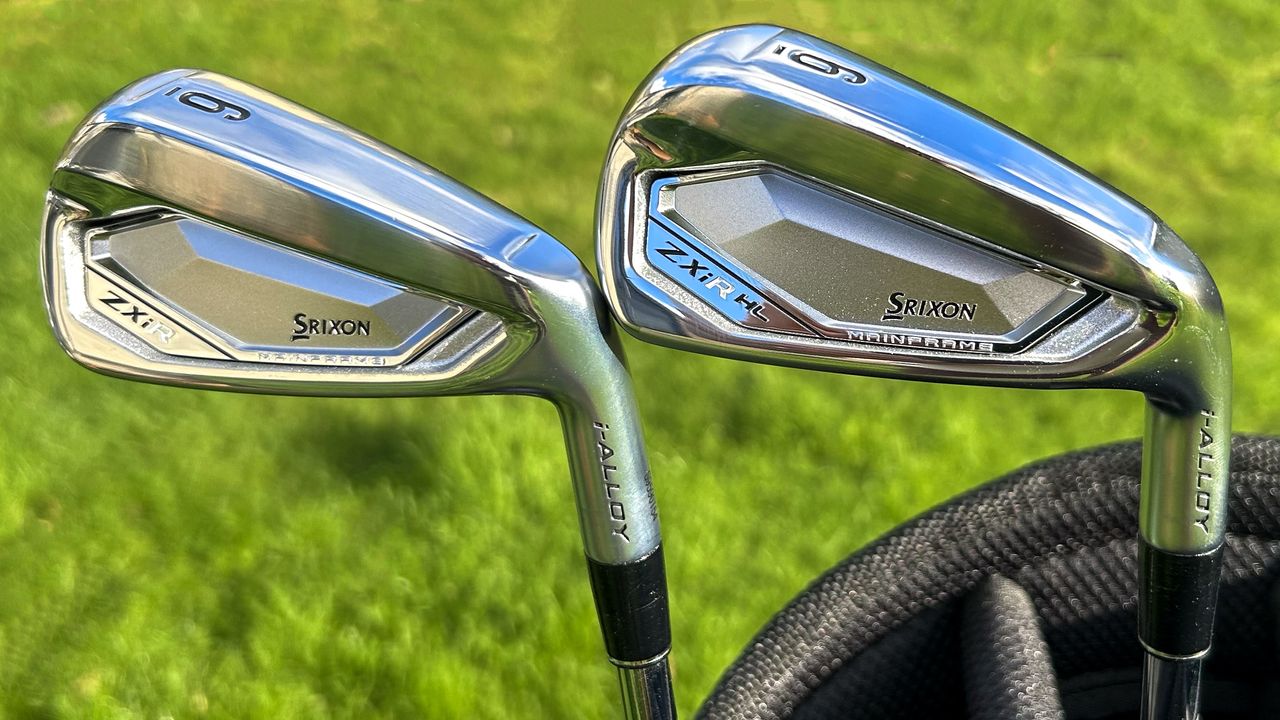
Photo of the Srixon ZXiR And ZXiR HL Irons.

The Srixon Z-Series has been the unheralded choice of the discerning player for some time now, offering sleek, forged irons that sit perfectly on the line between classic aesthetics and modern performance.

However, with the ZXiR and ZXiR HL irons, Srixon has made a long-awaited dip of a toe into the genuine game improvement market.
(Image credit: Future)

While the ZXi4 and its previous equivalents could be considered very user-friendly, it would be a stretch to call them true game improvement. The Srixon ZXiR family steps confidently and unashamedly into that space, designed for maximum distance and forgiveness, so I wanted to test them out to see if they could rival some of the best irons in the game.

Aesthetically, Srixon has done a predictably outstanding job from the 'in the bag' perspective on these irons. The ZXiR range simply oozes shelf appeal.

The two new models blend seamlessly into the ZXi iron family from that angle, featuring premium, cavity back badging and an extremely clean, sophisticated overall look.

ZXiR 6-iron (Image credit: Future)
ZXiR HL irons (Image credit: Future)

The playing position, however, is where things really matter to me, and I have slightly mixed feelings here.

The topline, while noticeably thicker than other Srixon irons, is beautifully executed and is genuinely additive to the feeling of confidence on offer, rather than being bulky for the sake of it. Furthermore, the rest of the proportions and general shaping are also excellent and very much in keeping with what I have come to expect from one of my favorite iron manufacturers in the game.

For me, however, while the standard model just treads the right side of the line, in my opinion, the HL model features a little too much offset, which is more noticeable in the mid-long irons.

(Image credit: Future)

I get it, I do. The function of offset is primarily to help stop the right miss or the slice by allowing the leading edge a fraction of a second longer to catch up and reach square through impact; however, not everyone shopping in this market has that right miss. In fact, plenty of high handicap amateurs I play with have the exact opposite tendency and pull their irons.

As such, the fairly hefty offset on show here might actually be prohibitive to a good proportion of the target audience. However, that is a relatively minor point.

ZXiR HL 6-iron (Image credit: Future)
ZXiR HL 8-iron (Image credit: Future)
ZXiR HL pitching wedge (Image credit: Future)
(Image credit: Future)

On to more positive notes, from a sound and feel point of view, this iron is as good as anything I have tried in the game improvement category, and a far cry from the clunky, harsh feels of yesteryear.

The construction uses i-ALLOY, a brand-new steel that is significantly softer than the 431 steel commonly used in this category, and it is very effective.

(Image credit: Future)

Although it is, as you would expect, a touch livelier off the face than, say, the more refined ZXi7 iron, the ball still melts into the face beautifully and offers great feedback from centered strikes. In addition, the levels of forgiveness off-center in terms of feel are of the highest order, with even some very severe toe strikes that would ordinarily sting a little, feeling almost subdued through my hands.

Srixon’s Mainframe technology is no doubt behind this success. This clever internal feature saves and redistributes additional weight, adding more MOI (Moment of Inertia) through an enhanced milled pattern on the back side of the iron face.

With this particular iteration of Mainframe, Srixon highlighted a predominant miss for the high handicap player being low in the face, and has added support specifically in that area.

Something I was thrilled to see make the cut in the design room was the Tour V.T. sole, which is the envy of many a manufacturer.

Although the sole width has massively increased, as you would expect on a game improvement iron (which flattens the pitch of the V sole a touch), this has been carefully thought about in other areas of camber on the sole, making it something of a 'modified' Tour V.T. sole.

I have to say it is an absolute triumph, operating like the bottom of a boat through choppy seas, gliding through with an ease I haven't felt in the game improvement category before.

Data was collected using the Foresight Sports GC3 launch monitor (Image credit: Future)

From a performance standpoint, the standard ZXiR irons are absolute rocket launchers in terms of ball speed, exceeding almost anything else I have tried in the game improvement sector. However, that must be caveated with the fact that the lofts are very strong, with the pitching wedge coming in at 43˚ and the 7-iron at an eye-watering 28.5˚.

In truth, this worked impressively for me in terms of my own Foresight Sports GC3 launch monitor numbers, but I swing a 7-iron at approximately 100 mph, so launch isn’t an issue for me. I would have serious concerns about slower players being able to generate enough height to make them an effective choice in some conditions.

(Image credit: Future)

This is most likely why Srixon has created the ZXiR HL (High Launch) version to complement the extremely powerful, low-lofted standard model.

For context, the HL version is exactly the same in terms of its core technologies, with the only differences (aside from the additional loft) being a fractionally longer blade length and (sadly for me) more offset.

The HL version offered me an entirely different launch window, with significantly more spin, and, crucially, nearly 30 feet more peak height, something not to be sniffed at for the low-ball hitters among you.

While the standard ZXiR lofts get a little bunched (only 2.5° difference by the time you get to the top of the bag), the HL version has its lofts spaced much more evenly, along with being significantly weaker (as much as 4° at points in the set) to assist with launch.

Personally, while I totally see the necessity for the strong-lofted standard model in the range to compete with distance irons such as the Cobra DS-Adapt and the Titleist T350 on the distance front, based on my experience, more high handicap players would see actual, genuine game improvement from the HL model, as opposed to just distance improvement.

ZXiR 6-iron (left) and ZXiR HL 6-iron (right) (Image credit: Future)

Overall, I really like this first foray into genuine game improvement from Srixon, and I think it is a very smart move to offer the two models.

For the player who maybe has a touch more speed and generates a little more dynamic loft, the ZXiR will be a great fit to maximize distance output.

However, I see the ZXiR HL offering more players tangible game improvement qualities, such as height and stopping power, if they can avoid becoming bedazzled by that often misleading total distance number in the fitting bay. On the whole, I think these are excellent additions to the ZXi lineup.

Sign up to read this article
Read news from 100’s of titles, curated specifically for you.
Already a member? Sign in here
Related Stories
Top stories on inkl right now
One subscription that gives you access to news from hundreds of sites
Already a member? Sign in here
Our Picks
Fourteen days free
Download the app
One app. One membership.
100+ trusted global sources.