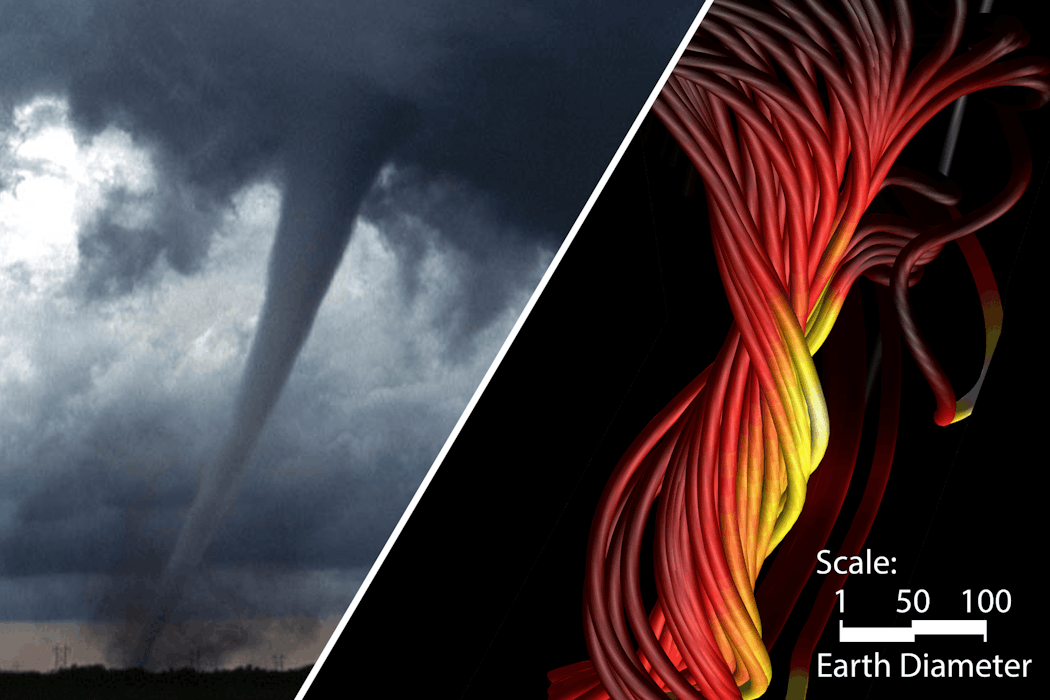
Weather forecasting is a powerful tool. During hurricane season, for instance, meteorologists create computer simulations to forecast how these destructive storms form and where they might travel, which helps prevent damage to coastal communities. When you’re trying to forecast space weather, rather than storms on Earth, creating these simulations gets a little more complex. To simulate space weather, you would need to fit the Sun, the planets and the vast empty space between them in a virtual environment, also known as a simulation box, where all the calculations would take place.
Space weather is very different from the storms you see on Earth. These events come from the Sun, which ejects eruptions of charged particles and magnetic fields from its surface. The most powerful of these events are called interplanetary coronal mass ejections, or CMEs, which travel at speeds approaching 1,800 miles per second (2,897 kilometers per second).