
Get all your news in one place.
100's of premium titles.
One app.
Start reading
MarketBeat
MarketBeat
Jeffrey Neal Johnson

Space Race 2.0: AI's Trillion-Dollar Escape Plan

The digital gold rush for artificial intelligence (AI) has an unseen, physical cost. The insatiable appetite of AI for processing power is creating a direct and growing strain on global energy and water resources. This immense computational demand, which powers everything from generative language models to complex drug discovery, is fundamentally based on terrestrial data centers.

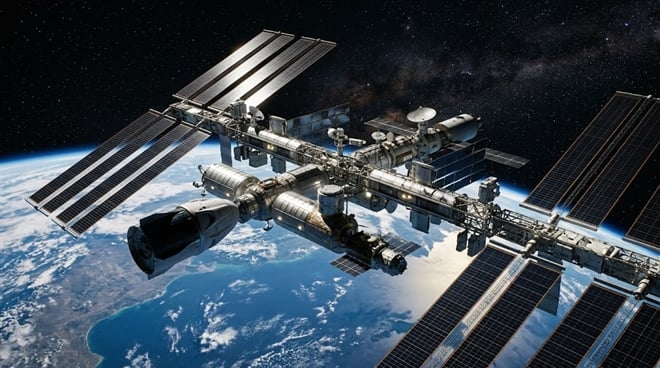
As demand for AI accelerates, the physical limitations of Earth-based infrastructure are coming into sharp focus, forcing the technology sector to seek viable, large-scale alternatives. A new class of infrastructure is emerging not in Silicon Valley, but in the silent, sun-drenched vacuum of space.

AI's Earthbound Anchor: The Terrestrial Gridlock

The core challenge for scaling artificial intelligence is no longer just about designing faster chips; it is about finding the power to run them. Modern data centers, the backbone of the cloud, are consuming significant portions of regional power grids.

In some technology hubs, these facilities account for a substantial share of total electricity usage, and securing new, large-scale power purchase agreements has become a major hurdle. The introduction of AI workloads dramatically increases this consumption, a trend that threatens to overwhelm local energy supplies and has already led to moratoriums on new data center construction in several key markets.

This power problem is compounded by a cooling crisis. High-performance processors, such as those used for AI, generate immense heat. On Earth, managing this heat requires complex, power-hungry HVAC systems and, often, vast quantities of water, a resource that is itself becoming more scarce and regulated. The environmental and logistical strain is immense.

This reality directly impacts financial performance. Rising operational expenditures from a 15% year-over-year increase in energy costs, along with massive capital expenditures for new power infrastructure, threaten the profit margins of the entire data center ecosystem. The model of building ever-larger facilities on the ground is facing a wall of physical and economic limitations.

The Orbital Tipping Point Is Here

The concept of moving compute infrastructure into orbit has shifted from science fiction to sound strategy due to three converging factors. This is not a distant, theoretical solution; the necessary components are falling into place now, creating an actionable inflection point for the industry.

First, the economics have fundamentally changed. Over the past decade, the cost of launching one kilogram into low Earth orbit has plummeted by over 90%. This dramatic cost reduction, driven primarily by reusable rocket technology, makes the deployment and replacement of satellite hardware economically feasible for commercial enterprises.

Second, the technology has matured. The industry is seeing the active development of radiation-hardened, high-performance processors and durable satellite platforms. These components are specifically engineered to survive and operate effectively for extended missions in the harsh environment of space, mitigating the risk of early failure. Furthermore, the advancement of intersatellite laser links enables these orbital platforms to communicate at high speeds, creating a true cloud network in space.

Finally, the market demand has become urgent. The gridlock and resource constraints facing terrestrial data centers are no longer distant forecasts. They are immediate, tangible barriers to AI scaling, creating powerful demand from cloud providers and governments for an alternative path to growth.

This urgent demand is being met by new partnerships between aerospace engineering and semiconductor design. Two companies, in particular, represent the core of this emerging investment thesis: the builder of the orbital real estate and the provider of its powerful engine.

Rocket Lab: The Orbital Landlord

Rocket Lab USA (NASDAQ: RKLB) has strategically evolved far beyond its origins as a small satellite launch service. The company is now a vertically integrated space infrastructure provider, a transition that positions it perfectly to capitalize on the space compute trend. Its core value in this thesis is its role in building the orbital real estate, the high-performance satellite buses that will house the data centers of the future.

By manufacturing its own critical components, from reaction wheels to star trackers, Rocket Lab controls its supply chain and can offer a complete, end-to-end solution.

The most compelling evidence of this strategic success lies in the company's financials.

The Space Systems division, which designs and manufactures satellite components and buses, now accounts for over 65% of total revenue.

This is a critical metric for investors, as it proves that a robust market for orbital hardware already exists and that Rocket Lab is a primary beneficiary.

Looking forward, the development of its medium-lift Neutron rocket serves as a major catalyst. Neutron is designed to deploy entire constellations of heavier, more powerful data-processing satellites in a single launch, fundamentally changing the company’s payload capacity and revenue potential. Market confidence is reflected in the company's record $1.2 billion backlog, which provides a clear demand pipeline and visibility into future revenue.

NVIDIA: The Engine of Space Compute

If Rocket Lab is building the physical structures, NVIDIA (NASDAQ: NVDA) is providing the essential engine that makes them valuable. As the undisputed leader in GPUs for artificial intelligence, NVIDIA is a foundational pick-and-shovel play on nearly every AI trend, including orbital computing. The company is not passively waiting for the market to develop; it is actively enabling it.

A key indicator of this commitment is NVIDIA's direct research and development into radiation-hardened GPUs. Standard computer chips are vulnerable to cosmic rays in space, which can cause data errors or permanent damage. Creating rad-hardened chips is a significant engineering feat that provides a powerful competitive moat.

By investing in this technology, NVIDIA is validating the commercial potential of the orbital market and ensuring its hardware will be the standard. This new segment contributes to the company's staggering $26.2 billion in quarterly data center revenue, a figure that continues to grow as AI expands into specialized, high-margin environments. Wall Street has taken notice, with a bullish consensus analyst price target of $275 and an even more bullish high side price target of $360. This reflects a broad expectation that NVIDIA's dominance will extend from terrestrial data centers into this next frontier of computing.

The Dawn of the Orbital Economy Is Now

The convergence of AI's terrestrial limits and the expanding capabilities of the commercial space industry is creating a new, durable infrastructure market. This is not a speculative future; the financial reports and product roadmaps of key players show the build-out is already underway.

The strain on Earth's power grids is acting as a powerful catalyst, transforming the vacuum of space into one of the most valuable assets for the next stage of the AI revolution. This orbital shift represents a long-term, structural trend that is just beginning to gain momentum.

For investors monitoring this sector, revenue growth in the Space Systems divisions of aerospace companies and semiconductor firms' R&D allocation toward space-grade hardware may serve as key indicators of the trend's accelerating adoption rate.

Where Should You Invest $1,000 Right Now?

Before you make your next trade, you'll want to hear this.

MarketBeat keeps track of Wall Street's top-rated and best performing research analysts and the stocks they recommend to their clients on a daily basis.

Our team has identified the five stocks that top analysts are quietly whispering to their clients to buy now before the broader market catches on... and none of the big name stocks were on the list.

They believe these five stocks are the five best companies for investors to buy now...

See The Five Stocks Here

The article "Space Race 2.0: AI's Trillion-Dollar Escape Plan" first appeared on MarketBeat.

Sign up to read this article
Read news from 100's of titles, curated specifically for you.
Already a member? Sign in here
Related Stories
Top stories on inkl right now
One subscription that gives you access to news from hundreds of sites
Already a member? Sign in here
Our Picks
Fourteen days free
Download the app
One app. One membership.
100+ trusted global sources.