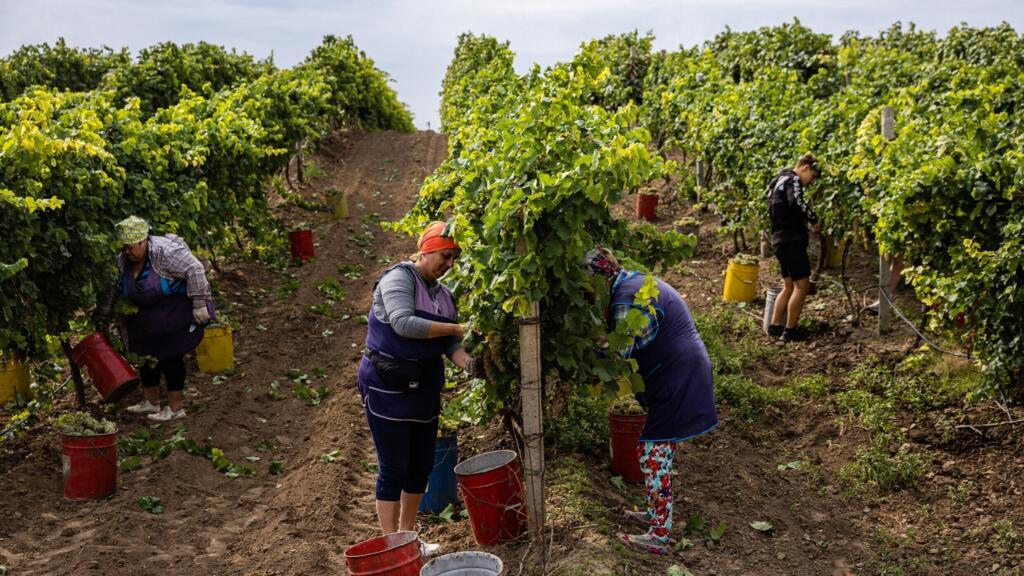
The vineyards of southern Ukraine are still producing wine nearly four years into the war with Russia, following the full-scale invasion of February 2022 – even as nearby fighting and repeated air raid alerts take their toll on daily life.
Strikes have intensified in southern Ukraine in recent weeks, prompting the government to order the evacuation of civilians, including around 40 children, from villages near Zaporizhzhia, as Moscow’s forces advance.

But on the outskirts of Mykolaiv, a city by the Black Sea, the Beykush estate continues to make wine – 10 kilometres from Russian positions.
To reach the vineyard now requires a military escort and passing through several checkpoints.
For security reasons, visiting the vines themselves is not always possible. Attacks are launched regularly from across the river, shaping how and when work can be done.
The pressure on Ukraine’s wine sector began back in 2014, when Russia’s annexation of Crimea wiped out more than half of the country’s national production.
Ukrainians responded by turning to local wines, a patriotic reflex that helped new vineyards emerge. That has continued since Russia’s invasion in 2022, helping sustain producers such as Beykush.
Ukraine war videos raise questions over Russia’s recruitment of Africans
'Working is a way of holding on'
At the estate, production was stopped for just one month, even as nearby Mykolaiv was caught up in intense fighting. Since then, work has continued under constant threat.
“At the beginning of the war, work was the only thing that helped keep our spirits up,” winemaker Ola Romanenko told RFI.
“It gave us something to focus on instead of thinking about the constant danger. And even today, working is a way of holding on, of not thinking about everything else.”
The estate has not been hit directly, but drones often fly overhead before crashing nearby or heading towards Odesa. The team has had to adapt quickly to the risks.
Only four people now handle production at the winery. Romanenko lives on site, while the other employees are neighbours. During the harvest, local residents also help out so the work can be done as quickly as possible.

The winery has also set up shelters.
“We have a basement for our barrels, which is very safe,” she said. “We also have an old tasting room that is almost underground and works as a shelter. If the noise is too loud or the danger too high, we go there.”
The team stays in constant contact with the army, and helps to support it financially.
“For security, we make donations,” she said. “Some QR codes on our bottles allow people to support the rehabilitation of soldiers. Several of our employees are also serving in the army and we help them.”
Despite the conditions, production has not fallen. Beykush produces around 19,000 bottles a year across 15 different wines, and output has even increased since 2022.
France now supplies most of Ukraine’s intelligence, Macron says
'Identity is our strength'
The wines have also gained international recognition.
“This year, at the most prestigious competition in London, Larbinat won gold in the orange wine category,” Romanenko said. “L’Oca Deserta, a red, won silver. They sell so well that some are already sold out.”
In Mykolaiv, Marina Stepanova runs one of the city’s few remaining wine shops. With frequent air raid alerts, power cuts and a curfew, opportunities to go out in the evening are limited.
She told RFI that while foreign importers were keen to support Ukraine’s wine sector in 2022, that interest has since faded. Local producers are now relying mainly on Ukrainian customers.
At the entrance to Stepanova's shop, one shelf is dedicated to wines from the Mykolaiv region, with more Ukrainian bottles further inside. A small room at the back is used for tastings.
Here, local architect Efren Polanco invites foreign colleagues to sample regional wines.
“When you introduce yourself and say you come from France, you have your identity, your personality,” he told the visitors. “For our wine, it’s the same. Identity is our strength.”
Pouring a glass from the Beykush estate, Polanco added: “This wine is like the blood of the Mykolaiv region.”
Outside, an air raid alert sounded. Inside, the small group clinked glasses.
This article is based on a report in French by RFI's Accents d'Europe podcast.