Get all your news in one place.
100's of premium titles.
One app.
Start reading
The Economic Times
The Economic Times
Debaroti Adhikary

South Korea's Kospi crashes 5% again, plunges 31% in one month. Is the AI frenzy over?

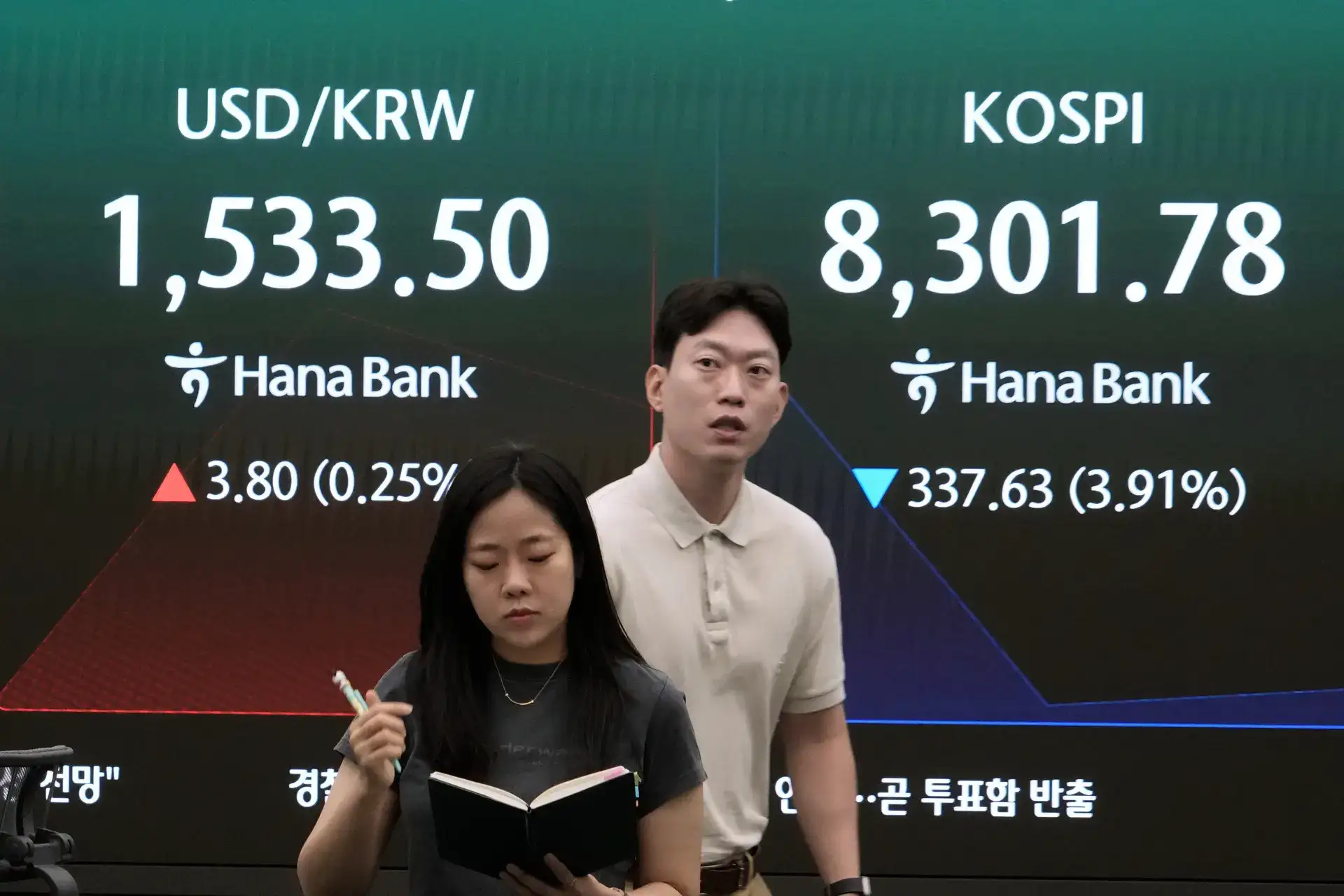
South Korea's Kospi, the world's best-performing market of 2026, crashed another 5% on Tuesday to extend sharp losses that pushed it down over 31% from its June peak following a skyrocketing rally.

Kospi dropped to 6,448.86 on Tuesday morning, marking a more than 31% crash from its June peak of 9,386. The benchmark index has now crashed nearly 14% in just two days, and is currently in bear market territory.

The recent selloff in South Korea’s stock market comes after a skyrocketing rally in tech stocks that pushed Kospi sharply higher. Despite the latest crash, the index is still up over 50% in 2026 so far.

Today’s crash also comes amid an overall downtrend in global stock markets as oil prices shot up amid the latest escalations in the war in the Middle East.

How South Korea's stock market went up, and then down

Just a year ago, South Korea’s President Lee Jae Myung set a 5,000-point target for the Kospi, which seemed wildly ambitious. Little did investors know that the Asian market is going to blast past 9,000 driven by an AI-fuelled surge. Lee meanwhile insisted that South Korean stocks were still cheap.

The Kospi’s performance is closely tied to two chip giants Samsung Electronics and SK Hynix, which together account for nearly half of the index’s weight and have contributed roughly two-thirds of its gains this year. As these stocks crashed, so did Kospi.

South Korea’s Finance Minister Koo Yun-cheol last week said authorities would closely monitor risks that could further increase stock market volatility. The finance ministry said market swings have intensified due to foreign and institutional investor profit-taking, portfolio rebalancing, and changing expectations around the global artificial intelligence sector. The comments came after Koo met with the central bank governor and heads of financial regulators.

“Increasing concentration in the semiconductor sector has become a factor raising financial market volatility, with the impact of fluctuations in the chip sector on the whole stock market growing,” the ministry said in a statement.

Also read: Kospi enters bear market! What South Korea’s finance minister said after crash

“Supply-demand dynamics of the dollar-won market are expected to shift in the second half,” Deputy Finance Minister Moon Ji-sung said, adding that pressure from foreign investor profit-taking and portfolio rebalancing is expected to ease.

"It's a wake-up call," Reuters quoted Francis Tan, chief strategist for Asia at Indosuez Wealth Management in Singapore, as saying. "Both for those who are greedy and those who are fearful…For those who were fearful ... it's a great time to buy in, but if you are already overweight this gives you a reminder that exposure (to chips) can be a volatile game,” he said.

Also read: SK Hynix set to gain as South Korea eases capital-raising rules

(With inputs from agencies)

(Disclaimer: Recommendations, suggestions, views and opinions given by the experts are their own. These do not represent the views of The Economic Times)

Sign up to read this article
Read news from 100's of titles, curated specifically for you.
Already a member? Sign in here
Related Stories
Top stories on inkl right now
One subscription that gives you access to news from hundreds of sites
Already a member? Sign in here
Our Picks
Fourteen days free
Download the app
One app. One membership.
100+ trusted global sources.