Get all your news in one place.
100's of premium titles.
One app.
Start reading
Sports Illustrated
Sports Illustrated
Clare Brennan

Sophie Cunningham Is Already Trying to Clean Up the Mess She Made

Editor’s note: This story includes discussion of suicide. If you or someone you know needs help, the national suicide and crisis lifeline in the U.S. is available by calling or texting 988. There is also an online chat at http://988lifeline.org.

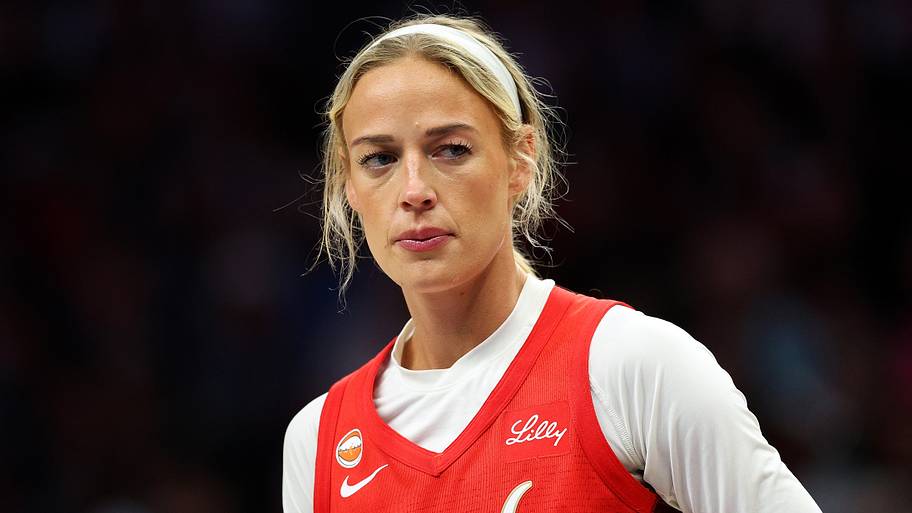
Sophie Cunningham may want to get back to basketball, but it’s too late for that. The WNBA was thrust into the epicenter of a swirling culture war after the Fever guard spoke about her opposition to transgender participation in women’s sports in a recent ESPN profile. “I want to protect young girls in a locker room, or young girls in sport who shouldn’t have to go against biological men,” Cunningham said.

Her remarks spurred considerable fallout. Fever road games have been marked by rallies put on by supporters of Cunningham and counterprotests from groups speaking out against her remarks. The WNBA suspended Storm co-owner Celeste Keaton from attending the team’s next five home games for an exchange she had with two fans who reportedly brought signage supporting Cunningham to the Storm’s July 28 matchup against the Fever. Lynx coach Cheryl Reeve wore a “Trans Kids Belong” T-shirt during Minnesota’s Aug. 2 game against Indiana. “I come from a space of inclusion,” Reeve told the media ahead of the game. “The narrative that I think is problematic is to suggest that transgender athletes are the biggest problem in women’s sports.”

Players, coaches, stakeholders and insiders are being asked to weigh in on the issue, with Fever star Caitlin Clark rebuffing the question when asked about her teammate’s remarks. “I think it’s for leagues and governing bodies to work with their athletes to find solutions,” Clark told reporters following Indiana’s matchup against Minnesota. The conversation has quickly been framed as a political and cultural hot potato, but it’s important not to lose sight of the human toll at the center of this debate. Cunningham doubled down on her initial comments before the Fever’s July 22 game, saying, “I think it’s really important to protect children, and that’s little girls who are also involved in that category.” But Cunningham isn’t protecting young girls; in fact, her words do the exact opposite, putting young athletes in harm’s way.

Professional athletes, like anyone else, should be free to express their views (that includes Cunningham, however misguided and hurtful one may think them to be). Shut up and dribble has never been a particularly compelling or genuine sentiment. But while Cunningham is free to speak her mind, she is not free from the consequences of her words. The truth is there are no active transgender players competing in the WNBA. Layshia Clarendon, who hasn’t played since 2024, was the first openly nonbinary and only openly transgender player to compete in the WNBA. In 2024, NCAA president Charlie Baker testified in front of a senate panel and stated that he knew of fewer than 10 transgender athletes in college sports. Currently, no known transgender athletes are competing in Division I women’s basketball. And even if there were, their participation would be limited, as the NCAA passed a policy in 2025 banning athletes assigned male at birth from competing in women’s sports.

Protesters ahead of a Fever-Lynx game
Fever road games have been marked by rallies put on by supporters of Cunningham and counterprotests from groups speaking out against her remarks. | David Berding/Getty Images

The International Olympic Committee announced a new policy in March, limiting participation in women’s events to athletes assigned female at birth, determined by a one-time genetic sex screening. In July, the WTA followed suit, announcing a similar policy for participation. There are no known active transgender WTA players. Renée Richards is the only openly transgender player in the history of professional women’s tennis and she stopped competing in 1981.

At the youth level, transgender participation in girls’ sports is also uncommon. Take Cunningham’s home state of Missouri. Since 2012, the Missouri State High School Activities Association has permitted 12 transgender student athletes to compete according to their gender identity. During the 2021–22 school year there were 176,231 total participants in Missouri high school athletics. Despite the small number of documented cases, Missouri passed Senate Bill 39 in 2023, banning transgender athletes from participating in sports that don’t align with their sex assigned at birth. So, between the limited occurrences of transgender athletes across professional, collegiate and youth sports to begin with and state laws and policies put in place by leagues and governing bodies restricting trans participation, the perceived “threat” to fairness posed by transgender athletes is almost nonexistent. If Cunningham, or anyone else who argues against transgender individuals’ participation in sports, wants to have a conversation about fairness based on actual instances of inequity, that is one thing. The impulse to protect the integrity of competition is understandable.

However, as it stands now, this is a largely hypothetical, boogeyman argument. And in service of making her speculative case, rhetoric like Cunningham’s ostracizes actual children. A study by The Trevor Project, published in the peer-reviewed journal Nature Human Behaviour in 2024, estimated that the enactment of state-level anti-transgender laws was followed by increases of up to 72% in past-year suicide attempts among transgender and nonbinary youth. Cunningham used distinct imagery of “young girls in locker rooms” being pitted against “biological men.” This paints the picture of hulking grown men disguising themselves as young girls, lecherously peering around a locker room. This, of course, is not the reality of the situation. That type of language is not only misleading and bombastic, but it also alienates and antagonizes transgender girls, an already vulnerable group. It’s not just what Cunningham said, it’s how she said it.

While we’re here, for those who are purporting to be concerned with the preservation, sanctity and safety of women’s sports, statistics may point to more pressing issues. Sticking with youth sports, according to a 2024 UNESCO report, 21% of women athletes (and 11% of men athletes) reported experiencing at least one form of sexual abuse as a child in sport. Never mind the garden-variety discrimination and lack of funding many girls’ and women’s athletes face.

Cunningham spoke with reporters at Gainbridge Fieldhouse on Wednesday, lamenting that in “the WNBA media, all we ever do is cover everything except basketball,” adding that “we gotta keep the main thing the main thing.” The 29-year-old dropped a grenade in the middle of WNBA discourse and would now like to walk away unscathed. Cunningham has built a substantial platform as a basketball firebrand, boasting 3.5 million Instagram followers and is the third-most followed WNBA player behind only Angel Reese and Clark.

While Cunningham has shrugged off the “MAGA Barbie” moniker bestowed on her and described her politics as “very much in the middle,” she has benefited and grown her platform on the divisive nature of America’s political environment, which has permeated every crevice of our culture. This can be seen in her comments, off-court engagements (like being a guest ring girl at UFC 329, an event headlined by Conor McGregor, who was found liable for sexual assault by an Irish civil court) and on-court demeanor.

Cunningham has embraced her role as Clark’s protector and enforcer, backing up her teammate over perceived egregious fouls. Who exactly does Clark need protecting from? In a predominantly Black league, and considering the incendiary dialogue that has glommed onto Clark, Cunningham’s flippant antics—while maybe intended as cheeky and competitive gestures—at best push the boundaries and at worst are careless. This is all to say, her comments on transgender athletes follow a pattern of Cunningham walking right up to a line, while maintaining plausible deniability. Should Cunningham be held accountable to this high of a standard? With great power comes great responsibility, and if she has monetized her platform by tiptoeing on the edge, it’s fair to scrutinize how she chooses to use that soapbox. In this instance, she used her stage and spotlight to punch down at an already marginalized and at-risk group under the guise of righteousness. I agree with Cunningham that it would be great to return the focus to the high-level basketball being played in the WNBA, but before we do, let’s not lose sight of the humanity at the center of this discourse.


MORE WNBA FROM SPORTS ILLUSTRATED

Sign up to read this article
Read news from 100's of titles, curated specifically for you.
Already a member? Sign in here
Related Stories
Top stories on inkl right now
Our Picks
Fourteen days free
Download the app
One app. One membership.
100+ trusted global sources.