
Get all your news in one place.
100's of premium titles.
One app.
Start reading
What Hi-Fi?
What Hi-Fi?
Technology
Andy Madden

Sony PS-LX5BT vs PS-LX3BT: what are the differences between the two Bluetooth turntables?

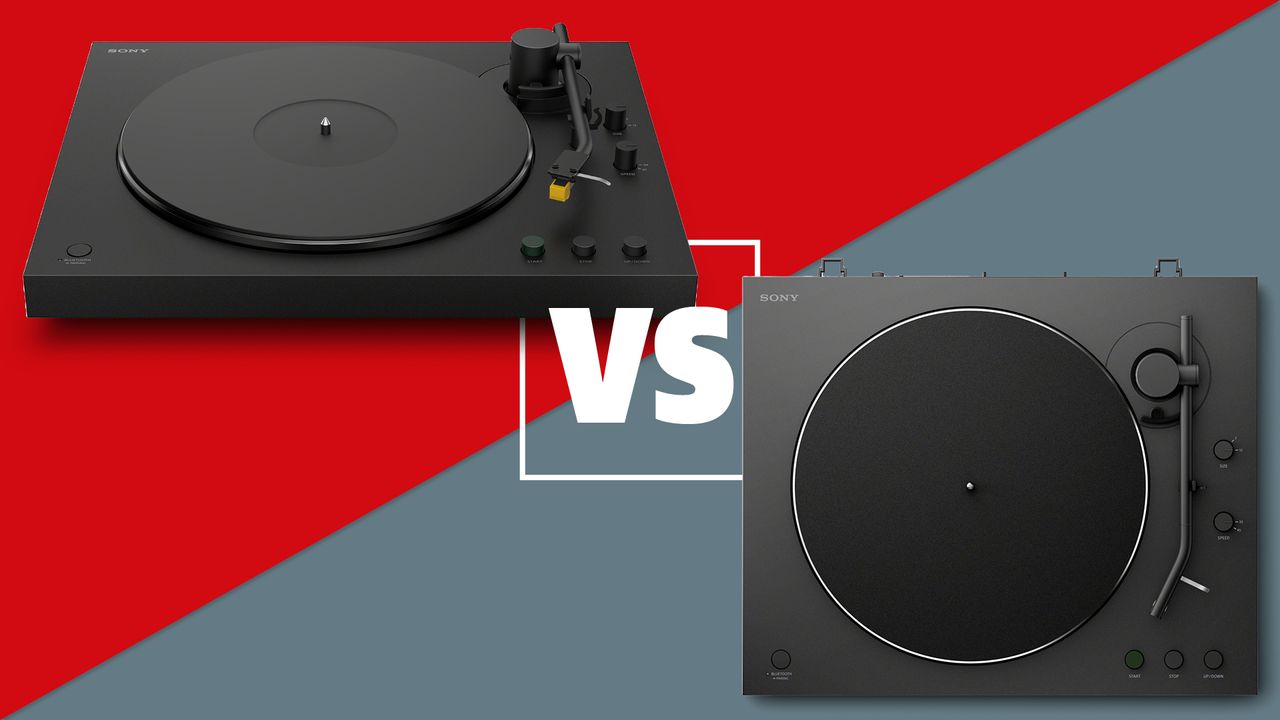
Sony PS-LX5BT and PS-LX3BT Bluetooth turntables on a red and grey background.

We've been recommending Sony's entry-level PS-LX310BT Bluetooth turntable for the better part of seven years – it's a great budget, fuss-free, plug-and-play option for those dipping their toes into vinyl.

It has been long overdue an update however, and clearly Sony agreed. The Japanese tech brand launched not one, but two new affordable Bluetooth turntables this year: the PS-LX3BT and the PS-LX5BT. We've now tested both these new models, and not only have they both received five-star ratings, they've also made it into our best Bluetooth turntables buying guide.

The two record players do look quite similar on the surface, and are priced quite closely – so what are the differences, and which one is best for you? Allow us to explain...

Sony PS-LX3BT vs PS-LX5BT: price

Sony PS-LX3BT turntable has a grey finish and near-identical features as its pricier LX5BT sibling (Image credit: What Hi-Fi?)

To begin with, the two Sony record players aren’t a million miles away from each other in terms of price.

The PS-LX3BT costs £299 / $400 / AU$469, while the step-up PS-LX5BT is yours for £399 / $500 / AU$599. You can get the LX3BT for even cheaper with current deals listing them at £249 in the UK.

It’s quite a small price gap between the two, but as you're about to discover, that’s because there are only a handful of things differentiating them.

**Winner: Sony PS-LX3BT**

Sony PS-LX3BT vs PS-LX5BT: build & design

The moving magnet cartridge (white) on the PS-LX3BT (Image credit: What Hi-Fi?)

Place the PS-LX3BT and PS-LX5BT side by side and they look virtually identical. Both are belt-drive designs, and boast a very minimalist look with a smattering of large, circular buttons.

There’s a Bluetooth pairing button, dials for choosing the speed and size of records, and a row of control buttons for the tonearm: start, stop and up/down.

To the right of the arm of each deck are dials for switching record size (between 7in and 12in) and speed (between 33⅓ or 45 RPM). In the box, you'll find a 45 RPM adapter, should any of your records require it, as well as a dustcover lid.

There are some small differences, however. The PS-LX3BT has a grey finish while the step-up PS-LX5BT sports a darker black finish. Both models feature a die-cast aluminium platter and come with a rubber mat, but mat is slightly thicker and of a noticeably better quality on the LX5BT.

The lightweight build and chunky, plasticky controls make both turntables feel more functional and utilitarian rather than sleek. They won't win any design awards, but they are easy to navigate and operate straight out of the box. There's no need to balance the tonearm, add a counterweight or set the bias – you simply plug it in, hit the power button at the back, and get started.

Both of the Sony turntables are fully automatic in operation, so once you’ve hit the start button, the turntable will do the rest, queuing up the tonearm at start of the groove to play until it reaches the end of your record, all without you having to touch the arm at any point. Both turntables actually use the same automatic mechanism that you’ll find in the outgoing PS-LX310BT.

The step-up moving magnet cartridge (yellow) on the PS-LX5BT (Image credit: What Hi-Fi?)

The biggest difference between the two models is the cartridge that comes supplied with each. The PS-LX3BT is fitted with a white moving magnet (MM) cartridge with a tracking force of 3.5g, while the PS-LX5BT comes with a step-up, yellow MM cartridge with a 2.0g tracking force.

The aluminium tonearms on both models are nearly identical – the arm tube on the PS-LX5BT is a little different, however. The cartridge is fixed on the LX3BT and removable on the LX5BT (there are screws at the end of the arm), but you can only do a like-for-like cartridge replacement as there is no scope for adjusting the arm.

The stylus on either cartridge can be replaced if damaged, however. Sony doesn't divulge the name of the brand who provides the cartridges for each deck, but it won't take you long to discover the maker when you search for a replacement stylus.

**Winner: Sony PS-LX5BT**

Sony PS-LX3BT vs PS-LX5BT: features

Switch between using the Sony's internal phono stage or bypassing it entirely (Image credit: What Hi-Fi?)

Given the turntables' plug-and-play nature, there really isn’t much to do when it comes to set-up, apart from fitting the belt and platter. After that, you're ready to start spinning.

Both turntables support Bluetooth streaming, so you can beam your records wirelessly to compatible Bluetooth speakers and wireless headphones, leading to flexible ways of listening. The aptX Adaptive codec is supported on both, which lets you stream in up to 24-bit/96kHz audio quality.

Pairing is simple: put the turntable and your chosen Bluetooth product (such as the JBL Charge 6 or Sony WH-1000XM6) in pairing mode, and they should connect instantly. You can have up to eight different devices paired at any one time, but just remember to turn off pairing mode when you're switching back to the physical connection.

Continuing the plug-and-play theme, both turntables have a built-in phono stage with three-level gain control to make them more flexible when it comes to equipment matching. For instance, either turntable can be plugged directly into a pair of active or desktop speakers, such as the Onkyo GX-30ARC or Ruark MR1 Mk3 for an ultra-compact vinyl set-up.

Sony says the phono stage circuit in both new turntables has been improved over the one used in the outgoing PS-LX310BT, with “improved carbon resistors and a revised grounding layout for better sound performance”.

You can pair the LX3BT to Bluetooth speakers like the JBL Charge 6 (Image credit: What Hi-Fi?)

It's switchable too, which means you can opt to use the Sonys' built-in phono stage or bypass it entirely and use the one in your stereo amplifier. During our tests, we found that the phono stage of both Sony turntables is of really rather good quality, so it's one to take advantage of in your system if you don't have the space or cash for a separate phono stage.

There's is, however, scope to upgrade the turntable by opting for a better-quality outboard phono stage, should you wish, but the point of this type of turntable is to keep things as simple and neat as possible.

One last physical difference between the two is that the LX3BT has captive audio cables, while the interconnects on the LX5BT are removable – which means you can upgrade them with your own set of cables.

**Winner: Draw**

Sony PS-LX3BT vs PS-LX5BT: sound

The LX5BT turntable can be connected – via Bluetooth or wired cables – to Ruark MR1 Mk3 powered speakers for a compact vinyl system (Image credit: What Hi-Fi?)

With the main material differences between the two models being the cartridge and rubber mat, is that enough to deliver distinct differences in sound quality?

In short, yes it is.

Whether plugged into the Ruark MR1 Mk3 powered speakers or in a more hi-fi system of the Arcam A5+ amplifier and Epos ES-7N speakers, both Sony turntables offer a composed, controlled and well-organised sound. There's a good deal of punch, textural insight and a sense of solidity across all the genres we spin on these record players.

The LX3BT has "a genuine sense of musicality", with Rudimental’s Rudim3ntal album sounding appropriately punchy and forthright, "while Nas’ Illmatic walks a satisfying line between hazy smoothness and authoritative punch." It does sometimes falter when dealing with rhythmically complex arrangements, but overall this budget automatic turntable holds its own.

The LX5BT exhibits much of the same sonic personality, but is noticeable better. It has a more open and wider soundstage than its cheaper sibling, giving instruments space to breathe. There is more detail across the board too, and the LX5BT does a fine job in justifying the additional £100 / $100 you'll be paying for it over the more affordable LX3BT.

Even on its own, the LX5BT's authoritative sound balances poise and punch, while voices sound authentic and natural, and instruments sound nimble and propulsive to keep us invested in the tunes being played.

Granted, rival purist options such as the fully manual Rega Planar 1 Plus (which has a phono stage but no Bluetooth) will offer a considerably subtler, more dynamic and rhythmically precise performance for about £399 / $599 / AU$899.

But the Sony turntables major in convenience and their set of features is a huge draw for those that want a no-fuss, easy to use turntable – that they sound so enjoyable and capable for this type of turntable is no mean feat.

**Winner: Sony PS-LX5BT**

Sony PS-LX3BT vs PS-LX5BT: verdict

The pricier LX5BT offers a step up in performance (Image credit: What Hi-Fi?)

So there you have it. The Sony PS-LX3BT and PS-LX5BT have plenty of similarities. They share the same automatic operation, have the same features (built-in switchable phono stage and Bluetooth streaming), and they even work in the same way.

The cartridges do make a big difference, and it's entirely up to you and your budget as to whether you want to make the extra monetary leap for the better performance of the LX5BT. If you can, then it's worth the investment. If you can't, however, you'll still be satisfied with the plug-and-play performance of the LX3BT, and you won't miss out on any features.

It seems Sony has put plenty of effort into how its two new affordable Bluetooth turntables sound, and for those looking to take their first step on the vinyl ladder – and perhaps doesn't want to plunge straight into separates hi-fi just yet – these are worth considering.

MORE:

Sony’s new Bluetooth turntables have an ace up their sleeve – and it’s great for vinyl newbies

Vinyl on your radio? Discover 4 non-traditional but easy ways to listen to your turntable

Our pick of the best turntables across all budgets

Sign up to read this article
Read news from 100's of titles, curated specifically for you.
Already a member? Sign in here
Related Stories
Top stories on inkl right now
One subscription that gives you access to news from hundreds of sites
Already a member? Sign in here
Our Picks
Fourteen days free
Download the app
One app. One membership.
100+ trusted global sources.