Get all your news in one place.
100's of premium titles.
One app.
Start reading
Sports Illustrated
Sports Illustrated
Clare Brennan

Something’s Got to Give With the Indiana Fever

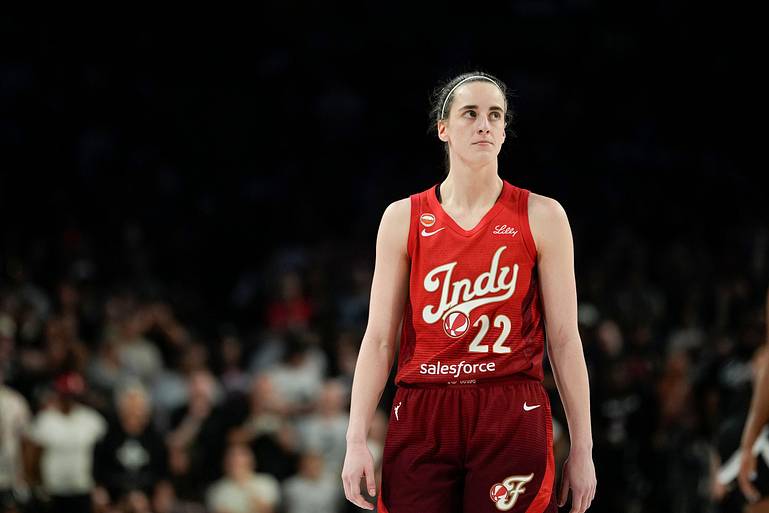
Caitlin Clark beelined to an official, her eyes wide and her left hand pulling up her lip to expose a cascade of blood dripping from her tooth. She pointed at the blot with her right index finger, an incredulous look plastered on her face. That was the enduring image from the last game of the Fever’s 2026 season, and in many ways the messy, unnerving scene was a fitting representation of the past year in Indiana.

​The Aces sent the Fever packing in the first round of the playoffs, with A’ja Wilson delivering a stark memorandum about how close, yet so far Indiana is from beating the best. But before Becky Hammon’s team could revel in the spoils of victory, Clark took an elbow to the face from Jewell Loyd in what appeared to be incidental contact, as both battled for a rebound in the final minutes of a decisive Game 3. No foul was called. Discourse ensued, as it often did with the Fever this season. This all came after Wilson got into a verbal altercation with a Fever fan at Gainbridge Fieldhouse in Game 2. (Indiana deemed that the fan did not breach the fan code of conduct and Wilson was not fined). Point being, it was a very Fever-esque series in tone and tenor.
Indiana may not be able to control some of the chaos that surrounds it, or its lightning rod status in the league, but to say that the franchise can go on as it has, simply blocking out the noise, is disingenuous. The team will make basketball decisions ahead of next season, but addressing the off-court discourse will be just as important in Indianapolis. So, where do the Fever go from here?


A cloud rolled in over Gainbridge Fieldhouse in May, and it stayed put into the fall. As much as players and staff put on a unified, nothing-to-see-here front amid countless controversies, the Fever didn’t exactly emit joy and positivity this season. Indiana tested the limits of what one team could take, with an ardent string of its fan base even resorting to turning on its own coach.

The fervor surrounding Clark, and by proxy the Fever, is nothing new. In many ways, her presence and popularity have permanently changed women’s basketball and the WNBA landscape. It’s no secret that a vocal contingent has used Clark as a Trojan Horse for its ideology, creating tension with the existing WNBA fan base, which largely holds a very different set of convictions.

Two years before Clark joined the league, in 2022, the Institute for Diversity and Ethics in Sports’s Racial and Gender Report Card cited that players of color made up 81.1% of the WNBA, and the league was represented by 70.3% Black or African American players. Clark emerging as the face of a league built primarily by Black women was always going to cause turmoil. In 2024, when asked, Clark denounced the use of her name to promote racism and misogyny. “I think everybody in our world deserves the same amount of respect. The women in our league deserve the same amount of respect,” Clark said. “People should not be using my name to push those agendas.” The extent to which it’s Clark’s personal responsibility to speak more frequently and in depth about the league’s racial dynamics and her fan base, beyond the statements she has made, remains the source of debate. But, critically, racism and bigotry have endured as the league continues to explode in prevalence. The WNBA and the Fever seem to have been caught off guard and unprepared for the hurricane of vitriol and divisiveness that has followed the league and the team.

A fan holds up a
Rallies and protests followed Fever games this season after Sophie Cunningham said she opposed transgender athletes in girls’ and women’s sports. | Steve Russell/Toronto Star/Getty Images

In 2026, the negativity swirling around the squad reached a fever pitch. With Clark and her team playing under a magnifying glass, how opponents guarded the star and how she was officiated became a hot topic. Alyssa Thomas said she received death threats after being issued a Flagrant 2 for a hard foul on Clark during a June matchup between the Fever and Mercury. (Clark condemned the online harassment directed at Thomas.) This incident only added to the narrative that Clark was guarded more physically than others, pitting her against the majority of the league and intensifying the racial undertones already coating the conversation around the 24-year-old.

In August, two fans were escorted out of Gainbridge Fieldhouse during a game against the Aces, with the spectators directing comments toward Las Vegas guard Jackie Young. The Fever later clarified that the fans did not violate the code of conduct and elected to leave. These incidents only add to the growing perception that a swath of Fever fans are antagonistic to the league in which the team competes—a red dot in a sea of blue, to borrow a phrase from political jargon. In 2024, Sky guard Dijonai Carrington posted to X: “the indiana fever have the nastiest fans in the W. ew.”

Fever GM Amber Cox addressed the narrative during the team’s Oct. 3 exit interviews. “The attacks on our fanbase have no basis in reality, and they need to stop …,” Cox said. “Every organization throughout professional sports has to deal with occasional bad behavior with spectators. Anyone who crosses the line needs to be held accountable. There’s a line, and people need to be held accountable. However, we didn’t have one fan pointed out by a player who violated the WNBA’s code of conduct this season.”

Aces forward Brianna Turner, who played eight games in a Fever uniform last season, responded to Cox’s comments in a post to X, writing, “This is an unequivocally false statement. Players inside and outside the organization have repeatedly issued complaints with the Fever Fanbase. While it’s not all Indy fans, it’s certainly a trend. To say the attacks have ‘no basis in reality’ is disingenuous.”

While Cox is within her rights to defend her team’s fans and correct the record, the narrative she’s hoping to squash didn’t appear out of nowhere, and it will persist as long as the underlying conditions and players’ accounts (like Turner’s) go unaddressed.

Then there’s Sophie Cunningham, a firebrand in the league who has been deemed MAGA Barbie by some WNBA fans. Cunningham has pushed back on that nickname but the moniker has stuck. The label, while perhaps imprecise, connotes that Indiana is the epicenter of the culture war that has consumed the league. Cunningham solidified that after making, then doubling down on, comments opposing transgender participation in sports in a July interview. “I want to protect young girls in a locker room, or young girls in sport who shouldn’t have to go against biological men,” Cunningham said, playing on harmful, bigoted tropes to describe transgender youth. Once again, the team found itself at odds with a league whose long-term supporters consider it a safe space, and where 25% of its players publicly identify as LGBTQ+, according to Autostraddle. Conservative groups protested outside Fever games and at opposing teams’ arenas in support of Cunningham and her comments. Gasoline, meet fire.

When Fever fans felt White hadn’t gone to bat hard enough for Cunningham after describing a Flagrant 2 foul Carrington committed against her in a matchup with the Sky as unintentional, they booed White at a home game. The coach later called the play “egregious” after reviewing the tape. Clark said it “made her a little sick” to see White booed.

“It’s a shame that we can’t have an opportunity to talk about what great basketball they’re playing,” White said, addressing the mounting fan uproar against her. “The hate, the fear-mongering, the divisiveness, the stuff that is trying to hijack our league will not win.”i

The problem? To a certain extent, the call is coming from inside the house.


Kelsey Mitchell speaks during the 2026 exit interviews
Kelsey Mitchell spoke candidly about her experience playing in Indiana this season. | Grace Smith/IndyStar/USA TODAY NETWORK/Imagn Images

Kelsey Mitchell has had a front-row seat to the franchise since Indiana drafted her with the No. 2 pick in 2018. While she had a career season in 2026, averaging an astronomical 24.7 points per game, Mitchell also acknowledged the hardship she endured being a part of the Fever this year.

“Showing up every day to compete for fans that may or may not like you is hard,” Mitchell said during her exit interview. “Playing with [Clark] and having the eyes that she got, we get a lot of flak just for being on her team. … I think this organization is unbelievable, but I think that when it comes to really trying to be yourself, it hasn’t always been easy.”

That quote should stop Cox in her tracks. Her own player, someone who was drafted by the franchise and stuck with Indiana through its lowest points, said she has to play in front of fans that may or may not like her and that it’s been a difficult environment for her to be herself. How can Cox issue a full-throated defense of Fever fans, stating unequivocally, “our fans love this team,” on the same day Mitchell issued such an honest and reflective statement about her own experience? Surely, many Fever supporters do love the team, but some have a very funny way of showing it.

Yes, there are things the team can’t control, like the relentless dissection of every move Clark makes, but it’s important to sort out what’s just noise and what discourse actually needs addressing. There are things, small and big, that the team and league can do to combat the negativity. The first step comes with a more honest and curious accounting of how some of the fan base plays a critical role in fomenting “fear-mongering” and “divisiveness.” Until the powers that be do that, controversies will continue to follow Indiana, and a culture war will continue to commandeer the league, overshadowing the talent and greatness of its players.

The WNBA and Fever may have been late to address the initial wound, but there is still time to stop the bleeding.


MORE WNBA FROM SPORTS ILLUSTRATED

Sign up to read this article
Read news from 100's of titles, curated specifically for you.
Already a member? Sign in here
Related Stories
Top stories on inkl right now
One subscription that gives you access to news from hundreds of sites
Already a member? Sign in here
Our Picks
Fourteen days free
Download the app
One app. One membership.
100+ trusted global sources.