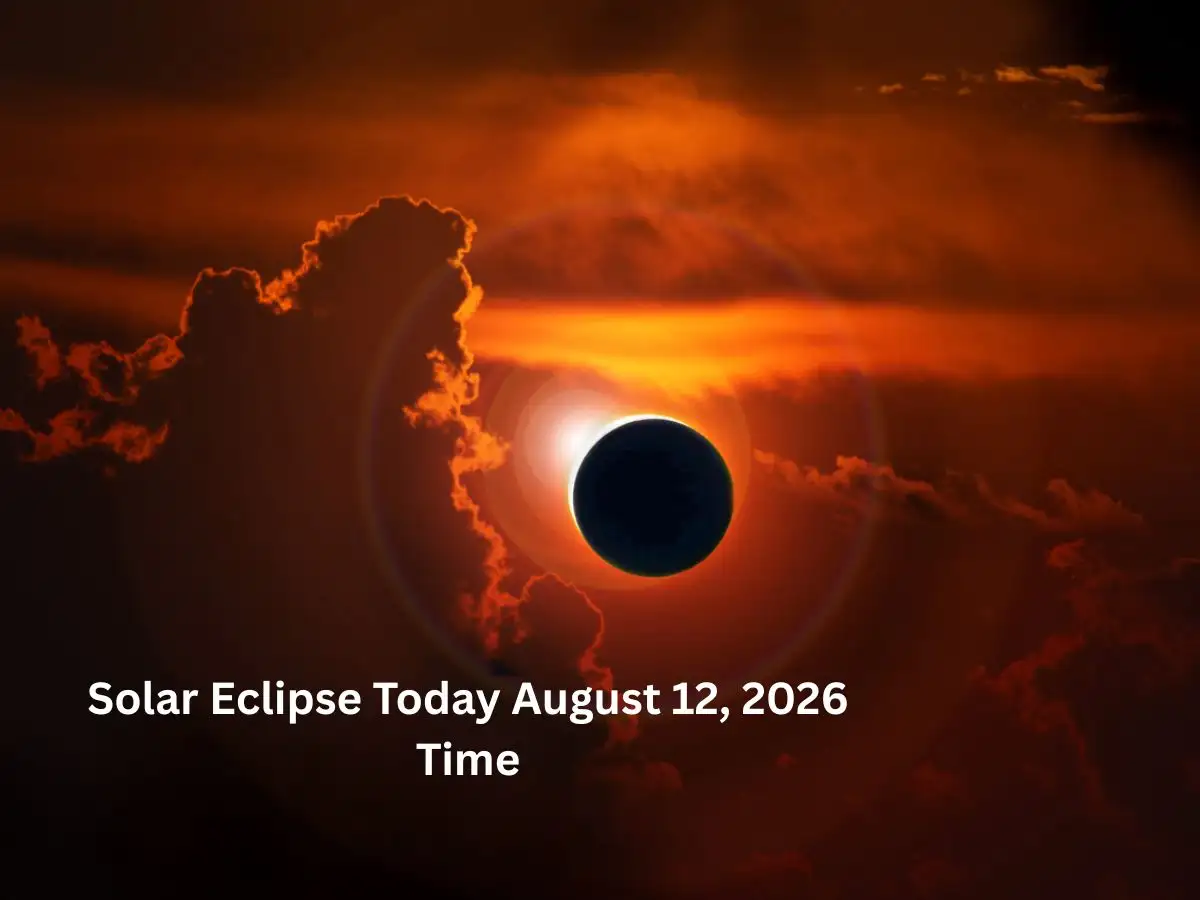
The August 12 total solar eclipse will give millions of people across parts of Europe an opportunity to witness the Moon completely cover the Sun, marking the return of totality to central and western mainland Europe after 27 years. NASA is encouraging skywatchers, including people in the US who will not experience totality, to follow the event through its livestream. NASA confirms that the eclipse will cross Greenland, Iceland, northern Russia, Spain and a small part of Portugal, while a partial eclipse will be visible across wider areas of the Northern Hemisphere.
The total eclipse will last a maximum of about 2 minutes and 18 seconds.

When is the solar eclipse?
The total solar eclipse will take place on Wednesday, August 12, 2026 . The Moon's shadow will move across the Northern Hemisphere before reaching Europe.
The eclipse will first become visible in extreme northern Russia at 17:00 UTC, or 1 p.m. Eastern Time . It will then move towards Greenland and Iceland before crossing parts of Spain and Portugal.
Totality will be visible from parts of Iceland and Spain, while much of the rest of Europe will experience a partial solar eclipse. NASA's eclipse data places the greatest eclipse at about 17:45 UTC , with the longest totality lasting approximately 2 minutes and 18 seconds.
What time is the eclipse today?
The exact timing depends on the location. It will reach northeast Greenland at about 1:30 p.m. ET and western Iceland at around 1:45 p.m. ET . Totality will begin in Reykjavík at 5:48 p.m. local time .
After crossing the North Atlantic, the eclipse will reach northern Spain at about 2:30 p.m. ET . Totality will begin at 8:32 p.m. local time in Valencia .
The whole path will be over by about 2:45 p.m. ET .
For people in North America who will see a partial eclipse, the maximum will occur at different times depending on the city. Toronto will see its maximum at 1:40 p.m. local time , while New York City will reach maximum coverage at 1:54 p.m. In Fairbanks, the maximum will occur at 8:27 a.m. local time .
When can you watch the solar eclipse in US?
The US will not experience totality during the August 12 eclipse, although parts of the country will see a partial solar eclipse. NASA says the partial eclipse will be visible across parts of the northern US, including Alaska and areas extending southward toward North Carolina.
Canada will also experience a partial eclipse across much of the country.
For North American viewers, the maximum eclipse will occur at different times depending on location. New York City will reach maximum coverage at 1:54 p.m. local time , while Fairbanks will reach its maximum at 8:27 a.m.
United States: August 12 solar eclipse timings
| City | Eclipse begins | Maximum | Coverage | Eclipse ends |
|---|---|---|---|---|
| Anchorage | 7:36 a.m. | 8:21 a.m. | 28% | 9:09 a.m. |
| Bangor | 12:54 p.m. | 1:53 p.m. | 24% | 2:49 p.m. |
| Boston | 1:01 p.m. | 1:55 p.m. | 16% | 2:46 p.m. |
| Detroit | 1:03 p.m. | 1:36 p.m. | 3% | 2:08 p.m. |
| Fairbanks | 7:37 a.m. | 8:27 a.m. | 37% | 9:18 a.m. |
| Juneau | 7:41 a.m. | 8:24 a.m. | 17% | 9:08 a.m. |
| New York City | 1:07 p.m. | 1:54 p.m. | 9% | 2:38 p.m. |
| Philadelphia | 1:11 p.m. | 1:53 p.m. | 7% | 2:35 p.m. |
| Portland, Maine | 12:57 p.m. | 1:53 p.m. | 19% | 2:27 p.m. |
| Washington, D.C. | 1:17 p.m. | 1:53 p.m. | 4% | 2:27 p.m. |
Note: All timings are local times for the respective cities in the United States.
Canada: August 12 solar eclipse timings
| City | Eclipse begins | Maximum | Coverage | Eclipse ends |
|---|---|---|---|---|
| Edmonton | 10:02 a.m. | 10:38 a.m. | 6% | 11:15 a.m. |
| Halifax | 1:58 p.m. | 3:00 p.m. | 31% | 3:58 p.m. |
| Montreal | 12:50 p.m. | 1:45 p.m. | 18% | 2:38 p.m. |
| St. John's | 2:28 p.m. | 3:35 p.m. | 53% | 4:37 p.m. |
| Toronto | 12:55 p.m. | 1:40 p.m. | 8% | 2:23 p.m. |
| Winnipeg | 11:25 a.m. | 12:02 p.m. | 5% | 12:40 p.m. |
Note: All timings are local times for the respective cities in Canada.
When will Europeans be able to see the solar eclipse?
The path of totality will move from northern Russia across Greenland and Iceland before reaching Spain and a small part of Portugal. Much of the rest of Europe will experience a partial solar eclipse.
In Spain, the eclipse will travel roughly from the northern city of Oviedo to Mallorca. The path will also cross areas affected by devastating wildfires that scientists say were made more likely by human-driven climate change.
The last total solar eclipse visible from central and western mainland Europe occurred on August 11, 1999 . The August 12 event therefore marks a return of totality to the region after 27 years.
Europe: August 12 solar eclipse timings
| City | Country | Eclipse begins | Maximum / totality begins | Eclipse ends |
|---|---|---|---|---|
| Reykjavík | Iceland | 4:47 p.m. | 5:48 p.m. totality | 6:47 p.m. |
| Dublin | Ireland | 6:12 p.m. | 7:10 p.m. | 8:05 p.m. |
| London | United Kingdom | 6:17 p.m. | 7:13 p.m. | 8:06 p.m. |
| Paris | France | 7:22 p.m. | 8:17 p.m. | 9:09 p.m. |
| Stockholm | Sweden | 7:03 p.m. | 7:56 p.m. | 8:46 p.m. |
| Berlin | Germany | 7:15 p.m. | 8:08 p.m. | 8:38 p.m. |
| Milan | Italy | 7:27 p.m. | 8:20 p.m. | 8:35 p.m. |
| Saint Petersburg | Russia | 7:59 p.m. | 8:51 p.m. | 9:00 p.m. |
| León | Spain | 7:32 p.m. | 8:28 p.m. totality | 9:22 p.m. |
| Zaragoza | Spain | 7:34 p.m. | 8:29 p.m. totality | 9:07 p.m. |
| Valencia | Spain | 7:38 p.m. | 8:32 p.m. totality | 9:01 p.m. |
Note: All timings are local times for the respective cities and countries. For Reykjavík, León, Valencia and Zaragoza, the middle timing shown is the start of totality. For the other European cities, it is the time of maximum partial eclipse.
How to watch the August 12 solar eclipse safely
Anyone viewing a partial solar eclipse must use certified eclipse glasses or a safe solar filter. Looking directly at the Sun without proper protection can cause permanent eye damage.
NASA also emphasises that eye safety is essential when viewing solar eclipses.
How to watch the August 12 eclipse online
People outside the path of totality can watch the event online. NASA's livestream is scheduled to begin at 1:15 p.m. EDT and will include telescope views, footage from a high-altitude research aircraft, expert commentary and other coverage.
The European Space Agency will also provide live coverage from Spain.
Why is the August 12 eclipse significant?
The eclipse is notable for its return of totality to central and western mainland Europe after 27 years. For observers inside the narrow path of totality, the Moon will completely cover the Sun, briefly darkening the daytime sky and revealing the Sun's outer atmosphere, or corona.
The total phase will reach a maximum duration of approximately 2 minutes and 18 seconds.
What comes after the August 12, 2026 eclipse?
The August 12 eclipse begins a notable sequence of total solar eclipses. On August 2, 2027, another total solar eclipse will cross parts of southern Europe, North Africa and the Middle East. NASA lists a maximum totality of 6 minutes and 23 seconds for that eclipse.
A third total solar eclipse will follow on July 22, 2028, with totality crossing parts of Australia and New Zealand.