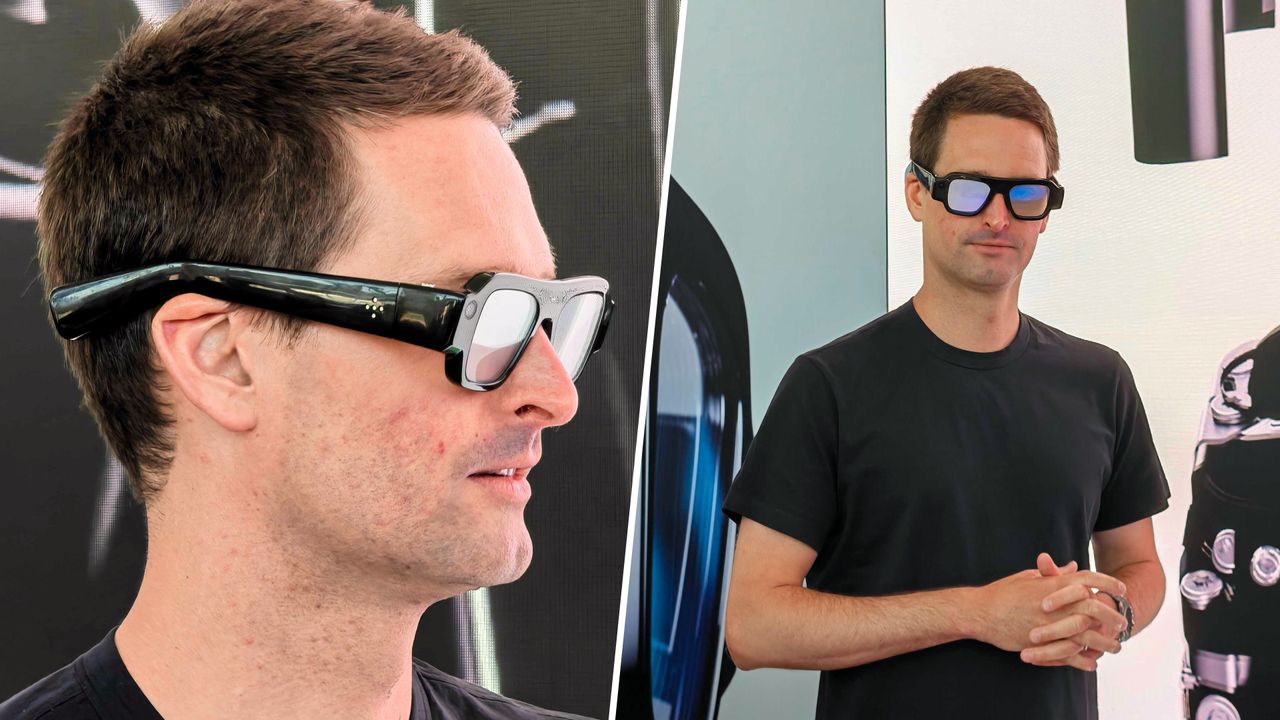
Picking out your favorite pair of the best smart glasses is about to get tougher as Snap is expected to unveil its next generation of AR smart glasses in California today. The company will be bringing the fight to the Ray-Ban Meta smart glasses.
Snap CEO Evan Spiegel took to the stage at the Augmented World Expo (AWE) event in Long Beach today to reveal the new Snap Specs. Snap already has a developer version out in the world, but this marked the first consumer version of Snap's answer to Meta, Xreal, Viture and all the rest.

The build-up to today's reveal has been gaining momentum over the last year or so. We've already seen some key updates made to Snap OS to make it ready for today's event, and we know the hardware will be powered by a partnership with Qualcomm.
How to watch today's keynote
The biggest announcements
- The Snap Specs will cost $2,195 ; they're available for preorder starting today, and are expected to ship this fall
- Battery life is about 4 hours , but the Specs can be recharged while you're wearing them, and the USB cable can be used to stream content directly to the glasses.
- The Specs are powered by two Qualcomm Snapdragon chips, one for visual processing, and one to run the rest of the glasses.
- The Specs deliver a 51-degree FOV , the equivalent of a 24-inch desktop monitor or a 115-inch TV from 10 feet away
The keynote is scheduled took place today, June 16 at 9:30am PT / 12:30pm ET / 6:30pm BST.
Evan Spiegel's keynote address was titled “Making Computing More Human" and lasted for around 30 minutes on the Main Stage at the AWE Expo in Long Beach, California.
The address was live streamed on the AWE YouTube channel
LIVE — latest updates
Hello and welcome!
A post shared by SPECS (@specs)
A photo posted by on
Welcome to our live coverage of today's Snap Specs announcement! It's just under six hours until Evan Spiegel is due to take the stage at AWE 2026. There have been a lot of rumors about what's coming, but the only official glimpse we've had so far came last week on Snap's Instagram post teasing the forthcoming hardware at today's reveal.
The competition
Snapchat was one of the first companies to experiment with smart eyewear but now the company is far from alone. The biggest competitor to Snap is its old arch-rival Facebook. Sorry, Meta. In the form of the Ray-Ban Meta smart glasses.
Meta's glasses look cool, feature a respectable camera, decent battery life and a responsive AI that lets you take full advantage of the glasses’ hardware. The second-gen Ray-Ban Meta costs $379 to start but the first-gen Ray-Ban Metas are still on sale for $299.
What exactly do we expect from Snap today?
It's not a foregone conclusion that Speigel will reveal the new Snap Specs today, but the timing would line up nicely. Last year at AWE 2025, Spiegel talked up Snap's 5th-generation standalone AR glasses and announced that the company had plans for a consumer model called "Specs" in 2026.
Spiegel promised this consumer version of the wearable would be lighter with a smaller-form-factor. He said they would have "a fraction of the weight, with a ton more capability."
If Speigel doesn't reveal any hardware today, he could spend time talking about how the company is pushing forward with what it calls "Lenses" — basically, its own take on apps for its smart glasses.
Developers have hopefully been busy
There's no point launching a new hardware product if you don't have the software to back it up. Snap currently rents its Spectacles development kit glasses out to developers for $99/month to build "Lenses" (apps) through a program called Lens Studio on Windows and macOS.
Although Snap OS is based on Android, it's restricted in the fact that you can't install APKs or use third-party engines on it. Snap is likely hoping to capture some of the benefits of Apple's visionOS approach here: a bespoke suite of consistent apps that operate without friction.
If it can have a robust set of titles ready for users at launch, it's a much easier sell. Particularly if there's a killer app it can point to.
The rumored price for the Snap Specs is *high*
One of the biggest questions around any potential Snap Specs is likely to be how much they'll cost you. And according to Alex Heath's Sources newsletter (via UploadVR) it could be a lot. Heath suggested Snap is looking at producing 100,000 Specs with a target price of $2,500 (£1,800)!
That puts that way ahead of both Meta's most expensive Ray-Ban glasses and its Quest 3 VR headset. The Viture Beast is our current pick of the best AR smart glasses you can buy, and a pair of those costs $549. Launching a gen 1 product into the smart glasses space with that high a price could be dangerous. Just ask Apple.
Expect a lot of talk about AI, too
Back in January, Evan Spiegel gave us an idea of what he may be preparing to talk about today.
"For over a decade we’ve been working to make computing more human by building a new type of eyewear called Specs that integrate your digital experience with the real world," he wrote.
If the recent keynote speeches from other tech leaders like Sundar Pichai, Satya Nadella and Tim Cook are anything to go by, we can expect a lot of AI talk to accompany a hardware reveal today.
Spiegel promises a "first-of-its-kind Intelligence System" with Snap Specs that "uses its understanding of you and your world to help get things done on your behalf while protecting and respecting your privacy."
Snap will face competition from Project Aura and Android XR
The Snap Specs have an ever-increasing list of competitors to worry about, not least Xreal's Project Aura.
We got a glimpse of Aura back at Google I/O. If you didn't tune in to that particular event, let me enlighten you: These are Xreal's next serious attempt at AR glasses packed into a design hat you wouldn't be afraid to be seen in.
Xreal's glasses will run Android XR and connect to a computing “puck” that looks about the same size as a phone. That’s where most of the brains are, and it also happens to double up as a trackpad. Also, because this is Google's platform, you'll get access to all of Google's apps, like Chrome or Maps.
What's more, Project Aura is tipped to cost between $1,000 and $1,500 at launch. Which is a lot easier to swallow than the rumored $2,500 price tag of the Snap Specs.
What are some of the experiences they could offer?
At last year's AWE, Snap gave us a taste of some of the things users could do with the Specs. These included Pool Assist, which helps you make better plays on the billiards table and Super Travel which is supposed to translate signs, menus and other text while abroad.
In the months since, my colleague Darragh Murphy got to try out the glasses for himself at an event in London. During his demo, he was able to play games with virtual creatures, summon AI-created images in front of his eyes and share the virtual space with other users wearing their own pair of Spectacles.
"From creating AI-generated 3D images right on the AR glasses and drawing smiley faces in the air to dropping virtual sandwiches to Peridot creatures, everything I was doing in augmented reality could be seen in real time by others wearing Snapchat Spectacles," Darragh wrote.
@tomsguide ♬ Vlog lo-fi chill hop ♬(1258569) - Ninja Muzik Tokyo
How much would you pay for Snap smart glasses?
With the price of the Snap glasses rumored to be more than $2,000, we wanted to ask you how much you'd pay for the new specs.
Snap's big bet
It might be fair to say that a lot is riding on the new Snap smart glasses. The company has spent $3.5 billion on its new specs, and back in April, laid off 1,000 employees, about 16% of its staff.
Last month, Inc. magazine ran a story titled "Snap CEO Evan Spiegel Has to Go," saying that the company has never been profitable in its 15 years of existence. Its stock price has also bottomed out over the last few years; it's now trading at around $5 per share, down from a high of around $83.
Powered by Qualcomm
While we're still waiting to hear everything that Evan will reveal, we do know that the Snap glasses will be powered by a Qualcomm Snapdragon XR chip, as the companies announced a partnership back in April.
Qualcomm's chips are in a lot of the best smart glasses and AR/VR glasses — including all of the Meta Ray-Ban glasses, The Xreal Project Aura, and the Rayneo X3 Pro — so it's not surprising that Snap would partner with them on its initiative.
Fused with AI
Snapchat, like all the other tech companies out there, is leaning as hard as it can into AI. Spiegel has already claimed that more than two-thirds of the new code written at Snapchat is done by AI, and the company's "Lens Studio" platform is becoming "more and more agentic", according to a report in Inc.com.
The title of Spiegel's keynote address later today is "Making Computing More Human" so I'm expecting a lot of talk about adopting AI into our fleshy human lives.
Snap's recent layoffs probably won't be mentioned
One thing that probably won't get brought up today is the recent layoffs at Snap.
Back in April, the company laid off around 1,000 employees and closed hundreds of open roles. At the time, Spiegel said in a memo (published by Business Insider) that AI meant the company could run a leaner operation.
The cuts didn't affect Specs Inc, which was spun off into a separate company back in January to focus on AR efforts.
Twenty minutes to go
We're about 20 minutes from the start of the livestream — make sure you're ready!
Our own Jason England is at the press conference, and will report back live from the event. Ori Inbar, the CEO of AWE, takes the stage ahead of Spiegel to warm up the crowd.
Evan Spiegel takes the stage, and starts off by talking about the Snap developer community, and how they kept believing and building.
"I feel so fortunate to work on what I feel is the next major leap in computing"
"Steve Jobs was my hero," Spiegel says. "He promised your life in your pocket"
"But almost 20 years later, we have to ask ourselves what happens when the device starts pulling us away from each other?"
"Augmented Reality puts computing into the world."
12 years ago we saw the opportunity for something different," Spiegel says. "Something that understands the world around you rather than pulling you out of it."
"Specs will become meaningful because of the lenses you build. We've shipped 10 OS updates with more than 40 new features and APIs. Developers have already published hundreds of lenses."
We're now seeing a few of the Lenses that developers have built, like virtual games, dinosaurs, and rockets lifting off.
Spiegel explains that it understands the room around you so that it becomes part of an interactive space. So you can use things like physical tables and incorporate that into a virtual environment. And, the Specs can talk to each other so that multiple people can play the same game together.
Next, Spiegel talks about AI. Spatial Benchmark will test how well various AIs work across the different virtual environments. In an early test, GPT 5.5 worked best overall, with Gemini 3 Flash coming in close behind.
And finally, the Specs are revealed!
Devices today force a tradeoff between capability and wearability. AI glasses are wearable but limited. Headsets are capable but shut you out of the world.
Specs - "Designed to be wearable and highly capable. No puck, no tether," Spiegel says.
A new kind of computer designed for real life and built into see-through glasses.
Made from TR90 polymer - light enough to be worn for hours.
Specs come in two sizes:
47mm frame weighs 132 grams
52mm frame is 136 grams
The Specs not only support prescription lenses, but the lenses can also be removed, so you can share them with friends.
The glass that carries light from the glasses to your eye is called a waveguide, and the Specs waveguide creates an immersive 51-degree field of view image.
That's like a 24-inch desktop display, or a 115-inch screen about 10 feet away.
It can also display 16 million colors.
Specs use the same tech as Boeing 787 Dreamliners, and can shift from clear to tinted in just 10 seconds.
The Specs have two Qualcomm Snapdragon processors, one for running the glasses themselves, and one for computer vision.
Spiegel says the Specs have a 7ms motion to photon latency, so when you move, the Specs respond virtually instantly.
Directions appear as you move throughout a city, measurements change, and translations and data appear in front of you.
Spiegel then shows some examples of Specs in the real world, like helping someone improve their golf game, or showing what drums to hit if you're sitting in front of a set.
Battery life is about 4 hours, according to Spiegel, which is less than what you get with the Ray-Ban Displays, but understandable given the more powerful processing in the Specs. Still, that's far short of a full day.
However, you can recharge them while wearing them - and you can use that same USB cable to stream video to the specs while you're recharging.
The case also gives you up to 20 hours of use.
As suspected, the Specs aren't cheap: $2,195! Somehow, people are cheering at this price.
You can preorder them starting today, and they're expected to ship this fall.
And that's a wrap! The Snap livestream has ended, and it's given us a lot to chew on.
If you want to see what the Specs look like on a supermodel, check out our story on Imogen Heap and Jack Harlow wearing the smart glasses.
We also have a complete rundown of the Snap Specs complete stats and price, so you'll want to take a look at that story for a deeper dive.
Let us know in the comments what you think!
Jason is now heading to the hands-on area to see what these specs are like up close. Stay tuned for more updates from AWE 2026. As you can see, there's a lot of people here!
Up close and personal
Seeing them on someone's face is the best way to gauge the bulkiness of the Specs. They do appear to be a little large, but not comically so. They could easily pass as a pair of chunky frames for regular glasses, which is obviously what the team at Snap is aiming for.
In case you missed it
See the embed above for the keynote if you didn't get to watch it live (or just read the posts below this, as it covers all the big news).
Are you excited?
Do you think they look good?
The Specs have now been seen up close and personal by our own Jason England. They've also been worn by celebrities to show us a bit more about the style the smart glasses offer.
Do you think they look good? Would you think anything of seeing people out in the wilderness with these?
A look at the Specs from different angles
We're still hoping to get a full hands-on later, but for now, here's what the Snap Specs look like from different angles. Their arms and frames are definitely chunkier than the Ray-Ban Displays, but then again, these glasses have to support dual displays.
Eyes-on with the Snap Specs
Our very own Jason England was able to go see the Snap Specs at AWE up close and personal, and while he's going to wait until he can wear them out in public to render a final verdict, his initial impressions were that they are "pretty chunky."
Still, he says they're a fair bit sleeker than the developer model that's been out for a while.
Snap gave the weight of the glasses as 132 grams; for those who live in the U.S., that's about 4.7 ounces, That's about twice as heavy as the Meta Ray-Ban Display, and a little more than one ounces lighter than the iPhone Air.