
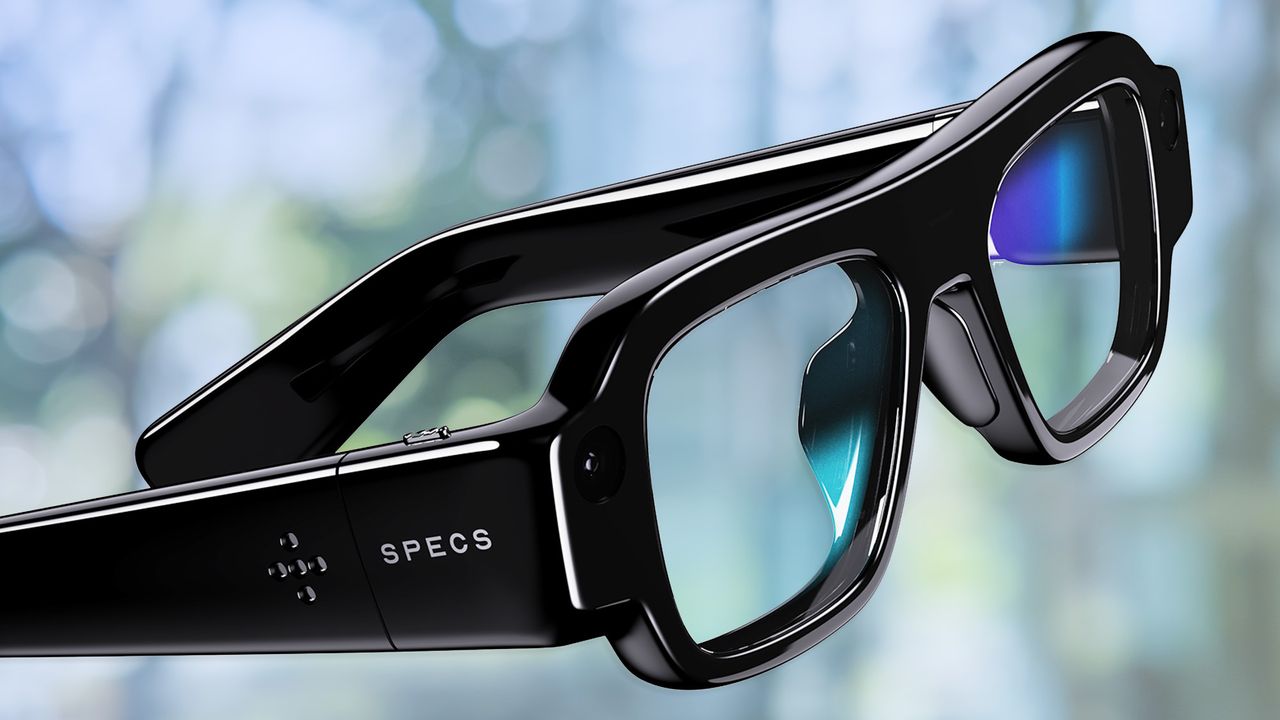
Snap CEO Evan Spiegel has just revealed Specs — a new pair of AR glasses that are "the beginning of a new era in computing." As with many smart glasses or AI-forward devices, Specs are being pitched as a way to avoid looking at our smartphones all day, and the first thing you're probably noticing is the chunkier stylings to house all of that compute.
That's because they're able to do everything something like an Android XR headset is able to do, but with all two Snapdragon processors built into the glasses themselves (no puck needed).

Specs are meant to sit between the lightweight-but-limited AI glasses and the heavy but isolating VR headsets. That's the key differentiator that makes Specs "not designed to replace the world," but rather "to bring computing into it."
And for that, you'll be paying a pretty penny for them when they come out this fall! Are you sitting down? The starting price is $2,195 (that's why I warned you to sit down). Will these be the stylish breakthrough to shake up our best smart glasses list? Let's talk about them.
Specs "specs"
Form factor |
Fully standalone augmented reality glasses |
Build material |
Swiss TR90 polymer |
Sizes & weights |
132 grams (47mm model) and 136 grams (52mm model) |
Display |
Proprietary waveguide displays with 51-degree field of view, support for 16 million colors |
Lenses |
Electrochromic lenses (10-second transition time to tinted) with prescription support |
Processors |
Dual Snapdragon processors (1x computer vision, 1x AR lenses) |
Tracking |
Hand tracking and spatial mapping, 7ms response time |
Battery |
4 hours on one charge, up to 20 hours when used with the case |
A head-turner
Last year, when I got to talk to Scott Myers, Snap's former hardware VP, he spoke about how this design is "substantially smaller."
While that is definitely the case (especially when you look at that weight), they're still definitely a bold aesthetic that will turn heads. From the thick-rimmed black frame and large temples to the integrated sensor placement on the front, there will be no hiding the fact you're wearing smart glasses when it comes to these.
Not to say they're bad-looking at all. I actually think Snap's pulled off what I thought would be the impossible in compressing all that tech into something that looks good to wear everywhere (no compute puck required). But I can also fully understand that this louder vibe won't be everyone's cup of tea.
They do also get a nice premium build too thanks to that Swiss TR90 Polymer construction, and the electrochromic lenses will ensure that they can be worn anywhere.
But, as I found out testing the Specs a while back, it's not about what they look like, it's about what you can do on them.
"Bring computing" into the real world
“For decades, computers have asked us to look down, sit still, or step out of the moment," Spiegel commented. "Specs bring computing into the world around us where we live, work, learn, create, and connect.”
On the face of it, that new paradigm of computing can seem like your usual pair of display smart glasses — hands-free navigation, asking an AI assistant for advice, etc.
But the real differentiator comes in when you start to make use of all that raw onboard horsepower. Like a VR headset, you can work in instant virtual workspaces, collaborate within them and more. You can measure objects in the space around you without a tape measure, and even learn and create in the virtual space around you. There's even specialized interactive tools like real-time graphic golf alignment or basketball shooting traning.
This is an incredibly versatile platform that's going to hit the ground running after years of development.
AI tools
AI will be a part of Snap OS that runs the glasses and Snap has promised that it will be useful in understanding visual context and providing information "where it's needed."
“With SPECS, AI is not intelligence trapped in a chat box,” Spiegel said. “It is intelligence that can see what you see, understand what you’re trying to do, and help you in the moment.”
The company is encouraging developers to create Snapchat Lenses using new agentic tools like Claude Code. There is also a benchmark for spatial computing to help AI models perform "real-world" spatial tasks like reasoning on coordinates, object relationships and more.
Privacy and price
Snap says that privacy was a "core design principle" from the beginning. The glasses are meant to be transparent in how they work.
In practice, that means requesting permission before accessing sensitive information, an LED light that indicates when the glasses are recording and a prioritization in on-device processing.
Pre-order now
If the price doesn't scare you away, you can pre-order the Snap Specs today at specs.com for $2,195 with a $200 refundable deposit.
Snap expects to ship the glasses in the US, UK and France starting this fall.
More from Tom's Guide
- Acer just unveiled new AI and AR smart glasses, putting more pressure on Meta — here's why
- Kuo: Apple is scrapping Vision headsets in favor of 2 smart glasses — but there's bad news for the release dates
- I tried to replace my gaming monitor with Asus ROG Xreal R1 glasses — it’s not quite what I hoped for