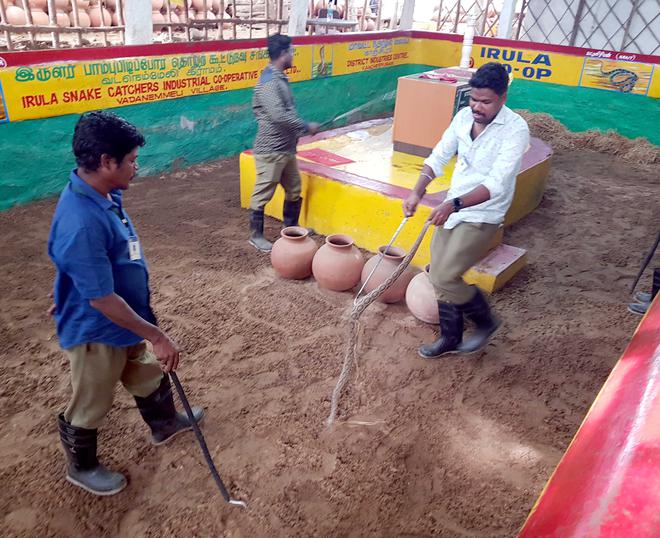
In Tamil Nadu, a unique group of tribals — the Irula — makes its living by catching snakes and rodents. Two members of this community were recognised only last year with the Padma Shri award. This tribe is the driving force behind a unique endeavour in the State: snake venom extraction. In changing times, when automation and cruelty-free testing have become the norm, the Irula Snake Catchers’ Industrial Cooperative Society, a one-of-its-kind collective at Vada Nemmeli in Kancheepuram, is on the cusp of changes that the Irulas are unprepared for.
Snakebite envenoming, a life-threatening disease caused by the toxins in a venomous snake’s bite, is primarily a ‘poor man’s disease’, mainly afflicting farmers, labourers, and tribals. It is a mounting public health concern, occurring mostly in rural areas. India has one of the highest number of snakebite deaths, averaging over 50,000 a year. The society, being run under the Department of Industries and Commerce, meets over 80% of the country’s venom requirements. As many as 350 Irulas are engaged in catching the ‘big four’ snakes (Russell’s viper, saw-scaled viper, common krait and spectacled cobra) from farmland in and around Kancheepuram, Chengalpattu, and Tiruvallur. Once the snakes pass a ‘health check’, the Irulas extract venom three to four times from each snake before releasing it back into the wild at the end of 21 days. The Forest Department decides the number of snakes to be caught a year, depending on venom stocks. Pharmaceutical companies buy the venom from the society to make anti-snake venom serum. The collective is staring at uncertainty because of a dated venom extraction method, requirements for region-specific anti-snake venom in the country, and scientific advances in the production of anti-snake venom serum.