
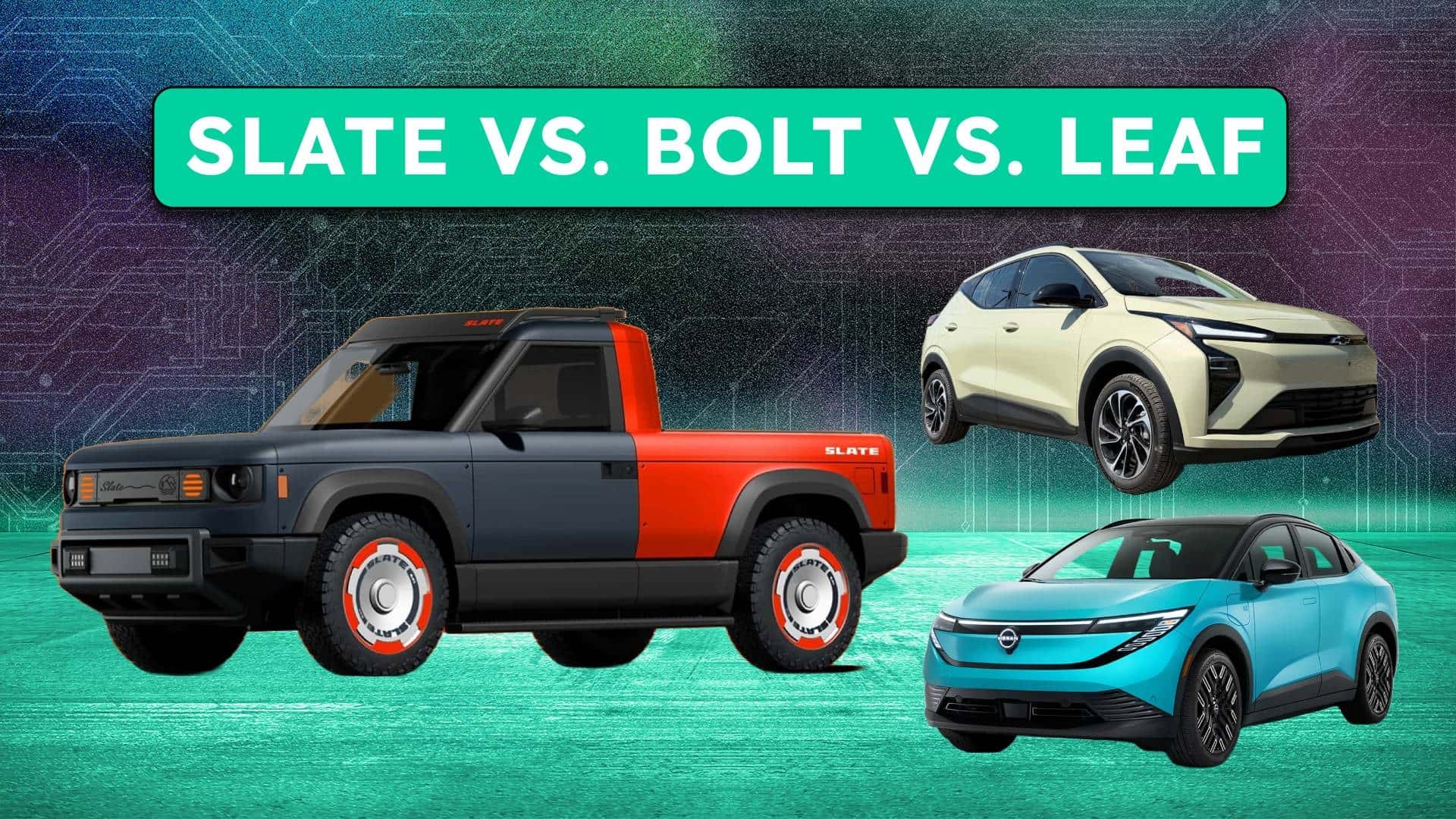
When deliveries of the Slate truck begin in the fourth quarter of this year, it will be America's most affordable electric vehicle and the country's cheapest pickup. At a starting price of $24,950 before destination and fees, it will occupy a category all by itself with no direct competitors.
But how does it fare against the refreshed Chevy Bolt and the latest-generation Nissan Leaf, two of America's cheapest electric cars? Both start in the $30,000 bracket and offer genuine value. Here's how they stack up on range, charging, performance, price, and overall equipment.

Range
| Slate Truck | Chevy Bolt LT | Nissan Leaf S+ | |
| Battery | 65 kWh LFP | 65 kWh LFP | 75 kWh NMC |
| Range | 205 miles (Slate estimate) | 262 miles EPA | 303 miles EPA |
The Nissan Leaf comes out on top here, and it's not particularly close. The Slate truck gets 205 miles of manufacturer-estimated range from a 65 kilowatt-hour lithium-iron-phosphate (LFP) battery. The Bolt, which uses a similar-sized LFP pack, does noticeably better at 262 miles. That makes sense given the Slate's comparatively brick-like design. The Leaf S+ wins the range battle with 303 miles from a larger 75 kWh unit.
There are some unknowns hanging over the Slate, though. The truck will also be offered in SUV and fastback body styles, and it's not yet clear how those configurations affect range. (Last year, Slate's head engineer told us that the SUV would offer slightly more range than the truck, thanks to better aerodynamics. But it's not talking specifics now.) It also has a 2,000-pound towing capacity and 1,500 pounds of payload, so expect real-world range to drop when it’s carrying heavy materials.
Whether buyers actually use it as a work truck or more of a lifestyle commuter remains to be seen.
Charging
| Slate Truck | Chevy Bolt LT | Nissan Leaf S+ | |
| Port | NACS | NACS | NACS |
| Peak Charge Rate | 120 kW | 150 kW | 150 kW |
| Fast Charge Time | 20–80% in 30 min | 10–80% in 25 min | 10–80% in 35 min |
| Route Planning | App only | Built-in Google | Wireless CarPlay/Android Auto |
All three vehicles ship with the Tesla-style North American Charging Standard (NACS) port, giving owners access to more than 27,500 Tesla Superchargers nationwide. CCS stalls are accessible via an adapter on all three as well.
The Slate truck will charge from 20-80% in about 30 minutes at a peak rate of 120 kilowatts. The Bolt and Leaf both peak around 150 kW, with Chevy claiming a 10-80% charge in 25 minutes and Nissan rating the Leaf for the same in 35 minutes.
One area where the Slate meaningfully lags behind is route planning. Both the Bolt and the Leaf ship with built-in Google infotainment that automatically suggests charging stops along your route. However, this feature is unavailable on the base Leaf S+, which still gets Android Auto and Apple CarPlay, both of which will soon get route planning updates.
The Slate, which is low-tech by design, launches without an infotainment system entirely and relies on a smartphone app for navigation. We’ll let you know how it works in real life when we drive the EV.
Performance
| Slate Truck | Chevy Bolt LT | Nissan Leaf S+ | |
| Horsepower | 181 hp | 210 hp | 214 hp |
| Torque | 195 lb-ft | 169 lb-ft | 261 lb-ft |
| 0-60 miles per hour | 8.0 seconds | Under 7.0 seconds | Under 7.0 seconds |
None of these vehicles are going to pin you to your seat, but the Leaf and Bolt are genuinely fun to drive. In our testing last year, the Leaf's front wheels spun under hard acceleration, giving the kind of hot-hatch energy that’s unexpected from an affordable EV. The Bolt is more comfort-focused but feels nimble and fun thanks to its compact footprint.
Both edge past the Slate on power and torque. The Leaf is rated for 214 horsepower and 261 pound-feet of torque, the Bolt puts down 210 hp and 169 lb-ft, and both crack 60 miles per hour in under seven seconds. The Slate takes a more leisurely 8.0 seconds to get there, with 181 hp and 195 lb-ft on tap from a rear-mounted motor.
For what it's worth, our very own Tim Levin took a short ride in a Slate this week and noted plenty of low-end torque and that classically zippy EV acceleration. We haven't had a chance to drive the truck, but The Autopian called it "insanely fun" for the price.
Equipment
The base Slate truck is bare bones, and deliberately so. At $24,950, you get cloth seats, air conditioning and heating, manual crank windows, and steering wheel controls to navigate the gauge cluster. There's no central infotainment display. It's an intentionally stripped-back package, though it does come with a smartphone mount if you prefer to use that for navigation.
That said, the Slate's big pitch is customizability. It comes with over 200 accessories, more than 80% of which are priced under $500. Buyers can add tablet and speaker mounts, a center console, door pockets, fancier seat covers, and various cosmetic touches like gunmetal cabin accents. You can also choose from more than 30 starter packs, which bundle different combinations of body styles and accessories to give the truck a more polished look without configuring everything yourself.
Safety features like traction control, airbags, a rear camera, and forward collision warning will all come as standard. You also get a frunk and a five-foot bed, with 7.0 and 35.1 cubic feet of cargo volume, respectively.
By comparison, the base Bolt and Leaf arrive considerably better equipped out of the factory. Both get a large infotainment screen, automatic climate control, USB ports, and standard speakers.
The base Leaf gets wireless Apple CarPlay and Android Auto whereas the SV+ and Platinum+ also add a native Google-based infotainment system. The Chevy skips phone-mirroring but leans on the built-in Google system for navigation and media. Neither offers the kind of modular, build-it-yourself customization that the Slate is banking on as a core part of its personality.
Price
| Slate Truck | Chevy Bolt LT | Nissan Leaf S+ | |
| Price | $24,950 (excluding destination) | $28,995 (including destination) | $31,535 (including destination) |
| Body style upgrade | +$5,000-$7,000 (SUV or fastback) | NA | NA |
The base Slate truck undercuts the Bolt and Leaf by $4,000 and $5,000. But it comes with real compromises: less range, slower charging speeds, two seats, and a cabin that would feel spartan even by budget car standards. Opting for the SUV or fastback body kit, which adds a second row closes that price gap at an additional $5,000-$7,000. Stacking on accessories can push the total considerably higher from there.
The Bolt and Leaf offer more range and more technology as standard, and they're finished products from established automakers. What the Slate offers in return is something neither of them can: a genuinely modular vehicle that buyers can shape into something distinctly their own. Whether that trade-off resonates with budget-conscious buyers is something we’ll find out with time.
Contact the author: suvrat.kothari@insideevs.com
Click here to see all articles with lists of the best EVs