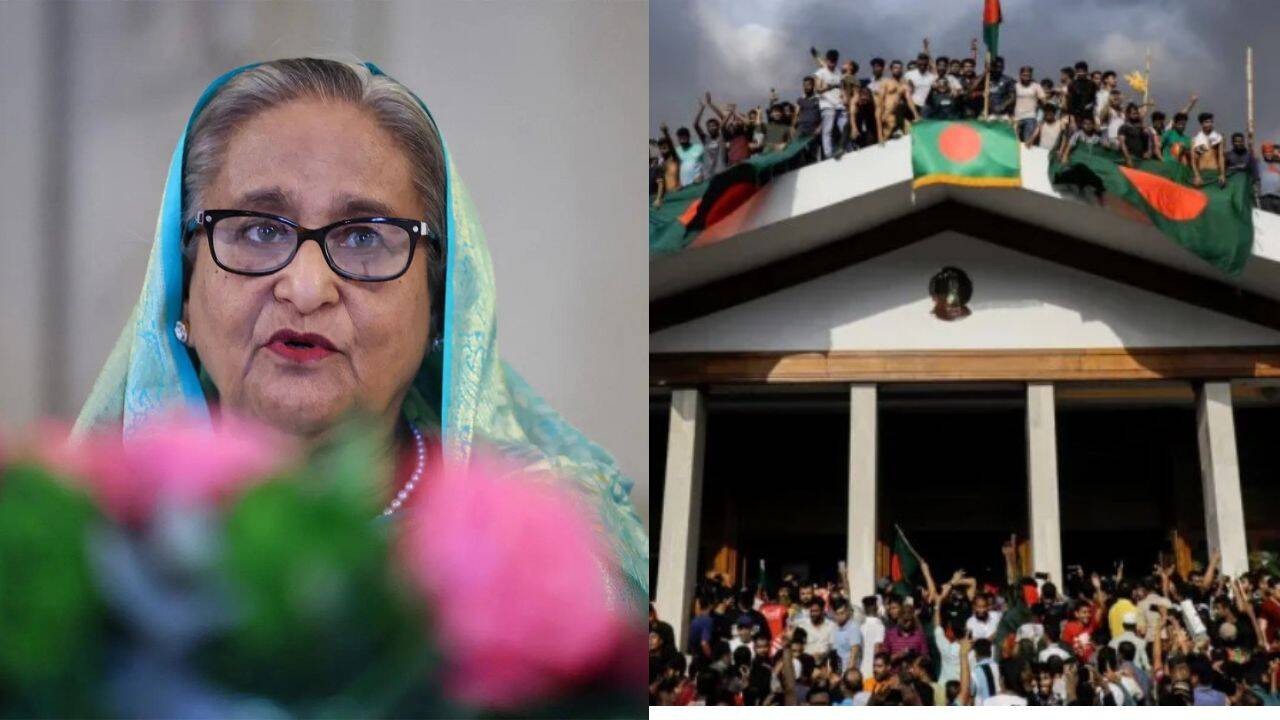
For the first time since fleeing Bangladesh two years ago, Sheikh Hasina has put a specific month on her planned return: December.
Get breaking news anytime, anywhere. Download the TOI app now!

In July, nearly a month before the second anniversary of the fall of her government, the 78-year-old former prime minister said she intended to return to Bangladesh in December along with senior Awami League leaders and surrender to the courts.
On August 5, the second anniversary of the collapse of her government, Hasina repeated that pledge despite the enormous legal and political risks involved.
She has already been sentenced to death in absentia over crimes against humanity linked to her administration’s crackdown on the July 2024 uprising, in which up to 1,400 people were killed, according to UN estimates. Hasina has rejected the charges and has described the proceedings against her as "politically motivated."
The question now is not simply whether she will follow through on her return plan. It is what she hopes to achieve by announcing it and what awaits her if she goes back.
A return plan and a high-stakes gamble
Hasina’s announcement is striking because the risks of returning are unusually high.
She herself has acknowledged that she could be arrested or even killed.
“They (Bangladesh government) may arrest me on my return, they may even kill me. Still, I have to go. If death comes, I want it to come on my own soil, where my parents are buried and where their blood was shed,” the former prime minister said on August 5, referring to the 1975 assassination of her parents and three of her four siblings by a group of army officers.
Her December plan therefore leaves her facing difficult choices.
If she returns, she could be taken into custody almost immediately and remain out of active politics for an extended period. If she stays in India, meanwhile, she remains vulnerable to accusations from opponents that she is unwilling to face the legal process at home.
By naming December, however, Hasina has also put a clear timeline on her own political future and brought the question of her return back into Bangladesh’s political debate.
Whether or not she ultimately follows through, the announcement keeps attention on both her and the Awami League at a time when the party has little room to operate politically.
The Awami League’s activities were first banned under the Muhammad Yunus-led interim administration in 2025, and the restrictions were subsequently given legal backing by parliament in 2026.
Politics behind Sheikh Hasina’s Bangladesh return plan
Through her remarks from India, Hasina has continued to present herself both as a prime minister whose government was toppled and as a victim of what she describes as a foreign-backed conspiracy.
Her August 5 address, at a virtual press conference in New Delhi, followed a similar pattern. She criticised Prime Minister Tarique Rahman’s government and called for the ban on the Awami League to be lifted.
Her proposed return also has obvious implications for the party.
It gives Awami League supporters a rallying point and keeps Hasina at the centre of discussions about the party’s future, despite the legal risks she faces if she goes back.
A political leader can remain influential even without holding office, particularly when supporters continue to identify strongly with that leader and believe the political system has treated the party unfairly.
Hasina’s announcement, therefore, serves another purpose: it prevents her from disappearing from the political conversation while the Awami League remains barred from normal political activity.
Sheikh Hasina return: What could unfold in Bangladesh
Hasina has made a dramatic return from exile once before.
In 1981, after nearly six years abroad following the assassination of most of her family, she returned to Bangladesh from India as the newly elected president of the Awami League.
Then, large crowds gathered to welcome her.
This time, the circumstances could hardly be more different.
Anti-Hasina sentiment remains strong, even though her father, Sheikh Mujibur Rahman, occupies a central place in Bangladesh’s independence history.
Hostility towards the Awami League has also extended beyond the former prime minister herself.
For instance, the family home of Shakib Al Hasan, one of Bangladesh’s most celebrated cricketers and a former Awami League MP, was targeted with petrol bombs just hours after his virtual appearance in the August 5 media interaction.
Awami League leaders themselves acknowledge the possibility of violence if senior figures, particularly Hasina, return.
“We will have to face whatever happens... There will be a backlash because the extremists are highly weaponised. We are preparing for this,” senior party leader Mohibul Chowdhury said a day after Hasina announced her return plan.
On its part, the incumbent government led by Tarique Rahman, son of Hasina’s longtime political rival Khaleda Zia, has little obvious political incentive to make her return easy.
The Awami League government was removed after a mass uprising, and the political order that followed has been built partly around a rejection of Hasina’s rule.
The Bangladesh Nationalist Party (BNP) government has already indicated that she would be arrested if she returns.
Her arrival could therefore become an immediate test of how the government handles both the legal process against her and the political consequences that could follow.
Banned and bruised: What happens to Awami League
Although Sheikh Mujibur Rahman was among the Awami League’s co-founders, the party gradually became synonymous with Sheikh Hasina, who has been its undisputed leader for more than four decades.
Her political future is therefore tied to another question: can the party survive without her?
The Awami League’s organisational strength was heavily dependent on Hasina’s leadership. Since her departure, with several senior leaders also in exile, underground or in custody, no obvious figure has emerged who appears capable of filling the political space she left behind.
Her children do not offer an obvious alternative either.
Her son, Sajeeb Wazed Joy, a dual US-Bangladeshi citizen, was previously involved with the Awami League and served as an adviser to his mother, but has not emerged as her political successor. Her daughter, Saima Wazed, meanwhile, has remained away from politics and is a senior World Health Organization official.
That makes Hasina’s continued political activity important for the Awami League.
Her return pledge gives supporters something to rally around at a time when the party remains politically marginalised.
But it also creates a dilemma.
A comeback centred entirely on Sheikh Hasina could keep the Awami League’s identity alive, but it could also make it harder for the party to develop new leadership and a new political message.
The environment that sustained Hasina for years has changed sharply. Public resentment towards her remains strong, while the legal cases and allegations of abuses against her government have made any political comeback far more difficult.
What lies ahead for Sheikh Hasina
Since late 2024, Dhaka has been seeking Hasina’s extradition from India, while New Delhi has said the requests are being examined under established legal processes.
Bangladesh has also linked progress on her extradition to Prime Minister Tarique Rahman’s proposed maiden official visit to India.
A voluntary return by Hasina could remove one of the most contentious issues in India-Bangladesh relations, although it would not by itself resolve the wider strains between the two governments.
Whether she actually follows through on her December pledge remains uncertain.
If she does return, the immediate risks are clear: arrest, incarceration and possibly, the enforcement of a death sentence handed down in absentia.
Her presence could also reignite political tensions in a deeply divided country.
At the same time, returning would give Hasina something she currently lacks from exile — a chance to physically reconnect with supporters and place herself once again at the centre of Bangladesh’s political drama.
December, therefore, could become a defining moment for Sheikh Hasina. It could mark the beginning of a comeback or the end of her career as an active political force.