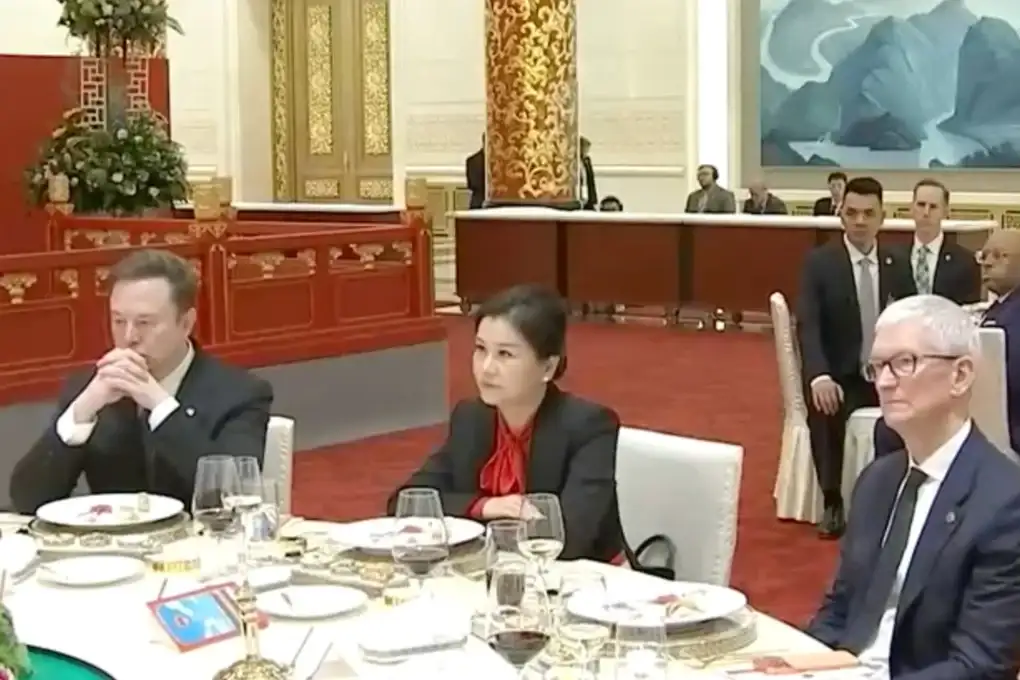
When Chinese state television showed Zhou Qunfei seated between Tim Cook and Elon Musk at a high-profile state banquet hosted by Xi Jinping for President Donald Trump, the image carried far more meaning than diplomatic symbolism. It quietly revealed how deeply China’s private manufacturing giants now sit inside the global technology ecosystem. The woman between two of America’s most influential technology leaders was not a celebrity entrepreneur built through media hype. She was a former teenage factory worker from rural Hunan who transformed a small glass-printing workshop into one of the world’s most important precision manufacturing companies.
The rise of Lens Technology mirrors the larger story of modern China itself. The company helped shape the smartphone era through Apple’s supply chain and later expanded into electric vehicles, AI hardware, smart cockpits, robotics, and aerospace components.

Zhou Qunfei — The hidden rise of China’s richest woman: How did a factory teenager build Apple’s billion-dollar glass empire?
Before smartphones reshaped modern life, Zhou Qunfei was already building expertise in glass manufacturing inside Shenzhen’s expanding industrial economy. Born into poverty in Hunan province, she reportedly left school at 15 before moving south for factory work. Like millions of migrant workers during China’s economic rise, she entered an environment defined by long hours, strict discipline, and relentless competition. Yet unlike most workers, Zhou studied manufacturing processes obsessively and eventually started her own small business in 1993.
That early workshop specialized in screen printing on watch glass. It was modest, crowded, and financially risky. But Zhou understood something many entrepreneurs missed during that era. Precision manufacturing would become increasingly valuable as electronics grew smaller, lighter, and more design-focused. Her company gradually evolved into a supplier capable of producing advanced cover glass and touch-related components for electronics manufacturers.
The partnership also reshaped Zhou Qunfei’s public image. In 2015, Lens Technology listed on Shenzhen’s ChiNext market, instantly turning Zhou into one of China’s richest self-made women. Her story gained attention because it contrasted sharply with inherited wealth narratives common among global billionaires. She represented industrial entrepreneurship built through manufacturing expertise rather than finance, real estate, or internet speculation.
Why Zhou Qunfei sitting between Tim Cook and Elon Musk mattered globally
The seating arrangement at the China state banquet drew global attention because diplomacy often communicates through symbolism. Zhou Qunfei sitting directly between Tim Cook and Elon Musk reflected the central role Lens Technology now plays across multiple industries. Apple depends on precision hardware suppliers capable of maintaining extreme manufacturing standards. Tesla increasingly requires advanced materials and structural components for smart vehicles and future robotics platforms. Lens sits inside both ecosystems.
Lens Technology’s expansion beyond smartphones explains why investors increasingly view the company as part of the AI hardware race. The company now produces components linked to smart vehicles, AI glasses, wearable devices, cockpit systems, and advanced structural manufacturing. Reports surrounding Lens have also connected the company to aerospace-related applications and humanoid robotics manufacturing capabilities.
For Elon Musk, manufacturing partners matter enormously because Tesla, Optimus robotics, and SpaceX all require industrial suppliers capable of scaling futuristic hardware efficiently. Lens Technology’s expertise in glass, metal processing, bonding systems, and precision structural parts aligns naturally with those ambitions. That connection explains why investors interpreted Lens references to a “major North American customer” as linked to Tesla and Musk’s broader technology empire.
Lens Technology’s AI hardware ambitions show how China’s manufacturing strategy is changing
For years, many Western observers viewed Chinese manufacturers mainly as low-cost production partners. That perception increasingly looks outdated. Lens Technology is attempting to reposition itself as a “one-stop precision manufacturing solutions provider” for the AI hardware era. That language matters because the next technology revolution may depend less on simple assembly and more on integrated industrial ecosystems capable of supporting advanced intelligent devices.
The company’s business diversification reflects this strategic shift. Smartphones and computers still generate most revenue, but Lens has aggressively expanded into smart vehicles, wearable technology, AI glasses, and aerospace-related manufacturing. The company also discussed ultra-thin photovoltaic glass modules and flexible glass technologies linked to space applications. These are not ordinary consumer-electronics ambitions. They represent an effort to move deeper into future-facing industrial sectors where margins, strategic value, and geopolitical importance are significantly higher.
China’s broader industrial policy increasingly emphasizes this transition. Instead of relying solely on mass manufacturing volume, Chinese firms now seek leadership in higher-value engineering, AI integration, robotics, electric mobility, and aerospace systems. Lens Technology’s evolution illustrates how private Chinese manufacturers are adapting to that national direction while still serving international clients.
Yet the transformation remains difficult. The company’s first-quarter 2026 results showed falling revenue and a swing into net losses, largely due to weaker smartphone demand and foreign-exchange pressures. Those figures revealed the challenge many manufacturing giants face globally. The smartphone market has matured, growth has slowed, and companies dependent on consumer electronics must find new engines for expansion. AI hardware and intelligent mobility represent potential answers, but those sectors remain fiercely competitive and capital intensive.
What Zhou Qunfei’s story teaches about modern wealth, manufacturing, and power
The fascination surrounding Zhou Qunfei extends beyond business rankings or banquet diplomacy. Her story resonates because it challenges simplistic assumptions about where modern influence comes from. In recent years, technology narratives often focused heavily on software founders, social-media platforms, or artificial intelligence algorithms. Yet the global economy still depends profoundly on physical manufacturing capability. Someone must build the glass, sensors, structural systems, and precision hardware powering modern life.
Zhou’s journey also reflects a deeper truth about economic transformation. Industrial revolutions rarely create opportunity evenly. Millions worked in Shenzhen factories during China’s rise, but very few built companies capable of competing globally. Zhou succeeded partly because she recognized the future value of precision manufacturing before smartphones fully emerged. She understood that as devices became more advanced, the quality of components would become strategically critical.