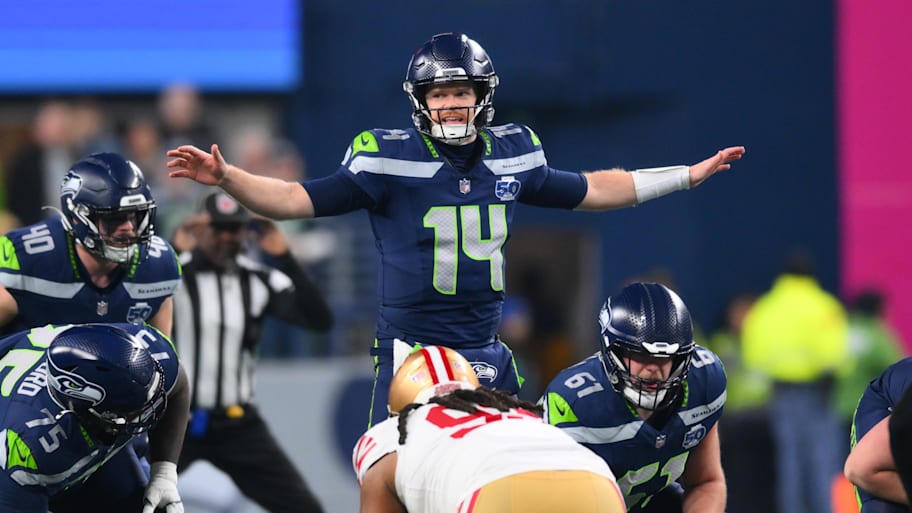
SEATTLE — Sam Darnold threw the pass that changed everything on a Thursday night in Week 16. Not in the playoffs. Nor in the regular-season finale. Not for the touchdown that beat the Rams that Thursday, even, nor the two-point conversion that completed an epic comeback and jumbled the NFC’s playoff seeding.
No, this pass set all that up, made all that—and much more—possible. It wasn’t a throw so much as an exorcism. L.A. led, in overtime, 37–30. Darnold drove the Seahawks past midfield. He dropped back on second down, with three Rams defenders from one of the fiercest defensive lines in football all but in lockstep. Darnold knew he would get hit and chucked the football, anyway, the pass arcing and layered and in the one spot where only Cooper Kupp might catch it. Darnold didn’t see Kupp closing, didn’t see his hands around the football, nor the nifty toe-tap to stay in bounds. This play went for 21 yards and would be overshadowed by the Seahawks’ subsequent victory.

And yet, there it was, the moment when they knew; they, in this case, meant everyone. The Darnold skeptics who held up his thin, shall we say, less-than-ideal playoff record. The rest of the NFL. The rest of the NFC West. Even Darnold himself had to know, at that precise moment, what he could have said he knew before it happened but didn’t, because there was no way for anyone to see until it happened. Until Sam Darnold, the failed No. 3 pick who left New York and continued trying, lifting his career from subterranean depths, with a critical stop in San Francisco, made it.
That throw to Kupp, uncelebrated as it was, marked the first time, legitimately, in all seriousness, that Darnold made the throw some (many?) insisted he’d never make. Huge game. Bigger implications. The kind of throw a franchise quarterback makes to signal they can lead a particular team to a specific Super Bowl. Surely, Darnold believed himself capable of delivering exactly that kind of pass in precisely that kind of moment. But on that day, on that throw, he finally, mercifully, did.
Imagine the following sentence on that night, Dec. 18, last year. Better yet, imagine this same sentence on the night of Sept. 7, after San Francisco snagged a season-opening victory over Seattle at Lumen Field: Only four months later, against the same hated division rival, inside the same stadium, the Seahawks won their first divisional round playoff game in over 4,000 days after trading an elite receiver this past spring and swapping signal-callers while quarterbacked by a player known for his lack of playoff experience/big-game success led by a head coach, in only his second season and his first playoff game in charge of an NFL team with each, with all, steering the whole operation to an entirely new timetable.
Right now. Super Bowl LX.
The Seahawks have found their formula. This matters, because Seattle’s roster is laden with talent, especially young talent, and while Darnold should be credited for his team’s success, he is part of this formula—a big part, but only one part. And part of his job is not losing games, rather than winning them via arm talent alone.
Seattle showcased this formula again Saturday, clinching another home game for the NFC championship, which it will host in eight days. The Seahawks again unleashed Rashid Shaheed. “Lightning in a bottle,” is how Jaxon Smith-Njigba described Shaheed afterward, after JSN himself scored another touchdown. The defense made Brock Purdy irrelevant again. And Darnold, well, he played conductor, handing the ball off rather than throwing it away, minimizing mistakes and ensuring a 17-0 first-quarter lead was all Seattle would need.
In the muted aftermath, Darnold first pointed to the “team win.” He said he didn’t come out for the non-padded warm-up because he only wanted to do that once. He tested his arm inside the Seahawks locker room, didn’t feel limited and told himself to “let it rip, no matter what.”
This, from a quarterback whose eight NFL seasons have unspooled less like a career and more like a telenovela. Drafted with the third pick in 2018. “Seeing ghosts” while quarterbacking the Jets against the Patriots. Two stopover seasons in Carolina. Another stop in San Francisco. The resurrection year, 2024, in Minnesota. More than one option for 2025. And his choice, the Seahawks, which changed this NFL season and for more than one franchise.
This, as doubts still threatened to engulf Darnold. Reports circulated mid-week that he hadn’t thrown in practice because of an oblique injury, hadn’t participated in parts of practice, might even, worst-case, gasp, not play.
Darnold didn’t surface in public view until 4:13 p.m. local time, or 47 minutes before the scheduled kickoff. He ran through a few drills, alongside backup Drew Lock. He threw the ball and it wasn’t obvious, at least in warm-ups, if it hurt to throw, let alone how much.
Of course he was going to play. The stakes were too high, the opportunity too rare, to consider anything else.
This ensured that a narrative steeped in remarkable symmetry remained in play. After all, while most credit Darnold’s star turn to that 2024 season in Minnesota, the resurgence actually began while he was in San Francisco, in what seemed like a lost year backing up Brock Purdy, with 46 pass attempts that season, many of those thrown with games already decided.
Head coach Kyle Shanahan loved Darnold, how he played, especially how well he ran play-action, long before welcoming Darnold in 2023, according to two members of that offensive coaching staff. There were discussions as to whether Purdy, career then rocketing skyward, or Darnold, who hadn’t yet displayed what he would in other places, was the better quarterback. Legitimate questions.
Which meant that Shanahan, still the NFL’s brightest offensive mind, essentially groomed Darnold to beat him on Saturday at Lumen Field. The QB didn’t duck the history afterward, the first playoff victory in eight seasons, which is misleading (90 regular-season starts) and not misleading at all, in that it meant something—and to him. “Huge,” Darnold said.
After a dominant Week 9 against Washington—21-of-24, 330 passing yards, four touchdowns—Darnold entered MVP consideration. What happened next wasn’t what anyone expected. Darnold did not end 2025 in any similar discussions. He set a career high for completion percentage (67.7%), started every game and threw for 4,048 yards. Not bad. He also tossed 14 interceptions, only one off his career high, from his rookie season (2018). But his yards per attempt (8.5) also marked a career high, as did his net yards gained per pass attempt (7.66). He led four game-winning drives, each crucial to Seattle obtaining the NFC’s top seed. In other words, Darnold did enough.
And that’s the truly wild part. As Darnold, at least statistically, played worse, Seattle began to decimate its opposition. During Darnold’s MVP turn, the Seahawks improved from 3–2 to 7–2. Their third loss came against Los Angeles, in Week 11, on Nov. 16.
The Rams picked off four Darnold passes in that game.
Seattle hasn’t lost since, and has lost once since Oct. 6.
Those who study NFL players didn’t necessarily see a dip from Darnold since that disaster in Los Angeles. They believed his statistical drop resulted more from schematic tweaks made by defensive coordinators who studied his first half-season in Seattle and adjusted or copied the adjustments they saw on film. No longer did opposing coordinators shove defenders toward the line when Seattle showed base packages, expecting them to run. That’s where Darnold ate like Joey Chestnut for 10 games, the first 10. Defenses always adjust.
That’s the wild part: Seattle adjusted, adeptly, too. This season’s formula fell into place, while most of the Seahawks fan base and the majority of national pundits spent all collective ink, lung capacity and brainpower on how Darnold would never fit on a Super Bowl contender.
They should have examined how he might fit. In Seattle. In 2025.
Darnold didn’t ruin his team’s chance to beat these same 49ers in the regular-season finale, with everything—division title, No. 1 seed, home-field advantage—at stake. Seattle’s defense held Purdy and a revived offense to three points in four quarters that all but predicated the blowout ahead.
En route to some—maybe, perhaps, cover your eyes!—playoff confidence, Darnold became part of an NFL first. Never before had a postseason began with both quarterbacks for each conference’s No. 1 seeds having never won a playoff game. Bo Nix won his first Saturday, before an ankle injury ended his season.
Next up: Darnold.
The overtime thriller in Denver pushed this kickoff more than 20 minutes. The delay only helped the 12s reach full pregame froth, as the sun dropped from nearby horizons. The volume inside the stadium rose in lockstep with the darkness, until only screams had a chance to be heard. Green towels were picked up inside and waved, incessantly and gloriously, throughout. Loud captures maybe a fifth of how it felt inside.
The Seahawks didn’t wait to amplify the volume. There went Shaheed, the NFL’s best trade deadline acquisition, on the opening kickoff. He sped up the right side of the field, found the sideline, then sprinted into Seahawks territory. A flag flew—tripping, turns out—en route to an NFL rarity, the game’s first score on the game’s first play.
Shaheed answered questions behind a lectern afterward, wearing sunglasses indoors, at night, a boxing classic. He pointed out that he hadn’t returned kicks to start this season. But his quarterback, Shaheed said, “wasn’t 100 percent.” He made sure that didn’t matter.
San Francisco punted. Seattle plodded back toward that south end zone where the diehards sit and scream. But that drive ended in a field goal, and a 10–0 Seahawks lead, while the 49ers started somewhere near disastrous, the early deficit still could have been worse.
Then: Darnold to Smith-Njigba. Touchdown, Seahawks, who staked a margin that registered as shocking even for a No. 1 seed and scored four points more than they had scored, against these 49ers, on this field, in the entire regular-season finale—and not even a full quarter in.
It got worse. Much worse. Staggeringly worse. Invoke-a-mercy-rule-that-doesn’t-exist worse. After one quarter, the Seahawks led, 17–0; after two, 24–6; after three, 34–6.
Plenty of 12s will wake up Sunday morning, grab their phones and shower group chats with text messages saying they, of all the fans, of all the diehards, knew all this was coming. The vast majority of those will be lying.
The Seahawks weren’t even exactly sure. When I told general manager John Schneider on the afternoon of Oct. 6 that I was wrong, that I had misjudged that defense and that I thought Seattle might win the Super Bowl, he didn’t say that I was right. He pointed out injured defenders, the number of games remaining, anything to avoid saying what would become more obvious each week.
He also didn’t say that I was wrong.
That Schneider has never won Executive of the Year is a crime. Not punishable in any court of law. But an absolute crime against things like logic, reason and common sense, nonetheless. This season’s maneuvering marked only his latest masterpiece, not to mention the second time he revived football in Seattle this century, in a place with three revivals, total, period, in 50 years of professional football.
Schneider might throw up when presented this list of his career highlights: the Marshawn Lynch trade; the Super Bowl XLVIII triumph, drafting Russell Wilson in the third round; penning wideout Doug Baldwin a handwritten letter to ensure he’d sign with Seattle, shaping the Legion of Boom. Schneider did all that in tandem with Pete Carroll, jettisoning players who were declining but not in ways so obvious that everyone could see them.
Even that enviable collaboration eventually began to sputter, leading to early playoff exits after 2019, ’20 and ’22, with no postseason ’21 and ’23. Seattle, for all its success under Carroll and Schneider, had endured 2,204 days between its last playoff victory and their next chance to end that drought. A full 4,025 days had elapsed since the Seahawks last divisional round victory and their next chance to end that drought.
Schneider didn’t want his partnership with Carroll to end. He didn’t crave more credit. He craved the team’s return to prominence. He weighed and agonized over Carroll, whether his approach, laudable as it had always been, Win Forever until that stopped, still worked; still worked in Seattle, specifically.
Analysis complete, the GM knew, deep down, soul level, the franchise needed to move forward. To move forward, Seattle needed to move on.
When Carroll bid farewell to the Seahawks, he said, of Schneider and to Schneider, “He’s [or you’re] going to find out.”
How it started morphed into how it’s going—ahead of schedule, the Seahawks back, in full, primed for another run; their first, really, since Wilson threw that interception that cost Seattle another triumph in Arizona a full decade ago. The Seahawks won 14 games for the first time in 2025. They nabbed the franchise’s fourth No. 1 seed. Schneider built three of those teams, including this one, now the odds-on favorite to win Super Bowl LX.
“John is in his bag,” Smith-Njigba said afterward, meaning, more or less, at the top of his executive game.
Seattle long-ago upended modest but realistic expectations from this summer. Bookmakers set their expected win total at 8.5. They needed a quarterback to do that. A better quarterback than the most recent iteration of Geno Smith. They needed enhanced locker room harmony to ascend higher. So Schneider shipped Smith to Las Vegas for a disastrous reunion with Carroll, traded disgruntled wideout DK Metcalf to Pittsburgh and signed Darnold. Most met that combination of contracts and departures with much skepticism.
Had the Seahawks actually gotten worse?
Nope. Each move was perfect, pure genius, pushing Seattle ahead of everyone else’s schedule and in time to its own. Schneider’s touch—golden, magical, lucky, earned; some combination; whatever—landed these Hawks their new franchise quarterback; a solid veteran who had won a title in Kupp; and a menacing defensive lineman in DeMarcus Lawrence this past offseason. The GM locked all three into multiyear deals.
He had already drafted left tackle Charles Cross (first round, 2022), Devon Witherspoon (first, ’23), Smith-Njigba (first, also ’23), traded for criminally underrated linebacker Ernest Jones IV (’24); and, in this past draft, selected guard Grey Zabel (first) and rangy, versatile safety Nick Emmanwori (second, Schneider traded up this time). That’s the core of these Seahawks, more or less, with each player acquired by Schneider at some point in the past three offseasons/seasons.
Smith-Njigba threatened the single-season receiving yards record in 2025. Cross became a mainstay, so much so that his health for this divisional round game assumed primary importance in the lead-up. (He played. It helped.) Zabel started in all 17 games and played 99% of the Seahawks’ offensive snaps. Witherspoon made his third consecutive Pro Bowl. Jones became coach Mike Macdonald’s defensive, on-field conduit. Lawrence wrecked some offensive plans all by himself.
The Seahawks don’t make this game, don’t host this game, don’t win this game without all the levers Schneider either pulled or chose not to pull before a single snap had been played. He’d suggest all credit go to those players. But even they’re aware this doesn’t happen without their general manager’s maneuvering, too.
As if to say hold my beer, Schneider didn’t stop when the football started. He also made the single-most impactful trade near the NFL’s deadline, giving up fourth- and fifth-round picks to obtain the speedy Shaheed, who became their scoring catalyst, on offense and especially on special teams, as evidenced on Saturday night.
Someone asked Jones afterward if the Seahawks had exceeded even their expectations. That’s a loaded question. Jones gave the only possible answer, no. In this case, it was easy to believe him.
In the almost two seasons of this new Schneider-Macdonald partnership, the Seahawks are 24–10 in the regular season. They finished second in the division (with no playoff bid) and then first in those seasons. They’ve also gone 15–2 on the road in that stretch and 20–5 in their past 25 games. Schneider, then, should be named Executive of the Year.
Ya think?
Proof teemed all over Lumen Field in this rubber match that exposed the 49ers as pretenders. Proof, delivered in that final score, 41–6. Proof in Darnold’s line, 124 passing yards but, more critically, zero major mistakes. Proof in that defense and its suffocating nature. Proof in the 12s heading toward the exits early.
Smith-Njigba says he summarized this season and this game and the long stretch without a loss most often via the same phrase: “They don’t know.”
“They still don’t know,” he adds. “We’re going to shock the world.”
Already have. When will “they”—it’s always “they,” isn’t it?—know? “Hopefully,” he says, “soon.”
Seattle delivered more than enough proof on Saturday. No additional proof is necessary. Maybe none has been necessary since that Week 11 stumble. Perhaps that’s why the winning locker room wasn’t celebratory. Players weren’t unhappy, but they know what matters lies ahead.
It felt like it used to feel after another Seahawks playoff victory, like anything was possible and yet, also like an alternate universe. New team. New formula. Macdonald said this was the “most complementary game” Seattle had played all season.
The Seahawks can win the Super Bowl, and it won’t likely be because of their new quarterback. He’ll play his part to triumph, sure. But it’s this formula that projects not just a real chance this season but in upcoming seasons.
Wouldn’t that be something? The Legion members all retire. Wilson’s career sputters toward an inglorious end. Carroll is pushed out. And there’s Schneider, the one who remains, building the dynasty Seattle almost built 10 years ago.
More NFL From Sports Illustrated
- Broncos’ Defense Gives Them a Chance Even Without Bo Nix
- 2025 NFL Divisional Round Good, Bad and Ugly: Broncos Survive, While Seahawks Roll
- Emotional Bills Players Defend Josh Allen After Heartbreaking Loss to Broncos
- Sean Payton Shares Inspiring Message He Gave Bo Nix After Devastating Injury
- Kenneth Walker III Joins Seahawks Legend With Historic Three-Touchdown Game
This article was originally published on www.si.com as Seahawks Showcase Atypical Winning Formula in Rout of 49ers.