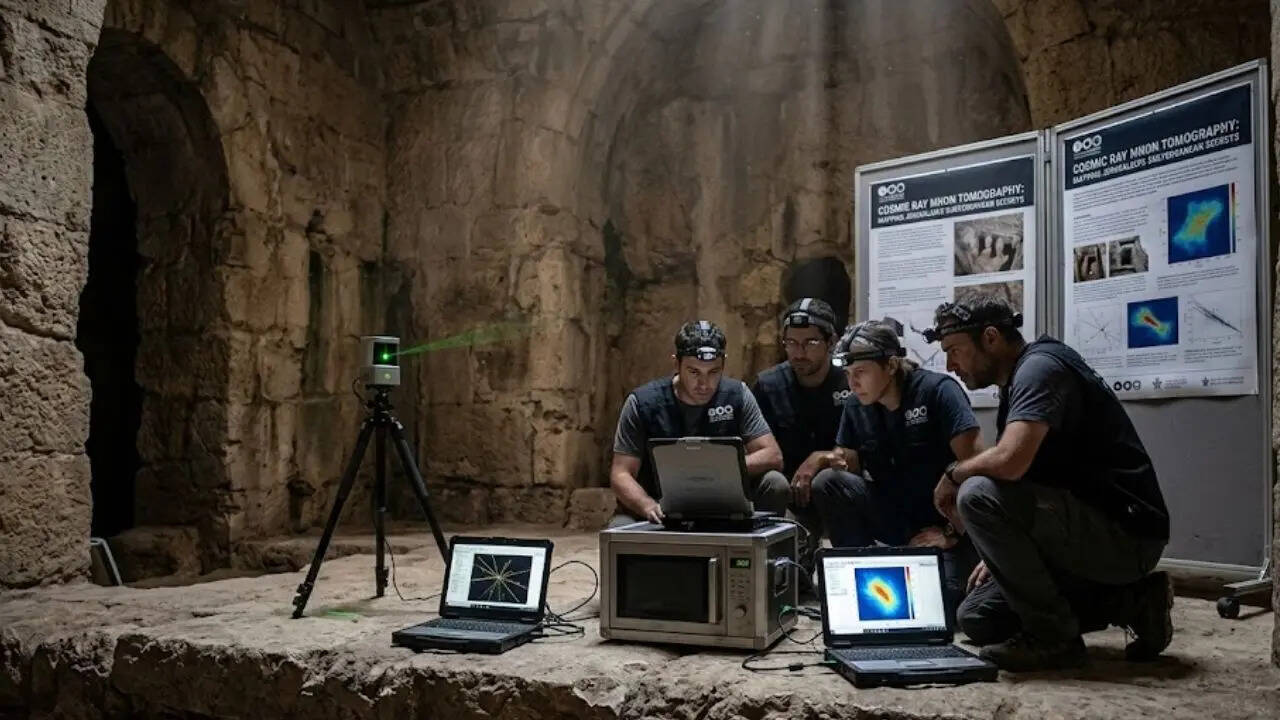
Archaeologists and physicists have achieved a breakthrough in historical exploration by using cosmic-ray muons to map subterranean structures in Jerusalem without traditional excavation. Cosmic rays are high-energy particles that collide with the Earth's upper atmosphere, and the muons that result from this collision penetrate through the Earth’s crust at a consistent rate.
As part of this investigation, researchers placed extremely sensitive miniaturised detectors inside ‘Jeremiah’s Cistern,’ located in the City of David, and measured the attenuation (or decrease in energy) of cosmic ray muons as they travelled through the surrounding rock and soil. The amount of energy lost when cosmic ray muons pass through a substance, such as empty caves, will be less than the amount of energy lost when they pass through a denser substance like solid rock, as noted in the Journal of Applied Physics. Therefore, the research team was able to successfully use this technique to identify underground voids and tunnels. This innovative, non-invasive ‘X-ray’ technology allows for the precise mapping of fragile archaeological sites while preserving their structural integrity for future generations.