Get all your news in one place.
100’s of premium titles.
One app.
Start reading
LiveScience
LiveScience
Damien Pine

Scientists squished microbes into a steel 'sandwich' — and made a profound discovery about life in space

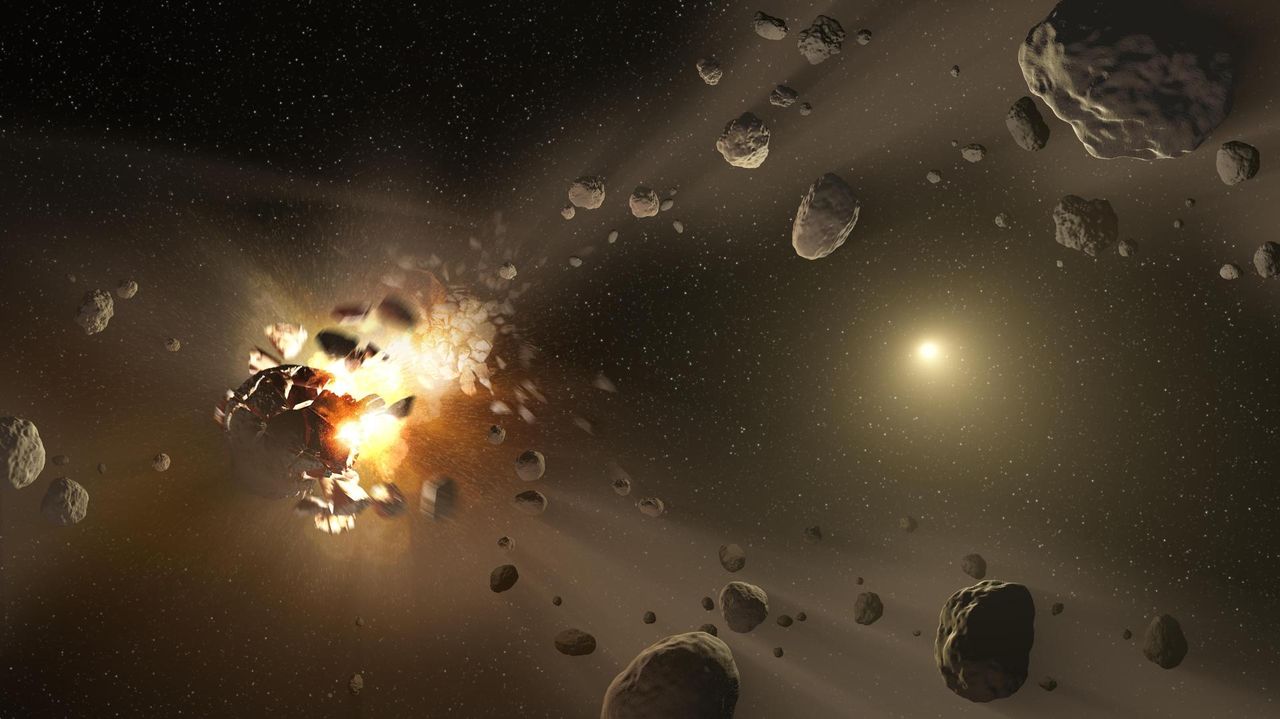
An illustration of two asteroids colliding in space. They create a glowing ball of energy, illuminating other debris around them in a dark space background.

"Extremophile" bacteria could survive asteroid impacts strong enough to launch them into space, a new lab experiment shows — hinting that these space-rock crashes could spread any potential alien life between worlds.

In the new study, published March 3 in the journal PNAS Nexus, researchers sandwiched Deinococcus radiodurans, a type of bacteria that has been shown to survive in space for years, between two steel plates. Then, they squished the "sandwich" very hard and fast to simulate asteroids slamming into a planet, and measured how many of the microbes survived.

The sandwich-squishing pressures were chosen based on what it would take for asteroids striking Mars to launch microbes and bits of planet into space. The team tested pressures from 1.4 to 2.9 gigapascals (GPa) — about 14,000 to 29,000 times the atmospheric pressure on Earth at sea level. Roughly 60% of the microbes survived being struck with 2.4 GPa, and up to 95% survived when the pressure was lowered to 1.4 GPa.

In most previous studies that tested such scenarios, the survival rates of the microbes were orders of magnitude lower. The study authors theorized that this may be because the microbes tested in the new study were different: stronger; more resilient; and able to withstand extreme radiation exposure, desiccation (getting extremely dried out) and high temperatures.

An extreme form of life

The researchers chose to test D. radiodurans because it can endure the cold, empty vacuum of space. A 2020 study found that D. radiodurans survived being exposed to space for three years while attached to the exterior of the International Space Station, which is not a friendly place for life. (Moss doesn't seem to mind it, though.)

The team also looked at how the microbes recovered after the impacts by incubating the cells at 98.6 degrees Fahrenheit (37 degrees Celsius) for a few hours and measuring which genes the microbes expressed. They found that, after being hit with higher-pressure impacts (hard enough to damage cell membranes), the microbes prioritized genes related to repairing cell damage rather than creating new cells. They also ate more iron and repaired their DNA.

D. radiodurans cells before being impacted (left image), after being squished by 1.4 GPa of pressure (middle image), and 2.4 GPa (right image). The black arrow on the right image points to internal cell damage, and the outlined arrow points to a damaged cell wall. (Image credit: Lily Zhao, et. al.)

An understanding of how life might travel between planetary bodies is important for sample-return missions, the study authors noted in the paper. For example, samples returned from Mars must go through rigorous procedures to prevent possible Martian microbes from hitching a ride to Earth and possibly contaminating our planet. If asteroid impacts could transport microbes elsewhere in the solar system, samples returned from other places might need additional precautions to prevent contamination as well.

Beyond that, the study shows that certain forms of life can survive being hurled violently into space. This may affect how and where we might look for life in the solar system.


Extraterrestrials quiz: Are you an alien expert, or has your brain been abducted?

Sign up to read this article
Read news from 100’s of titles, curated specifically for you.
Already a member? Sign in here
Related Stories
Top stories on inkl right now
One subscription that gives you access to news from hundreds of sites
Already a member? Sign in here
Our Picks
Fourteen days free
Download the app
One app. One membership.
100+ trusted global sources.