Get all your news in one place.
100's of premium titles.
One app.
Start reading
The Independent UK
The Independent UK
Technology
Andrew Griffin

Scientists reveal findings from the first robot to ever run a marathon

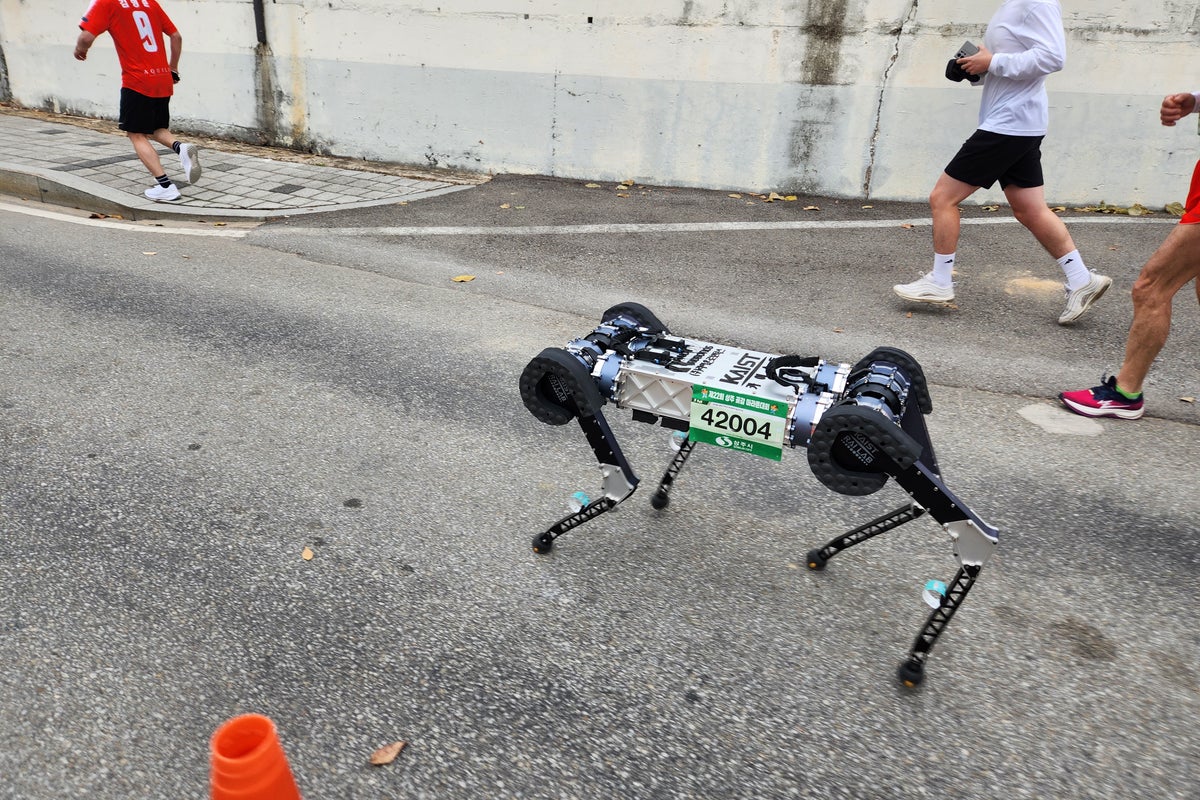
RAIBO2 during the Sangju Dried Persimmon Marathon in South Korea - (KAIST)

The researchers who built the first ever robot to run a full marathon have revealed their findings.

In November 2024, a robot named RAIBO2 completed the full 42.195km course of the Sangju Dried Persimmon Marathon in South Korea, in just under four hours and 20 minutes. It was the first time that such a robot has completed such a distance, and it did not need to have its battery changed.

Now, scientists say that the world-first achievement has been translated into useful findings that could help other robots operate over long distances and bring the technology into more functional purposes.

The researchers note that the importance of the robot does not necessarily lie only in its ability to run a marathon. Recent interest in using machines in a variety of environments has led to breakthroughs in robots’ running speeds and their ability to negotiate difficult environments – but they say that it is just as important to ensure that it is possible to make one that can work for a long time without using too much power, getting too hot, running out of battery or becoming unstable.

The researchers were able to address that problem by treating it as a “whole-robot system problem”, rather than trying to address it with single components such as bigger batteries or more efficient motors. Because quadruped robots lose energy from a variety of parts of their body as they move their legs, building one that can undertake such arduous tasks means optimising their entire design.

To ensure that design worked, the team ran alongside the robot during its marathon, recording its voltage, temperature and battery status along with other data. The robot was also registered as an official participant and was filmed throughout its journey.

Researchers now hope to use that data from the single research robot and turn it into a product that can be made in bulk and used in industrial environments. The RAIBO2 robot was designed and built by hand, but turning it into an actual product will require turning the design into something that can be used reliably across multiple robots, as well as ensuring that it is reliable in difficult industrial environments.

“This study goes beyond demonstrating how far a quadruped robot can run,” saidJemin Hwang, from the Korea Advanced Institute of Science and Technology (KAIST), where the robot was developed.

“Using actual marathon data, we demonstrated how the entire robot must be designed to achieve both high locomotion performance and energy efficiency. We will connect the world-class performance achieved in the laboratory to products that anyone can use reliably in industrial environments.”

The work is reported in a new paper, ‘A quadruped robot designed to complete a marathon on a single battery charge’, published in the journal Nature.

Sign up to read this article
Read news from 100's of titles, curated specifically for you.
Already a member? Sign in here
Related Stories
Top stories on inkl right now
One subscription that gives you access to news from hundreds of sites
Already a member? Sign in here
Our Picks
Fourteen days free
Download the app
One app. One membership.
100+ trusted global sources.